Sometimes it's good to step outside your comfort zone. In fact, I relish new and novel experiences. It's a major reason I enjoy attending hi-fi shows and events: for the chance to see and hear new things—new hi-fi equipment, especially equipment that's groundbreaking or unusual.
Sometimes a component speaks to you visually first. It reminds me of an expression about food presentation that loosely translates to "You eat with your eyes first" (footnote 1). Sometimes, you listen with your eyes first, too.
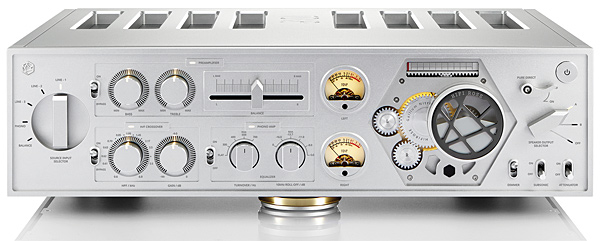
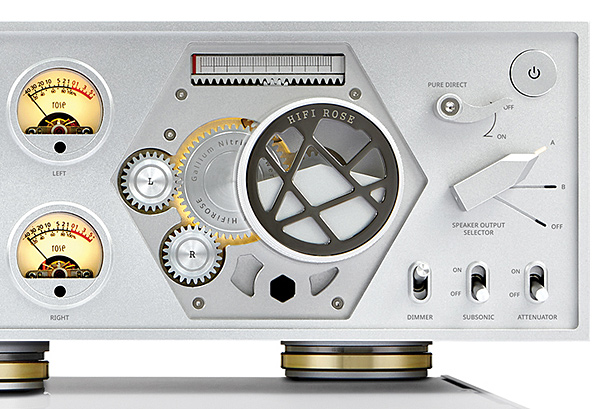
Love at first sight is too strong, but the first time I laid eyes on the HiFi Rose RA180 integrated amplifier, I was smitten. It was on static display at AXPONA in all its silvery, mechanical glory. "Output level meters and a full suite of controls grace the RA180's solid aluminum chassis' front panel," I wrote in my show report. "In a nod to mechanics, the volume control's moving cogs are visible behind a clear hexagonal covering"; putting the insides on the outside, a modernist touch. "The large volume control dial is topped with a chromed HiFi Rose brand symbol. The knobs, dials, and cockpit-style toggle levers have a nice, sturdy feel. Bonus: When you use the included IR remote control to switch sources or adjust volume, you can see the physical dials move (and they make a little sound)."
 The next day, the RA180 was making music, and I returned to hear it, briefly, driving a pair of Piega Coax 711 floorstanding speakers from Switzerland. "I ... recall highly resolved detail that stayed natural, not overhyped," I wrote. "The deep voices of Nick Cave and Leonard Cohen came to life on a couple of live tracks. Bass was substantial; highs were airy and smooth."
Nagra or Brazil (the movie)?
The next day, the RA180 was making music, and I returned to hear it, briefly, driving a pair of Piega Coax 711 floorstanding speakers from Switzerland. "I ... recall highly resolved detail that stayed natural, not overhyped," I wrote. "The deep voices of Nick Cave and Leonard Cohen came to life on a couple of live tracks. Bass was substantial; highs were airy and smooth."
Nagra or Brazil (the movie)?
Intentional or not, it's hard not to notice a resemblance to Nagra styling in the RA180's knobs and dials—but in its stylized, even gratuitous mechanical features, there's a steampunk element, too. It's pure-analog (class-D, although HiFi Rose calls it "class-AD") with four channels to facilitate biamping or bridging (so-called BTL mode, footnote 2). A small switch on the back toggles between the modes. (Speaker cables must also be reconfigured of course.) Two rows of speaker outputs allow two pairs of full-range speakers (two channels or four channels) to be connected. A turn of a front-panel dial lets you switch between A and B. Biamping is facilitated not only by the RA180's four channels but also by its built-in active crossover, configured to cross over in the midrange or treble, although it only rolls off the higher-frequency channel—not the lower—between 600Hz and 6kHz. There's also a HF gain setting, from 0 to – in 3dB increments. These controls, which could be likened to the amplifier on a subwoofer at the other end of the audible range, are specifically intended for driving a supertweeter.
Unusual features like these are complemented by classic features including tone controls for treble and bass, a balance slider, and a subsonic filter. A "Pure Direct" option, controlled by a big lever on the front panel, allows all preamplifier functions—balance, tone controls, the crossover, even the volume control—to be bypassed, allowing the RA180's use as a pure power amp. (Of course, you can bypass just the crossover using a different switch.)
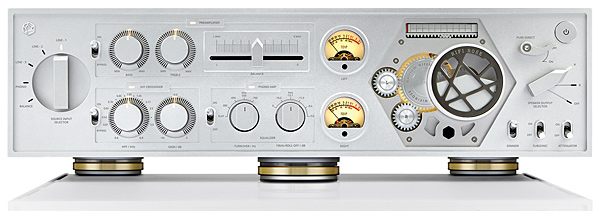 The RA180's built-in phono preamplifier is suited for MM or MC output; yet another toggle switch, this one on the back panel, allows you to choose one or the other. Unusually, you can customize the phono equalization curve on the RA180 with a choice of five low/mid turnover frequencies and six HF rolloff rates (RIAA settings are clearly indicated on the dials)—yet the phono load impedance is fixed at 47k ohms for both MM and MC, according to the specifications: no impedance-loading options.
Front-panel switches allow the illumination of the faceplate at three levels—I kept it on, on the middle setting, as it shows the amp's design details to nice effect—and a front-panel attenuator switch lets you turn the volume down to "a minimum level."
The RA180 is equipped with five input pairs: three RCA, one XLR (balanced), and one phono (on RCA of course). For a description of the outputs, read on.
The Korean company has quickly become known for its sleek network streamers with large touchscreens, and soon, the company will release an integrated amplifier with typical RS-series styling. The RA180 is an obvious departure: a mechanical-looking, all-analog (class-D) amplifier. Like the RS250, its streamer sibling, the RA180 packs plenty of functions into its chassis, but that's where the resemblances end.
It takes guts
The RA180's built-in phono preamplifier is suited for MM or MC output; yet another toggle switch, this one on the back panel, allows you to choose one or the other. Unusually, you can customize the phono equalization curve on the RA180 with a choice of five low/mid turnover frequencies and six HF rolloff rates (RIAA settings are clearly indicated on the dials)—yet the phono load impedance is fixed at 47k ohms for both MM and MC, according to the specifications: no impedance-loading options.
Front-panel switches allow the illumination of the faceplate at three levels—I kept it on, on the middle setting, as it shows the amp's design details to nice effect—and a front-panel attenuator switch lets you turn the volume down to "a minimum level."
The RA180 is equipped with five input pairs: three RCA, one XLR (balanced), and one phono (on RCA of course). For a description of the outputs, read on.
The Korean company has quickly become known for its sleek network streamers with large touchscreens, and soon, the company will release an integrated amplifier with typical RS-series styling. The RA180 is an obvious departure: a mechanical-looking, all-analog (class-D) amplifier. Like the RS250, its streamer sibling, the RA180 packs plenty of functions into its chassis, but that's where the resemblances end.
It takes guts
The RA180 is, as I've already written, a class-D design. Some of the advantages of class-D are well-known, most notably higher efficiency, which allows more power to be packed into a smaller space with less heat. HiFi Rose says that each of the RA180's four amplifier channels "supports" 200W into 4 or 8 ohms. When two channels are bridged, it can output two channels of up to 400Wpc.
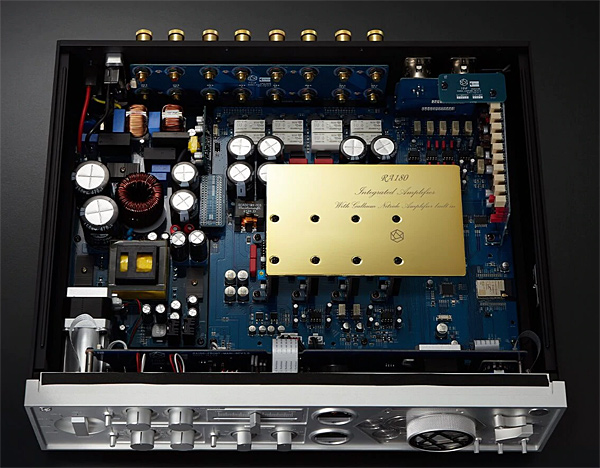 There's a retro element to the styling of this amplifier, but what's inside is au courant: gallium nitride (GaN) FET transistors in place of the standard silicon ones. A bit of online research (footnote 3) pointed to some advantages of GaN FETs over silicon FETs: GaN FETs respond faster to transients, dynamic swings, etc., with less overshoot and shorter recovery time. The result is faster switching times (with less "dead time") and more precise switching with less ringing, distortion, and EMI (electromagnetic interference). Class-D designs use negative feedback to offset such distortion; silicon-based amps need quite a lot of it to perform at their best. Starting with more precise, faster amplification means that less feedback is needed. GaN technology is also said to allow wider bandwidth: The RA180 integrated's response extends up to 90kHz, according to HiFi Rose's specifications. Sonic outcomes of GaN-based FETs—what Stereophile is all about—are said to include less harshness and more smoothness, improved detail, and a more neutral presentation.
The RA180's balanced power supply uses SiC (silicon carbide) FET technology and deploys a PFC circuit ("power-factor correction circuit," says the HiFi Rose literature; this compensates for impedance elsewhere on the line to align the phase between current and voltage). HiFi Rose says it's "designed not to be affected by sudden load fluctuations."
Hands-on
There's a retro element to the styling of this amplifier, but what's inside is au courant: gallium nitride (GaN) FET transistors in place of the standard silicon ones. A bit of online research (footnote 3) pointed to some advantages of GaN FETs over silicon FETs: GaN FETs respond faster to transients, dynamic swings, etc., with less overshoot and shorter recovery time. The result is faster switching times (with less "dead time") and more precise switching with less ringing, distortion, and EMI (electromagnetic interference). Class-D designs use negative feedback to offset such distortion; silicon-based amps need quite a lot of it to perform at their best. Starting with more precise, faster amplification means that less feedback is needed. GaN technology is also said to allow wider bandwidth: The RA180 integrated's response extends up to 90kHz, according to HiFi Rose's specifications. Sonic outcomes of GaN-based FETs—what Stereophile is all about—are said to include less harshness and more smoothness, improved detail, and a more neutral presentation.
The RA180's balanced power supply uses SiC (silicon carbide) FET technology and deploys a PFC circuit ("power-factor correction circuit," says the HiFi Rose literature; this compensates for impedance elsewhere on the line to align the phase between current and voltage). HiFi Rose says it's "designed not to be affected by sudden load fluctuations."
Hands-on
During my first encounter with the RA180 at AXPONA, HiFi Rose importer MoFi's Jon Derda mentioned that this was an amplifier for which he definitely read the manual. I thought, this must be an unusual amplifier. I was right.
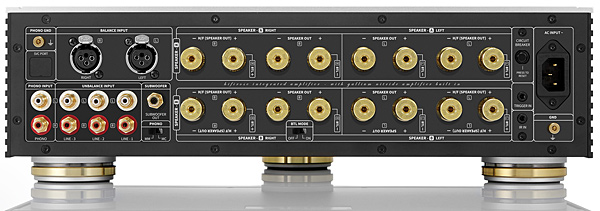 The back panel is crowded by 16 loudspeaker binding posts in two rows of eight, with a three-position toggle switch below. Some of the labels for the speaker inputs are printed right-side up and upside-down, presumably to make it easy to read when you peer over the top of the amplifier to view the back panel.
Early in my time with the RA180, I'd connected cables from the MBL 120 speakers in the RA180's terminals in a way that seemed logical, but music only played through one speaker channel. It turned out that I hadn't moved the toggle switch to the correct position—from OFF back into BTL mode—after I'd switched the cables' inputs. Once I realized that the "A" and "B" in the manual's instructions referred interchangeably to modes as well as each row of input terminals and the toggle text, it was smooth sailing. Read the manual carefully.
To control the amp, I relied mainly on the front panel. For basic needs such as volume, muting, on/off, etc., the RA180's smallish IR remote sufficed. You could also use HiFi Rose's RoseAMPConnect app for Android or iOS.
The back panel is crowded by 16 loudspeaker binding posts in two rows of eight, with a three-position toggle switch below. Some of the labels for the speaker inputs are printed right-side up and upside-down, presumably to make it easy to read when you peer over the top of the amplifier to view the back panel.
Early in my time with the RA180, I'd connected cables from the MBL 120 speakers in the RA180's terminals in a way that seemed logical, but music only played through one speaker channel. It turned out that I hadn't moved the toggle switch to the correct position—from OFF back into BTL mode—after I'd switched the cables' inputs. Once I realized that the "A" and "B" in the manual's instructions referred interchangeably to modes as well as each row of input terminals and the toggle text, it was smooth sailing. Read the manual carefully.
To control the amp, I relied mainly on the front panel. For basic needs such as volume, muting, on/off, etc., the RA180's smallish IR remote sufficed. You could also use HiFi Rose's RoseAMPConnect app for Android or iOS.
Footnote 1: Widely quoted and variously attributed, the earliest and most convincing source I've found for this quote is De Re Coquinaria by first-century Roman gastronome Apicius—though one suspects the aphorism was old even then.—Jim Austin Footnote 2: When I first saw this, I thought it was a reference to the superstar Korean boy band—but no, that's BTS. BTL stands for "bridge-tied load," a reference to a common method of bridging two amplifier channels to increase output power.—Jim Austin Footnote 3: For more, see bit.ly/3KjTgJe or this AES paper (free for AES members, expensive for everyone else): aes.org/e-lib/browse.cfm?elib=18612.
The next day, the RA180 was making music, and I returned to hear it, briefly, driving a pair of Piega Coax 711 floorstanding speakers from Switzerland. "I ... recall highly resolved detail that stayed natural, not overhyped," I wrote. "The deep voices of Nick Cave and Leonard Cohen came to life on a couple of live tracks. Bass was substantial; highs were airy and smooth."
Nagra or Brazil (the movie)?Intentional or not, it's hard not to notice a resemblance to Nagra styling in the RA180's knobs and dials—but in its stylized, even gratuitous mechanical features, there's a steampunk element, too. It's pure-analog (class-D, although HiFi Rose calls it "class-AD") with four channels to facilitate biamping or bridging (so-called BTL mode, footnote 2). A small switch on the back toggles between the modes. (Speaker cables must also be reconfigured of course.) Two rows of speaker outputs allow two pairs of full-range speakers (two channels or four channels) to be connected. A turn of a front-panel dial lets you switch between A and B. Biamping is facilitated not only by the RA180's four channels but also by its built-in active crossover, configured to cross over in the midrange or treble, although it only rolls off the higher-frequency channel—not the lower—between 600Hz and 6kHz. There's also a HF gain setting, from 0 to – in 3dB increments. These controls, which could be likened to the amplifier on a subwoofer at the other end of the audible range, are specifically intended for driving a supertweeter.
The RA180's built-in phono preamplifier is suited for MM or MC output; yet another toggle switch, this one on the back panel, allows you to choose one or the other. Unusually, you can customize the phono equalization curve on the RA180 with a choice of five low/mid turnover frequencies and six HF rolloff rates (RIAA settings are clearly indicated on the dials)—yet the phono load impedance is fixed at 47k ohms for both MM and MC, according to the specifications: no impedance-loading options.
Front-panel switches allow the illumination of the faceplate at three levels—I kept it on, on the middle setting, as it shows the amp's design details to nice effect—and a front-panel attenuator switch lets you turn the volume down to "a minimum level."
The RA180 is, as I've already written, a class-D design. Some of the advantages of class-D are well-known, most notably higher efficiency, which allows more power to be packed into a smaller space with less heat. HiFi Rose says that each of the RA180's four amplifier channels "supports" 200W into 4 or 8 ohms. When two channels are bridged, it can output two channels of up to 400Wpc.
There's a retro element to the styling of this amplifier, but what's inside is au courant: gallium nitride (GaN) FET transistors in place of the standard silicon ones. A bit of online research (footnote 3) pointed to some advantages of GaN FETs over silicon FETs: GaN FETs respond faster to transients, dynamic swings, etc., with less overshoot and shorter recovery time. The result is faster switching times (with less "dead time") and more precise switching with less ringing, distortion, and EMI (electromagnetic interference). Class-D designs use negative feedback to offset such distortion; silicon-based amps need quite a lot of it to perform at their best. Starting with more precise, faster amplification means that less feedback is needed. GaN technology is also said to allow wider bandwidth: The RA180 integrated's response extends up to 90kHz, according to HiFi Rose's specifications. Sonic outcomes of GaN-based FETs—what Stereophile is all about—are said to include less harshness and more smoothness, improved detail, and a more neutral presentation.
The RA180's balanced power supply uses SiC (silicon carbide) FET technology and deploys a PFC circuit ("power-factor correction circuit," says the HiFi Rose literature; this compensates for impedance elsewhere on the line to align the phase between current and voltage). HiFi Rose says it's "designed not to be affected by sudden load fluctuations."
Hands-onDuring my first encounter with the RA180 at AXPONA, HiFi Rose importer MoFi's Jon Derda mentioned that this was an amplifier for which he definitely read the manual. I thought, this must be an unusual amplifier. I was right.
The back panel is crowded by 16 loudspeaker binding posts in two rows of eight, with a three-position toggle switch below. Some of the labels for the speaker inputs are printed right-side up and upside-down, presumably to make it easy to read when you peer over the top of the amplifier to view the back panel.
Early in my time with the RA180, I'd connected cables from the MBL 120 speakers in the RA180's terminals in a way that seemed logical, but music only played through one speaker channel. It turned out that I hadn't moved the toggle switch to the correct position—from OFF back into BTL mode—after I'd switched the cables' inputs. Once I realized that the "A" and "B" in the manual's instructions referred interchangeably to modes as well as each row of input terminals and the toggle text, it was smooth sailing. Read the manual carefully.
To control the amp, I relied mainly on the front panel. For basic needs such as volume, muting, on/off, etc., the RA180's smallish IR remote sufficed. You could also use HiFi Rose's RoseAMPConnect app for Android or iOS.
Footnote 1: Widely quoted and variously attributed, the earliest and most convincing source I've found for this quote is De Re Coquinaria by first-century Roman gastronome Apicius—though one suspects the aphorism was old even then.—Jim Austin Footnote 2: When I first saw this, I thought it was a reference to the superstar Korean boy band—but no, that's BTS. BTL stands for "bridge-tied load," a reference to a common method of bridging two amplifier channels to increase output power.—Jim Austin Footnote 3: For more, see bit.ly/3KjTgJe or this AES paper (free for AES members, expensive for everyone else): aes.org/e-lib/browse.cfm?elib=18612.