We need audiophile audio and headphones at the SR-X9000's level so that we can savor every blessed second of recordings like Yo Soy La Tradición (16/44.1, Miel Music/Tidal), with Miguel Zenón fronting the Spektral Quartet. Compared to LTA's Z10e, the 3ES powering the Stax produced a terser, tighter, more brilliantly lit view of this jazz, which feels like sorcery. Zenón's composition "Cadenas" sounded smarter and fresher, more avant-garde, through the Woo amplifier; it was more lush and melodic—more about Puerto Rico—through the LTA. Through both amplifiers, the SR-X9000 displayed greater microscopic resolution than every other transducer I have in-house including my ultimate reference, the JPS Labs Abyss AB-1266 Phi TC.
Besides the Abyss TC, any list of today's elite headphones should include the HiFiMan Susvara, the RAAL SR1a, ZMF's Vérité Closed, and the Stax SR-009S. Now the Stax SR-X9000 must be added to that A+ group. It is a milestone product.
After two night-long listening sessions, I asked my Russian neighbor Vladimir, "If you could keep only one Stax headphone for the rest of your life, which one would you choose?" "That's easy," Vlad said. "I'd keep this new big one!"
The EAR Phono Classic
In December 2020, when the famously contentious polymath Tim de Paravicini died, I felt more than sad: I felt anxious and depressed, certain that some supremely important audio knowledge had just left the planet. To me, Tim's death signaled the end of an era. Now, in his absence, I fear the silicon-SPICEmongers and their armies of digital sand trolls will colonize even more audiophile worlds and force us all to work in DSP processing plants.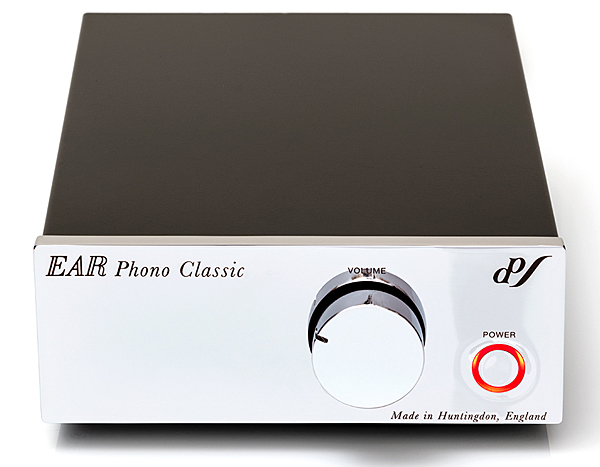 "Tim always felt that if a design was what it should be to begin with, there was no reason to change it, and in fact the design changes I have mentioned were mostly implemented to make the units more reliable and/or easier to manufacture and service.
"The biggest change in the 834P was probably the switch from 12AX7s to a tube with a slightly higher operating voltage—a tube that Tim dubbed the 13D16." This change was made to the 834P during the last couple of years of its life; those who wanted to could still use 12AX7s. "This change was made because he found that modern 12AX7s were becoming increasingly less dependable, and far too many were being rejected in the manufacturing process.
"Tim always felt that if a design was what it should be to begin with, there was no reason to change it, and in fact the design changes I have mentioned were mostly implemented to make the units more reliable and/or easier to manufacture and service.
"The biggest change in the 834P was probably the switch from 12AX7s to a tube with a slightly higher operating voltage—a tube that Tim dubbed the 13D16." This change was made to the 834P during the last couple of years of its life; those who wanted to could still use 12AX7s. "This change was made because he found that modern 12AX7s were becoming increasingly less dependable, and far too many were being rejected in the manufacturing process.
 "The Phono Classic retains this change, but for customers who prefer to tube-roll—not possible with the 13D16—there is an internal switch that permits them to use 12AX7s."
I've used the 13D16-equipped Phono Box for at least five months, and I did sometimes wonder what smooth-plate Telefunkens might sound like. But one of the review sample's best qualities was its tomblike silence—and everyone knows that my first rule of tube rolling is: Leave quiet tubes be.
The Phono Classic comes in three variations. The basic model sports a satin-black faceplate, costs $1695, and works only with high-output moving magnet cartridges.
A second version, with gain sufficient for low-output moving coil cartridges (via an internal transformer), is $1895. Finally, there's a fancy MM/MC version with a heavy chrome front panel, which costs $2395. This is the version they sent to me for review.
The moving magnet–only version provides 55dB of gain with an input impedance of 47k ohms. The MC version's moving coil step-up transformer brings the gain up to 72dB with an effective MC load impedance of 470 ohms. The Phono Classic provides no other cartridge-loading choices.
"The Phono Classic retains this change, but for customers who prefer to tube-roll—not possible with the 13D16—there is an internal switch that permits them to use 12AX7s."
I've used the 13D16-equipped Phono Box for at least five months, and I did sometimes wonder what smooth-plate Telefunkens might sound like. But one of the review sample's best qualities was its tomblike silence—and everyone knows that my first rule of tube rolling is: Leave quiet tubes be.
The Phono Classic comes in three variations. The basic model sports a satin-black faceplate, costs $1695, and works only with high-output moving magnet cartridges.
A second version, with gain sufficient for low-output moving coil cartridges (via an internal transformer), is $1895. Finally, there's a fancy MM/MC version with a heavy chrome front panel, which costs $2395. This is the version they sent to me for review.
The moving magnet–only version provides 55dB of gain with an input impedance of 47k ohms. The MC version's moving coil step-up transformer brings the gain up to 72dB with an effective MC load impedance of 470 ohms. The Phono Classic provides no other cartridge-loading choices.
 The rear panel of the 7" × 3" × 11.5" Phono Classic is dead simple. There's an IEC socket, one RCA input pair, one RCA output pair, a knurled lug for connecting a ground wire, and a small button that permits users to choose either moving magnet or moving coil operation.
The front panel features a too-brightly-lit on/off switch and a smooth-moving volume control.
Listening by EAR: Throughout my life, I've used Franz Schubert's lieder as a contemplative refuge, a psychic place I can visit and come out feeling renewed and inspired. What excites me most about Schubert's art songs is how he made the piano an equal partner to voice, both doing his dramatic and expressive work. Instead of merely setting words to music, Schubert created a new form of poetic experience.
Like every good lieder fan, I've spent goodly time with the godlike baritone of Dietrich Fischer-Dieskau and even more with my dream angel, Elly Ameling. Lately I've been discovering recordings by German mezzo-soprano Christa Ludwig with Irwin Gage on piano. Their Schubert-Lieder 2 (LP, DG 2530 528) is one of the most tonally balanced, precisely rendered voice-and-piano recordings I know. The $8450 Koetsu Rosewood Signature Platinum moving coil cartridge, its matching $4995 Koetsu step-up transformer, and the MM section of the Phono Classic presented a vivid, almost crystalline "vision" of these two performers. No key strike passed unnoticed, no vocal brilliance unadmired, no silky texture unfelt. Everything about this Ludwig-Gage recording seemed delectably just right, the way it's supposed to sound. Used as a 47k ohm MM input for a spectacular (and expensive) moving coil cartridge driving a top-tier step-up transformer, EAR's moderately priced Phono Classic enhanced my system's analog sound quality.
What about straight in? With the Koetsu cartridge plugged directly into the Phono Classic's MC input, I could compare the EAR's internal SUT with the high-nickel thrills of the $5k Koetsu SUT and the $2500 EMIA SUT. The differences were easily discernible. The Phono Classic's MC input is clear, easy on the ear, and cinematically detailed, but compared to these pricier SUTs, it's also kind of thin, flat, and low in contrast.
What about comparisons to other phono preamps? From 50Hz to 500Hz, the EAR's MC input is not as sharply focused or hardbody muscular as that of the solid state Kitsuné HiFi LCR-1 MK5 I reviewed in Gramophone Dreams #50 ($1198–$1398). The Kuo-Wei Tsai–designed LCR-1 can put a hammer to a railroad spike and let the listener lean back and savor the force of its ringing tone. The EAR MC input hits that spike with less force, and there's less clarity to its ringing tone, but the hammering Kitsuné could not match the midrange delicacy or tender charm of the EAR on vocal recitals like my tulips pressing of Schubert-Goethe-Liederabend with Dietrich Fischer-Dieskau, baritone, and Jörg Demus on piano (LP, Deutsche Grammophon 138117).
All these Phono Classic auditions were done using the Koetsu Rosewood Signature Platinum, the Hana ML, and Zu Denon DL-103 moving coils. With all three of these cartridges, the HoloAudio LCR-1 seemed wider-bandwidth, with stronger and better controlled bass than the Paravicini design—but only when the preamps were compared through their MC inputs. With any of these MC cartridges loaded with their own "special" SUT into the MM input, the sonic differences between these two moderately priced phono stages were not dramatic. The LCR-1 had a little more pow, sharper-focused detail, and denser body. But the EAR felt more fluid, color-saturated, and spacious, and a little brighter.
In my system, the Phono Classic was 100% wonderful through its MM input but less dense, and strong of bass through its MC input.
Realizing that, I decided to try the EAR with an affordable SUT.
Using Bob's Devices Sky 20: I've been using and recommending Bob's Devices' Sky 20 moving coil step-up transformer (footnote 4)) since Art Dudley loaned me his about four years ago. Bob's well-crafted devices are a smart, budget-friendly way to begin "stepping-up" to the tingling microdynamics and glittering luster of high-quality ferromagnetic cartridge gain.
The rear panel of the 7" × 3" × 11.5" Phono Classic is dead simple. There's an IEC socket, one RCA input pair, one RCA output pair, a knurled lug for connecting a ground wire, and a small button that permits users to choose either moving magnet or moving coil operation.
The front panel features a too-brightly-lit on/off switch and a smooth-moving volume control.
Listening by EAR: Throughout my life, I've used Franz Schubert's lieder as a contemplative refuge, a psychic place I can visit and come out feeling renewed and inspired. What excites me most about Schubert's art songs is how he made the piano an equal partner to voice, both doing his dramatic and expressive work. Instead of merely setting words to music, Schubert created a new form of poetic experience.
Like every good lieder fan, I've spent goodly time with the godlike baritone of Dietrich Fischer-Dieskau and even more with my dream angel, Elly Ameling. Lately I've been discovering recordings by German mezzo-soprano Christa Ludwig with Irwin Gage on piano. Their Schubert-Lieder 2 (LP, DG 2530 528) is one of the most tonally balanced, precisely rendered voice-and-piano recordings I know. The $8450 Koetsu Rosewood Signature Platinum moving coil cartridge, its matching $4995 Koetsu step-up transformer, and the MM section of the Phono Classic presented a vivid, almost crystalline "vision" of these two performers. No key strike passed unnoticed, no vocal brilliance unadmired, no silky texture unfelt. Everything about this Ludwig-Gage recording seemed delectably just right, the way it's supposed to sound. Used as a 47k ohm MM input for a spectacular (and expensive) moving coil cartridge driving a top-tier step-up transformer, EAR's moderately priced Phono Classic enhanced my system's analog sound quality.
What about straight in? With the Koetsu cartridge plugged directly into the Phono Classic's MC input, I could compare the EAR's internal SUT with the high-nickel thrills of the $5k Koetsu SUT and the $2500 EMIA SUT. The differences were easily discernible. The Phono Classic's MC input is clear, easy on the ear, and cinematically detailed, but compared to these pricier SUTs, it's also kind of thin, flat, and low in contrast.
What about comparisons to other phono preamps? From 50Hz to 500Hz, the EAR's MC input is not as sharply focused or hardbody muscular as that of the solid state Kitsuné HiFi LCR-1 MK5 I reviewed in Gramophone Dreams #50 ($1198–$1398). The Kuo-Wei Tsai–designed LCR-1 can put a hammer to a railroad spike and let the listener lean back and savor the force of its ringing tone. The EAR MC input hits that spike with less force, and there's less clarity to its ringing tone, but the hammering Kitsuné could not match the midrange delicacy or tender charm of the EAR on vocal recitals like my tulips pressing of Schubert-Goethe-Liederabend with Dietrich Fischer-Dieskau, baritone, and Jörg Demus on piano (LP, Deutsche Grammophon 138117).
All these Phono Classic auditions were done using the Koetsu Rosewood Signature Platinum, the Hana ML, and Zu Denon DL-103 moving coils. With all three of these cartridges, the HoloAudio LCR-1 seemed wider-bandwidth, with stronger and better controlled bass than the Paravicini design—but only when the preamps were compared through their MC inputs. With any of these MC cartridges loaded with their own "special" SUT into the MM input, the sonic differences between these two moderately priced phono stages were not dramatic. The LCR-1 had a little more pow, sharper-focused detail, and denser body. But the EAR felt more fluid, color-saturated, and spacious, and a little brighter.
In my system, the Phono Classic was 100% wonderful through its MM input but less dense, and strong of bass through its MC input.
Realizing that, I decided to try the EAR with an affordable SUT.
Using Bob's Devices Sky 20: I've been using and recommending Bob's Devices' Sky 20 moving coil step-up transformer (footnote 4)) since Art Dudley loaned me his about four years ago. Bob's well-crafted devices are a smart, budget-friendly way to begin "stepping-up" to the tingling microdynamics and glittering luster of high-quality ferromagnetic cartridge gain.
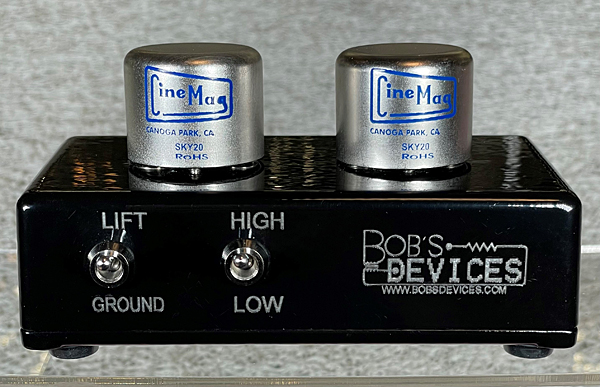 For this report, I used a new version of the Sky 20 SUT: all-new transformer, same old name. This $1375 1:20 step-up uses Bob Sattin's latest core material: 80% nickel mu-metal laminations, which, according to Bob, "are specially processed for optimal performance at very low signal levels.
"We use a secret process for annealing and have to hand-select the best laminations from each batch. The result is giant crystal structures within the material. You can actually see the crystals with the naked eye. When the laminations are stacked into the coils, great care is given not to induce any strain."
For this report, I used a new version of the Sky 20 SUT: all-new transformer, same old name. This $1375 1:20 step-up uses Bob Sattin's latest core material: 80% nickel mu-metal laminations, which, according to Bob, "are specially processed for optimal performance at very low signal levels.
"We use a secret process for annealing and have to hand-select the best laminations from each batch. The result is giant crystal structures within the material. You can actually see the crystals with the naked eye. When the laminations are stacked into the coils, great care is given not to induce any strain."
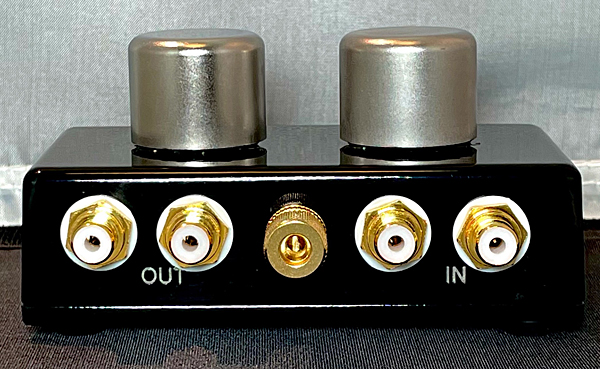 I connected Bob's new Sky 20 to the output of the Koetsu Rosewood Signature Platinum and to the moving magnet input of the EAR Phono Classic. My goal was to see if it is an improvement over the EAR's stock MC transformers and how it compared to the more expensive EMIA transformers.
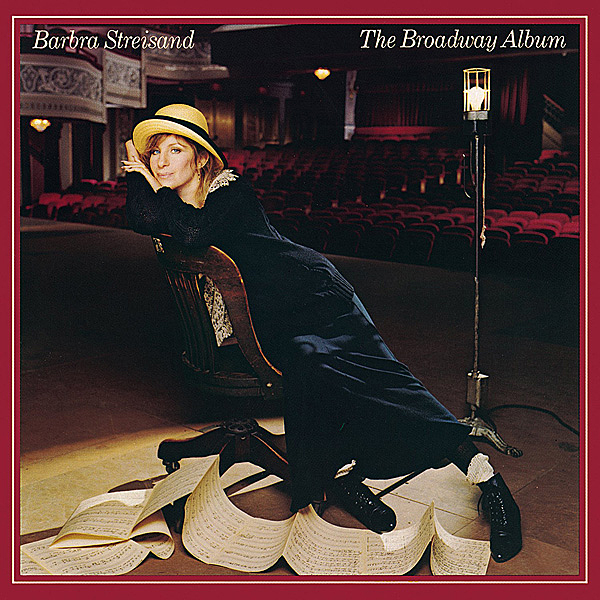 Barbra Streisand's The Broadway Album (LP, Columbia OC 40092) has me in its grip: I play it over and over. It fuels my desire to experience more of Ms. Streisand's immense talent. This album's substantial orchestration makes it a perfect recording for assessing subtle differences in analog components.
When I substituted the Sky for the EAR's internal SUT, the first thing I noticed was a not-subtle increase in see-into transparency and larger, better-defined images. The Columbia orchestra got bigger and stronger. Instruments were separated more in space, with more radiant tone. With the Sky, the bass was deeper and tighter; the midrange glowed; the treble seemed extended. Beauty flourished. Placed between the Koetsu cartridge and the EAR phono pre in MM mode, the modest Bob's Devices Sky 20 came within spitting distance of my beloved EMIA SUT.
The EAR compared to the Tavish Design Adagio: I played a lot of records while comparing the new EAR Phono Classic to my long-serving reference, Tavish Design's Adagio tubed phono stage ($1990–$2400), but I kept coming back to Side 1 of The Folk Blues of John Lee Hooker (LP, ERC/Riverside RLP 12-838). Its quiet, simply miked verity showed some subtle but important differences between these two extraordinary tubed phono stages. Listening to "Black Snake" through the Adagio's MC input, the room Hooker was playing in seemed much bigger and emptier. I noticed a slightly amber glow to the room's light. The window I was gazing through seemed squeakier-clean than it did with the Phono Classic. Otherwise, the two preamps delivered similar forms of slightly lush tube-preamp beauty.
Conclusion: The EAR Phono Classic, like the Adagio, includes an internal stereo SUT that, while useful, is less than wonderful with top-tier MC cartridges. Consequently, I use the Adagio almost exclusively in MM mode with external step-up transformers that match the cartridge I'm using. I'll probably use the EAR the same way.
Niggling complaints aside, it took less than one side of one LP for me to recognize the fundamental truthiness of the EAR's way with records. Like the 834P before it, the Tim de Paravicini–designed EAR Phono Classic will be a classic tubed phono stage for our time.
Barbra Streisand's The Broadway Album (LP, Columbia OC 40092) has me in its grip: I play it over and over. It fuels my desire to experience more of Ms. Streisand's immense talent. This album's substantial orchestration makes it a perfect recording for assessing subtle differences in analog components.
When I substituted the Sky for the EAR's internal SUT, the first thing I noticed was a not-subtle increase in see-into transparency and larger, better-defined images. The Columbia orchestra got bigger and stronger. Instruments were separated more in space, with more radiant tone. With the Sky, the bass was deeper and tighter; the midrange glowed; the treble seemed extended. Beauty flourished. Placed between the Koetsu cartridge and the EAR phono pre in MM mode, the modest Bob's Devices Sky 20 came within spitting distance of my beloved EMIA SUT.
The EAR compared to the Tavish Design Adagio: I played a lot of records while comparing the new EAR Phono Classic to my long-serving reference, Tavish Design's Adagio tubed phono stage ($1990–$2400), but I kept coming back to Side 1 of The Folk Blues of John Lee Hooker (LP, ERC/Riverside RLP 12-838). Its quiet, simply miked verity showed some subtle but important differences between these two extraordinary tubed phono stages. Listening to "Black Snake" through the Adagio's MC input, the room Hooker was playing in seemed much bigger and emptier. I noticed a slightly amber glow to the room's light. The window I was gazing through seemed squeakier-clean than it did with the Phono Classic. Otherwise, the two preamps delivered similar forms of slightly lush tube-preamp beauty.
Conclusion: The EAR Phono Classic, like the Adagio, includes an internal stereo SUT that, while useful, is less than wonderful with top-tier MC cartridges. Consequently, I use the Adagio almost exclusively in MM mode with external step-up transformers that match the cartridge I'm using. I'll probably use the EAR the same way.
Niggling complaints aside, it took less than one side of one LP for me to recognize the fundamental truthiness of the EAR's way with records. Like the 834P before it, the Tim de Paravicini–designed EAR Phono Classic will be a classic tubed phono stage for our time.
Footnote 3: EAR-Yoshino Ltd., Unit 1a Chester Road, Colmworth Business Park, Eaton Socon, St. Neots, Cambs. PE19 8YT, UK. Web: earyoshino.com. EAR USA, 1087 E. Ridgewood St., Long Beach, CA 90807. Tel: (562) 422-4747. Web: ear-usa.com
Footnote 4: Bob's Devices, 2117 Fairway Dr., Billings, MT 59102 Tel: (910) 612-8666. Web: bobsdevices.com
In December 2020, when the famously contentious polymath Tim de Paravicini died, I felt more than sad: I felt anxious and depressed, certain that some supremely important audio knowledge had just left the planet. To me, Tim's death signaled the end of an era. Now, in his absence, I fear the silicon-SPICEmongers and their armies of digital sand trolls will colonize even more audiophile worlds and force us all to work in DSP processing plants.
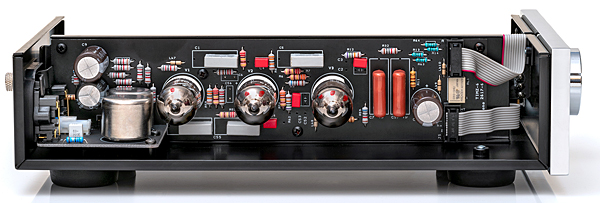
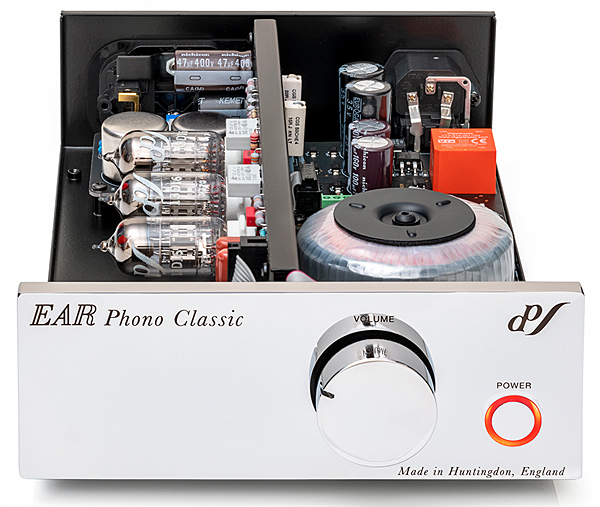
EAR's Phono Classic (photos: Wes Bender).
In the upper-left corner of its thick chrome faceplate, the EAR phono stage I'm auditioning says "Phono Classic" (footnote 3). Apparently, someone made that name up just for Americans: According to EAR's US distributor Dan Meinwald, this same component is called "Phono Box" throughout the rest of the world. On the bottom of its steel chassis, my sample says "EAR Yoshino Phono Box," as does the cardboard box it came in. "The Phono Box was named after a phono stage made only briefly in the early days of EAR, in the late 1970s," Meinwald told me in an email. The key piece of information here, though, is that the Phono Classic is the successor to the legendary EAR 834P, which was introduced more than 25 years ago.
"Over these years, the 834P incorporated a number of minor (evolutionary) changes, but EAR never trumpeted these as 'Mk.II' (etc.) versions, so the Phono Classic represents the first major change to the basic 834P design.
"The Phono Classic retains this change, but for customers who prefer to tube-roll—not possible with the 13D16—there is an internal switch that permits them to use 12AX7s."
The rear panel of the 7" × 3" × 11.5" Phono Classic is dead simple. There's an IEC socket, one RCA input pair, one RCA output pair, a knurled lug for connecting a ground wire, and a small button that permits users to choose either moving magnet or moving coil operation.
The front panel features a too-brightly-lit on/off switch and a smooth-moving volume control.
Listening by EAR: Throughout my life, I've used Franz Schubert's lieder as a contemplative refuge, a psychic place I can visit and come out feeling renewed and inspired. What excites me most about Schubert's art songs is how he made the piano an equal partner to voice, both doing his dramatic and expressive work. Instead of merely setting words to music, Schubert created a new form of poetic experience.
For this report, I used a new version of the Sky 20 SUT: all-new transformer, same old name. This $1375 1:20 step-up uses Bob Sattin's latest core material: 80% nickel mu-metal laminations, which, according to Bob, "are specially processed for optimal performance at very low signal levels.
"We use a secret process for annealing and have to hand-select the best laminations from each batch. The result is giant crystal structures within the material. You can actually see the crystals with the naked eye. When the laminations are stacked into the coils, great care is given not to induce any strain."
I connected Bob's new Sky 20 to the output of the Koetsu Rosewood Signature Platinum and to the moving magnet input of the EAR Phono Classic. My goal was to see if it is an improvement over the EAR's stock MC transformers and how it compared to the more expensive EMIA transformers.
Barbra Streisand's The Broadway Album (LP, Columbia OC 40092) has me in its grip: I play it over and over. It fuels my desire to experience more of Ms. Streisand's immense talent. This album's substantial orchestration makes it a perfect recording for assessing subtle differences in analog components.
When I substituted the Sky for the EAR's internal SUT, the first thing I noticed was a not-subtle increase in see-into transparency and larger, better-defined images. The Columbia orchestra got bigger and stronger. Instruments were separated more in space, with more radiant tone. With the Sky, the bass was deeper and tighter; the midrange glowed; the treble seemed extended. Beauty flourished. Placed between the Koetsu cartridge and the EAR phono pre in MM mode, the modest Bob's Devices Sky 20 came within spitting distance of my beloved EMIA SUT.
The EAR compared to the Tavish Design Adagio: I played a lot of records while comparing the new EAR Phono Classic to my long-serving reference, Tavish Design's Adagio tubed phono stage ($1990–$2400), but I kept coming back to Side 1 of The Folk Blues of John Lee Hooker (LP, ERC/Riverside RLP 12-838). Its quiet, simply miked verity showed some subtle but important differences between these two extraordinary tubed phono stages. Listening to "Black Snake" through the Adagio's MC input, the room Hooker was playing in seemed much bigger and emptier. I noticed a slightly amber glow to the room's light. The window I was gazing through seemed squeakier-clean than it did with the Phono Classic. Otherwise, the two preamps delivered similar forms of slightly lush tube-preamp beauty.
Footnote 3: EAR-Yoshino Ltd., Unit 1a Chester Road, Colmworth Business Park, Eaton Socon, St. Neots, Cambs. PE19 8YT, UK. Web: earyoshino.com. EAR USA, 1087 E. Ridgewood St., Long Beach, CA 90807. Tel: (562) 422-4747. Web: ear-usa.com