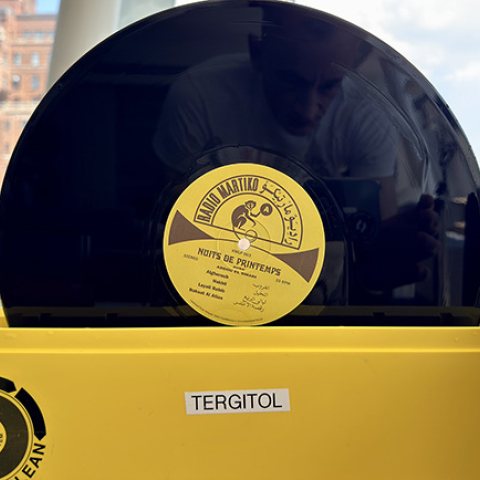
The Grados' high sensitivity exposed a bit of the First Watt's noise floor, but when the music played, that noise became unnoticeable. Gloriously, when the J2-powered Grados played Vivaldi's Gloria, sung by The Choir of King's College with David Willcocks conducting (LP, Argo ZRG 505), I witnessed a full three-dimensional apparition of the King's College Chapel in Cambridge, England. I wondered: Have anyone's floor speakers ever exposed this much of the Cambridge chapel's interior? The sense of being there was acute.
Interestingly, while listening to the Vivaldi with the Grados, I accidentally discovered that if I lightly pressed the perimeters of both earcups to my head—tightening the seal and moving the drivers a couple of millimeters closer to my ear canals—the sound improved, becoming more immediate, saturated, and focused.
By the way, the chief reason I do these headphone-with-amplifier experiments is to remind myself that, contrary to popular belief, neutral, low-distortion audio never sounds hard, gray, dry, or mechanical. When the sonic window is truly glassless, most recordings sound relaxed, naturally colorful, and vividly present.
The Feliks Audio Euforia Mark II
As you might have guessed, I do not drive headphones with power amps in my everyday life. There, I use a variety of regular-issue headphone amplifiers—which, conveniently, have headphone jacks, volume controls, and adjustable overall gain. One of the best amps I've used this year is the Feliks Audio Euforia Mark II ($2599, footnote 3): a good-looking, tubed, dedicated headphone amplifier that makes the GS3000e Grados sound more transparent and satisfying than either the Schiit Aegir or First Watt J2 power amps.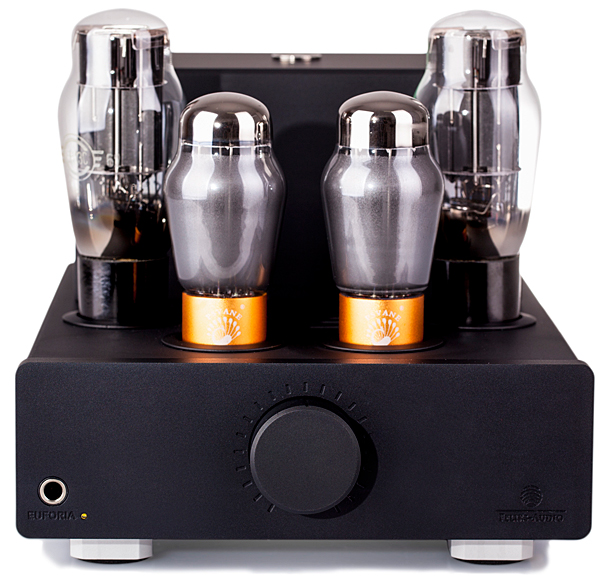 After studying the GS3000e with a pair of regular power amps, I felt certain the $2599 Feliks Audio Euforia Mark II headphone amplifier would deliver a similarly clear lens, while adding some tube radiance and solving the gain/noise issue. I'd been using the Euforia for about nine months, mostly with the Focal Clear over-ear, open-backed dynamic headphones—which, because of their profound transparency, 55 ohm impedance, and 104dB/mW sensitivity, are, um, clearly a good match.
The Euforia is designed and built in Poland under the supervision of Feliks Audio's managing director, Lukasz Feliks. It comes in a chic-looking matte-gray steel case, just 8" wide by 12" deep and less than 7" high, weighing a substantial 15.4lb. The Euforia is an output-transformerless (OTL) tube amp that employs the sturdy, rich-sounding 6AS7G/6080 dual-triode output tubes and octal-based 6SN7 dual-triodes for voltage amplification and driver stages. My review sample came with premium Psvane CV-181 Mk2 Gold 6SN7 tubes. The steel box at the back of the chassis houses the Euforia's heavy toroidal transformer, isolating it from the circuits below. Said toroid feeds solid-state rectifiers and a regulated power supply featuring large-value, high-quality Nichicon storage capacitors. There are no circuit boards—just point-to-point, hand-soldered wiring using Teflon- coated pure silver wire, Mundorf coupling capacitors, and the highest quality Dale and Caddock resistors. The Euforia is a single-ended design with a single pair of RCA inputs and a single ¼" output jack. The tubes are autobiased for drop- in replacement. The warranty covers the original owner for 3 years.
After studying the GS3000e with a pair of regular power amps, I felt certain the $2599 Feliks Audio Euforia Mark II headphone amplifier would deliver a similarly clear lens, while adding some tube radiance and solving the gain/noise issue. I'd been using the Euforia for about nine months, mostly with the Focal Clear over-ear, open-backed dynamic headphones—which, because of their profound transparency, 55 ohm impedance, and 104dB/mW sensitivity, are, um, clearly a good match.
The Euforia is designed and built in Poland under the supervision of Feliks Audio's managing director, Lukasz Feliks. It comes in a chic-looking matte-gray steel case, just 8" wide by 12" deep and less than 7" high, weighing a substantial 15.4lb. The Euforia is an output-transformerless (OTL) tube amp that employs the sturdy, rich-sounding 6AS7G/6080 dual-triode output tubes and octal-based 6SN7 dual-triodes for voltage amplification and driver stages. My review sample came with premium Psvane CV-181 Mk2 Gold 6SN7 tubes. The steel box at the back of the chassis houses the Euforia's heavy toroidal transformer, isolating it from the circuits below. Said toroid feeds solid-state rectifiers and a regulated power supply featuring large-value, high-quality Nichicon storage capacitors. There are no circuit boards—just point-to-point, hand-soldered wiring using Teflon- coated pure silver wire, Mundorf coupling capacitors, and the highest quality Dale and Caddock resistors. The Euforia is a single-ended design with a single pair of RCA inputs and a single ¼" output jack. The tubes are autobiased for drop- in replacement. The warranty covers the original owner for 3 years.
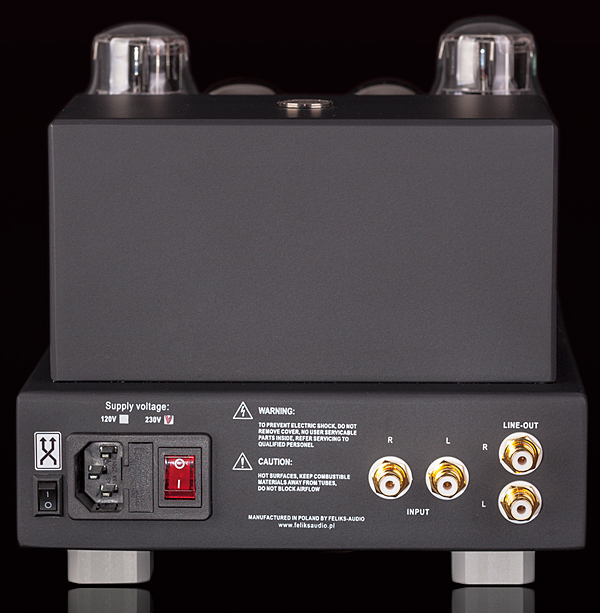 According to Feliks, "Measured with a max 1.8Vrms input where THD falls below 0.5%, the Euforia will deliver 0.13 watts into 32 ohms, 0.2W into 100 ohms, and 0.08W into 600 ohms. Voltage gain is 20dB, and output impedance 20 ohms. S/N is 97dB."
Though nowhere near as powerful as the Schiit or First Watt amps, the Euforia is a solid, hand-built, work of amplifier art.
I auditioned the Euforia in two systems. First I connected it to the line-level output of the
Mytek Brooklyn DAC+ in my desktop system. Later, I tried it in my main reference system using the tape output of the PrimaLuna EVO 400 preamplifier, fed by a HoloAudio Spring "Kitsuné Tuned Edition" Level 3 DAC. The Euforia pleased me in both settings, demonstrating enough power and enough umph-gain for the music to retain its natural excitement.
Feliks amp with the Grado GS3000e headphones
According to Feliks, "Measured with a max 1.8Vrms input where THD falls below 0.5%, the Euforia will deliver 0.13 watts into 32 ohms, 0.2W into 100 ohms, and 0.08W into 600 ohms. Voltage gain is 20dB, and output impedance 20 ohms. S/N is 97dB."
Though nowhere near as powerful as the Schiit or First Watt amps, the Euforia is a solid, hand-built, work of amplifier art.
I auditioned the Euforia in two systems. First I connected it to the line-level output of the
Mytek Brooklyn DAC+ in my desktop system. Later, I tried it in my main reference system using the tape output of the PrimaLuna EVO 400 preamplifier, fed by a HoloAudio Spring "Kitsuné Tuned Edition" Level 3 DAC. The Euforia pleased me in both settings, demonstrating enough power and enough umph-gain for the music to retain its natural excitement.
Feliks amp with the Grado GS3000e headphones
Playing Vivaldi's Gloria again, but this time with the Grados connected to the Feliks headphone amp, the first thing I noticed was how quiet and intimately detailed the music was at normal listening levels—and also how much sparkle and light was retained at the rear of the soundstage. The second thing I noticed was how much this degree of quiet enhanced the Grados' transparency and purified the singer's voices.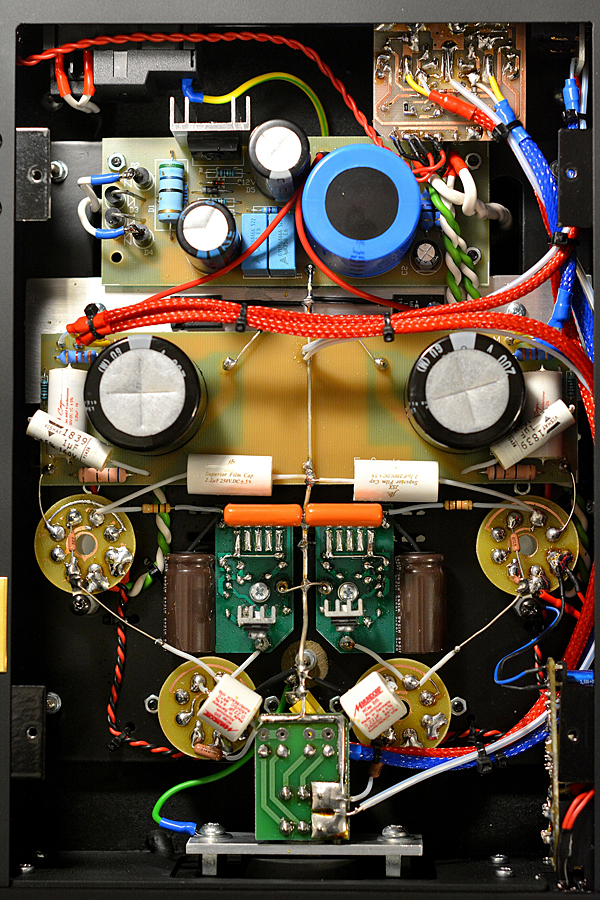 The next thing I noticed was really important. No matter how well transformers are designed, or what wire or core materials they use, output transformers always make their presence known. Therein lies the beauty of OTL amplifiers like the Feliks: At their best, OTL amps allow recordings to feel more direct and unmolested compared to similarly powered transformer-coupled designs. This shimmering triode-tube directness is the Euforia's chief virtue.
With the Schiit and First Watt amps, the Grados' greatest virtue was their swaggering rock'n'roll boogie factor. With the Feliks, the GS3000e's became elegant and refined. This system specialized in opera, solo violin, and piano. If my name was Grado, I'd use the Euforia to demonstrate my products at CanJam.
The Crossfeed Switch
The next thing I noticed was really important. No matter how well transformers are designed, or what wire or core materials they use, output transformers always make their presence known. Therein lies the beauty of OTL amplifiers like the Feliks: At their best, OTL amps allow recordings to feel more direct and unmolested compared to similarly powered transformer-coupled designs. This shimmering triode-tube directness is the Euforia's chief virtue.
With the Schiit and First Watt amps, the Grados' greatest virtue was their swaggering rock'n'roll boogie factor. With the Feliks, the GS3000e's became elegant and refined. This system specialized in opera, solo violin, and piano. If my name was Grado, I'd use the Euforia to demonstrate my products at CanJam.
The Crossfeed Switch
Crossfeed circuits are designed to enhance headphone listening by adding some amount of some type of opposite-channel information to each ear. The stated reason for this electronic connivery is to correct what some users perceive as the exaggerated stereo effect of the headphone experience. I'm sorry folks, but I am dumbfounded by the whole concept of "acoustically simulating" the experience of listening to stereo loudspeakers as opposed to headphones. Why in tarnation would I want to compromise my headphones' natural-born tendencies for audio vérité? According to Lukasz Feliks, "Our crossfeed circuit was developed entirely in-house. It is based on an analog low-frequency band-pass filter, which mixes both channels to the frequency level of 700Hz. Thus, both stereo signals below 700Hz become a 'mono' signal. The final effect depends heavily on the nature of a selected recording." The "effect" I noticed was fuzzy and less defined than I expected. One of the more interesting recordings I used to audition the crossfeed feature was Vaughan Williams: Songs of Travel, by tenor Robert Tear and pianist Philip Ledger (LP, Argo ZRG 732). It was interesting because without crossfeed, Tear is either centered or in the left channel, while Ledger is mostly centered—and oboist Neil Black is mainly on the right. Without crossfeed, these performers' positions were very specifically described and seemed to me more noticeably left–right than I would have personally preferred. But crossfeed didn't move the players—it just blurred their outlines, generalized their positions, and blunted transients.
Fortunately, the Euforia's crossfeed module can be switched completely out of the amplifier's circuit.
With Focal Clear headphones
Focal's midpriced ($1500) Clears have been my most beloved daily-use headphones since I reviewed them in the spring of 2018. Most days, they're sourced by a Mytek HiFi Brooklyn DAC+ driving either iFi Audio's Pro iCan or, more recently, Feliks's Euforia amplifiers. The Clears present recordings with a comfortable, seductive ease. They are extremely transparent. They disappear into the music even better than my previous daily-use reference, Sony's closed-back MDR-Z1R headphones ($1999). The Clears like all kinds of music, but, as happened with the Grados, the Euforia's radiant liquidity enhanced their sense of flow and resolve. Which, in turn, made 1920s electrical-era recordings sound real and vivid in a way that encouraged me to explore the earliest roots of my musical tastes.
Without trying, the Clear-Euforia combo led me straight to Texas songster Henry Thomas's 1928 recording of "Bull Doze Blues," which you may recognize as Canned Heat's big hit, "Goin' Up the Country." My source for this beautiful rustic lyricism was YouTube, and the sound, which was taken from a 78rpm disc, seemed perfect. All I needed was to hear the vivid moving air from Henry Thomas playing quills (which are similar to pan pipes). I grew up with Canned Heat's slippery electric guitar-and-LSD–infused version, which featured Jim Horn playing the quills part on flute and the late Alan "Blind Owl" Wilson playing guitar. The Thomas version, however, is shy, almost stumbling—but it pours straight from Henry's heart. The Focal Clears and Feliks Euforia made "Bull Doze Blues" feel and sound like epic poetry.
Euforia + Susvara
As you can see, the sound of every headphone will largely be determined by the quantity and quality of power driving it. In terms of available power, the Woo WA5, Schiit Aegir, and the First Watt J2 are like nuclear warheads. Contrastingly, the Euforia uses big, beautiful, old-school tubes, which make it sound rich, radiant, and unusually open and dynamic. But! Some listeners (including myself ) may consider it under-weaponized. It has only a single ¼" (6.3mm) output jack, it generates a fixed 20dB of gain, and it delivers only 0.13 watts into 32 ohms. Despite their 20dB gain, the Euforia seems optimized for higher sensitivity headphones like the Grado GS3000e and Audeze LCD-X. So then: How will Euforia perform driving the 83dB/mW Susvara?
The answer: very well, but not turbocharged, high-revving spectacular. And not as well (or as spectacular) as it performed driving the 16dB-more-sensitive Grado GS3000e. However, with the Susvara, "very well" was actually extraordinarily well on Aaron Neville singing Dylan's "With God on Our Side," from The Neville Brothers' Yellow Moon album (44.1/16 FLAC A&M/Tidal). This soulful, reverb-soaked "enhanced a cappella" rendition delivered a deep (artificial) space with evocative purity and hair-raising detail. The Susvaras' beauty was all there. Their punch, bite, and vivo were not.
In The End
This Dream was about the relationship between amplifier power and musical satisfaction, and a new, quickly evolving audiophile realm where I can close my eyes and a couple of low-distortion watts will bring me music at 90dB+ SPL with lifelike corporeality and uncanny transparency. The Woo Audio WA5 amp and Abyss AB-1266 Phi headphones demonstrated the leading edge of audio reproduction—but at an extremely high price. Meanwhile, the Grado GS3000e headphones, powered by the Feliks Euforia, did everything superbly at an extremely reasonable price. Highly recommended.
Footnote 3: Feliks Audio: HFelektronika 2a Tuwima St. 42-700 Lubliniec, Poland. Web: www.feliksaudio.pl. US Distributor: Upscale Audio, 2058 Wright Avenue, La Verne, CA 91750. Tel: (909) 931-9686. Web: www.upscaleaudio.com.
As you might have guessed, I do not drive headphones with power amps in my everyday life. There, I use a variety of regular-issue headphone amplifiers—which, conveniently, have headphone jacks, volume controls, and adjustable overall gain. One of the best amps I've used this year is the Feliks Audio Euforia Mark II ($2599, footnote 3): a good-looking, tubed, dedicated headphone amplifier that makes the GS3000e Grados sound more transparent and satisfying than either the Schiit Aegir or First Watt J2 power amps.
After studying the GS3000e with a pair of regular power amps, I felt certain the $2599 Feliks Audio Euforia Mark II headphone amplifier would deliver a similarly clear lens, while adding some tube radiance and solving the gain/noise issue. I'd been using the Euforia for about nine months, mostly with the Focal Clear over-ear, open-backed dynamic headphones—which, because of their profound transparency, 55 ohm impedance, and 104dB/mW sensitivity, are, um, clearly a good match.
The Euforia is designed and built in Poland under the supervision of Feliks Audio's managing director, Lukasz Feliks. It comes in a chic-looking matte-gray steel case, just 8" wide by 12" deep and less than 7" high, weighing a substantial 15.4lb. The Euforia is an output-transformerless (OTL) tube amp that employs the sturdy, rich-sounding 6AS7G/6080 dual-triode output tubes and octal-based 6SN7 dual-triodes for voltage amplification and driver stages. My review sample came with premium Psvane CV-181 Mk2 Gold 6SN7 tubes. The steel box at the back of the chassis houses the Euforia's heavy toroidal transformer, isolating it from the circuits below. Said toroid feeds solid-state rectifiers and a regulated power supply featuring large-value, high-quality Nichicon storage capacitors. There are no circuit boards—just point-to-point, hand-soldered wiring using Teflon- coated pure silver wire, Mundorf coupling capacitors, and the highest quality Dale and Caddock resistors. The Euforia is a single-ended design with a single pair of RCA inputs and a single ¼" output jack. The tubes are autobiased for drop- in replacement. The warranty covers the original owner for 3 years.
According to Feliks, "Measured with a max 1.8Vrms input where THD falls below 0.5%, the Euforia will deliver 0.13 watts into 32 ohms, 0.2W into 100 ohms, and 0.08W into 600 ohms. Voltage gain is 20dB, and output impedance 20 ohms. S/N is 97dB."
Though nowhere near as powerful as the Schiit or First Watt amps, the Euforia is a solid, hand-built, work of amplifier art.
I auditioned the Euforia in two systems. First I connected it to the line-level output of the
Mytek Brooklyn DAC+ in my desktop system. Later, I tried it in my main reference system using the tape output of the PrimaLuna EVO 400 preamplifier, fed by a HoloAudio Spring "Kitsuné Tuned Edition" Level 3 DAC. The Euforia pleased me in both settings, demonstrating enough power and enough umph-gain for the music to retain its natural excitement.
Playing Vivaldi's Gloria again, but this time with the Grados connected to the Feliks headphone amp, the first thing I noticed was how quiet and intimately detailed the music was at normal listening levels—and also how much sparkle and light was retained at the rear of the soundstage. The second thing I noticed was how much this degree of quiet enhanced the Grados' transparency and purified the singer's voices.
The next thing I noticed was really important. No matter how well transformers are designed, or what wire or core materials they use, output transformers always make their presence known. Therein lies the beauty of OTL amplifiers like the Feliks: At their best, OTL amps allow recordings to feel more direct and unmolested compared to similarly powered transformer-coupled designs. This shimmering triode-tube directness is the Euforia's chief virtue.
With the Schiit and First Watt amps, the Grados' greatest virtue was their swaggering rock'n'roll boogie factor. With the Feliks, the GS3000e's became elegant and refined. This system specialized in opera, solo violin, and piano. If my name was Grado, I'd use the Euforia to demonstrate my products at CanJam.
Crossfeed circuits are designed to enhance headphone listening by adding some amount of some type of opposite-channel information to each ear. The stated reason for this electronic connivery is to correct what some users perceive as the exaggerated stereo effect of the headphone experience. I'm sorry folks, but I am dumbfounded by the whole concept of "acoustically simulating" the experience of listening to stereo loudspeakers as opposed to headphones. Why in tarnation would I want to compromise my headphones' natural-born tendencies for audio vérité? According to Lukasz Feliks, "Our crossfeed circuit was developed entirely in-house. It is based on an analog low-frequency band-pass filter, which mixes both channels to the frequency level of 700Hz. Thus, both stereo signals below 700Hz become a 'mono' signal. The final effect depends heavily on the nature of a selected recording." The "effect" I noticed was fuzzy and less defined than I expected. One of the more interesting recordings I used to audition the crossfeed feature was Vaughan Williams: Songs of Travel, by tenor Robert Tear and pianist Philip Ledger (LP, Argo ZRG 732). It was interesting because without crossfeed, Tear is either centered or in the left channel, while Ledger is mostly centered—and oboist Neil Black is mainly on the right. Without crossfeed, these performers' positions were very specifically described and seemed to me more noticeably left–right than I would have personally preferred. But crossfeed didn't move the players—it just blurred their outlines, generalized their positions, and blunted transients.
Focal's midpriced ($1500) Clears have been my most beloved daily-use headphones since I reviewed them in the spring of 2018. Most days, they're sourced by a Mytek HiFi Brooklyn DAC+ driving either iFi Audio's Pro iCan or, more recently, Feliks's Euforia amplifiers. The Clears present recordings with a comfortable, seductive ease. They are extremely transparent. They disappear into the music even better than my previous daily-use reference, Sony's closed-back MDR-Z1R headphones ($1999). The Clears like all kinds of music, but, as happened with the Grados, the Euforia's radiant liquidity enhanced their sense of flow and resolve. Which, in turn, made 1920s electrical-era recordings sound real and vivid in a way that encouraged me to explore the earliest roots of my musical tastes.
As you can see, the sound of every headphone will largely be determined by the quantity and quality of power driving it. In terms of available power, the Woo WA5, Schiit Aegir, and the First Watt J2 are like nuclear warheads. Contrastingly, the Euforia uses big, beautiful, old-school tubes, which make it sound rich, radiant, and unusually open and dynamic. But! Some listeners (including myself ) may consider it under-weaponized. It has only a single ¼" (6.3mm) output jack, it generates a fixed 20dB of gain, and it delivers only 0.13 watts into 32 ohms. Despite their 20dB gain, the Euforia seems optimized for higher sensitivity headphones like the Grado GS3000e and Audeze LCD-X. So then: How will Euforia perform driving the 83dB/mW Susvara?
This Dream was about the relationship between amplifier power and musical satisfaction, and a new, quickly evolving audiophile realm where I can close my eyes and a couple of low-distortion watts will bring me music at 90dB+ SPL with lifelike corporeality and uncanny transparency. The Woo Audio WA5 amp and Abyss AB-1266 Phi headphones demonstrated the leading edge of audio reproduction—but at an extremely high price. Meanwhile, the Grado GS3000e headphones, powered by the Feliks Euforia, did everything superbly at an extremely reasonable price. Highly recommended.
Footnote 3: Feliks Audio: HFelektronika 2a Tuwima St. 42-700 Lubliniec, Poland. Web: www.feliksaudio.pl. US Distributor: Upscale Audio, 2058 Wright Avenue, La Verne, CA 91750. Tel: (909) 931-9686. Web: www.upscaleaudio.com.