Sidebar 3: Measurements
I measured the exaSound s88 with my Audio Precision SYS2722 system (see the January 2008 "As We See It") and the magazine's top-of-the-line APx555 system. I used the exaSound's single external power supply and followed the instructions in the manual to make sure that the optional external DAC power supply was deselected.
I connected the exaSound to my network and opened the product's "dashboard" by entering the address "s88.local" into my browser. The dashboard webpage allowed me to select inputs, check settings, view the manual, and access tutorials. The Roon app on my iPad recognized the s88, and by enabling the processor as a Roon endpoint, I could send audio data to it, sampled at rates up to 384kHz. (I don't have files with higher sample rates in my library.)
Before connecting the s88 to my MacBook Pro's USB port, I downloaded and installed the most recent version of exaSound's Mac ASIO driver app (5-3-40) on the laptop. Apple's USB Prober utility identified the exaSound as "exaSound-s88-1.0" from "Future Technology Devices International Limited" with the serial number string "FT57S07L." The app couldn't determine whether the USB port operated in the optimal isochronous asynchronous mode or the isochronous mode, presumably because exaSound's own driver acts as the necessary interface. Apple's AudioMIDI utility indicated that the s88 will accept 32-bit integer, two- and eight-channel data sampled at all rates from 44.1kHz to 768kHz.
I had problems with the optical and coaxial S/PDIF inputs. The TosLink input (which I understood KR hadn't used) wouldn't lock to data sourced from either the SYS2722 or the APx555. This was with both a long, cheap link and a short, premium link. The coaxial input initially locked to data sourced from the SYS2722, but then lost lock after a few seconds. It did lock to the APx555's coaxial output but was limited to sample rates of 96kHz and below. Except where noted, I continued the testing with USB and network data.
The s88's maximum output level at 1kHz was 4.67V from balanced outputs 1 and 2, 2.14V from the single-ended outputs, and 6.5V from the headphone output. The processor preserved absolute polarity (ie, was noninverting) from all of its outputs. The balanced output impedance was close to the specified 400 ohms, at 374 ohms across the audioband. The single-ended output impedance was 187 ohms, again at all audio frequencies. The headphone jack's output impedance is specified as 1 ohm; I measured 2.6 ohms, which is still extremely low. The s88 will have no problem driving low-impedance headphones.
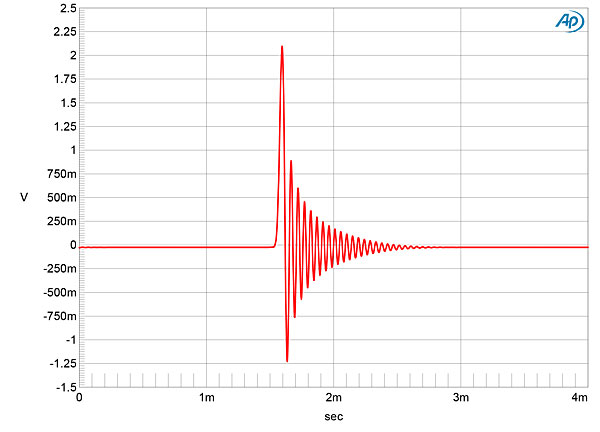
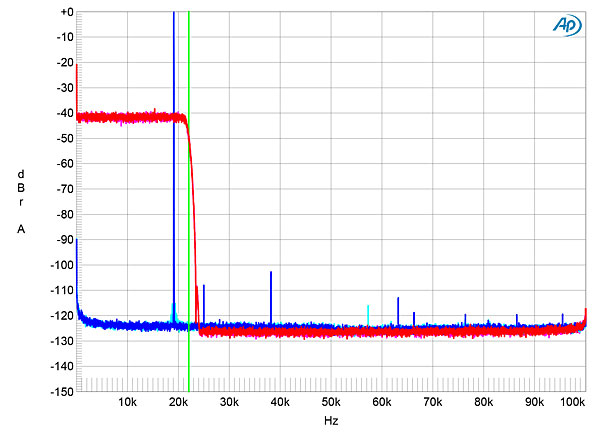
Although it uses ESS's Sabre DAC chip, which offers a choice of reconstruction filters for PCM data, the s88 features a single filter. Fig.1 shows this filter's impulse response with 44.1kHz data. It is typical of a minimum-phase filter with all the ringing following the single full-scale sample. The filter has a very fast ultrasonic rolloff with 44.1kHz data (fig.2, magenta and red traces), reaching full stop-band attenuation just above half the sample rate (the vertical green line). The aliased image at 25kHz of a full-scale tone at 19.1kHz (cyan, blue) is suppressed by almost 110dB. The harmonics associated with the 19.1kHz tone are all extremely low in level.
 When I examined the spectrum of the s88's noise floor, I found that the right channel, intermittently, had a higher level of random noise than the left. Otherwise, the exaSound's noise floor was identical in the two channels and commendably free from power supply–related spuriae (fig.4). This graph was taken with 24-bit coaxial S/PDIF data. USB and network data gave an identical result.
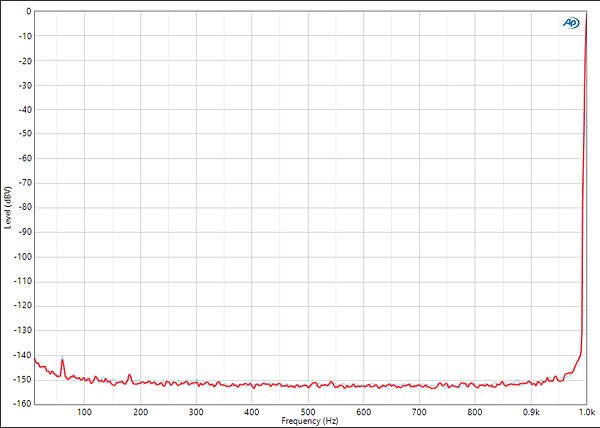
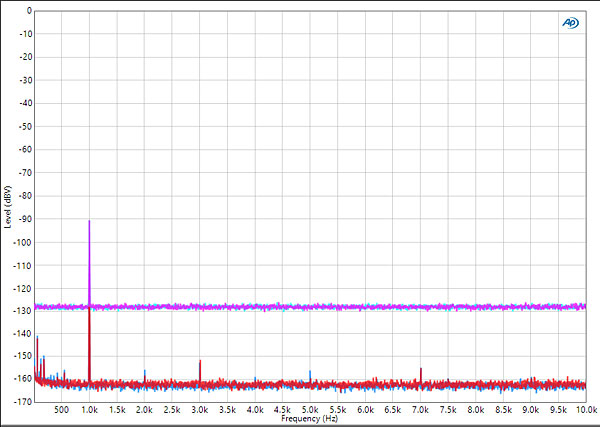
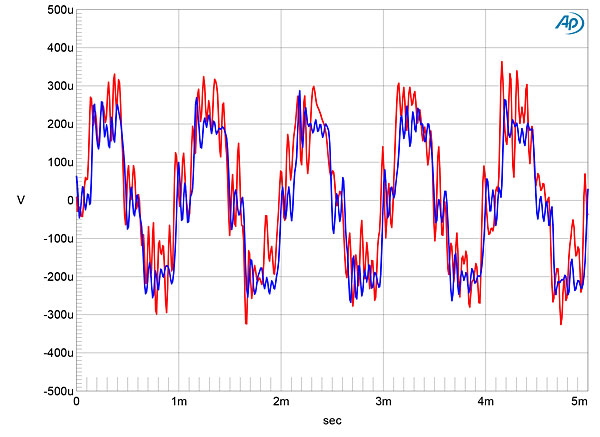
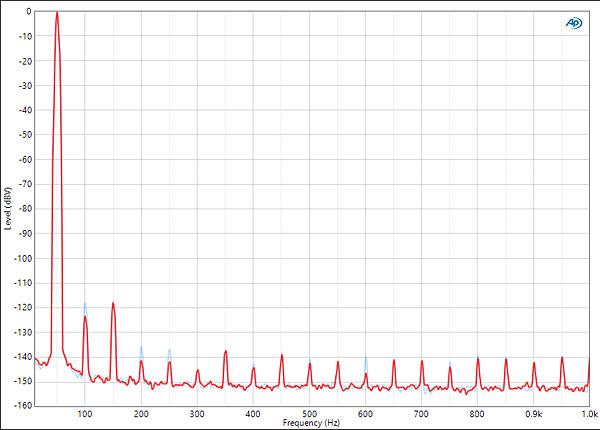
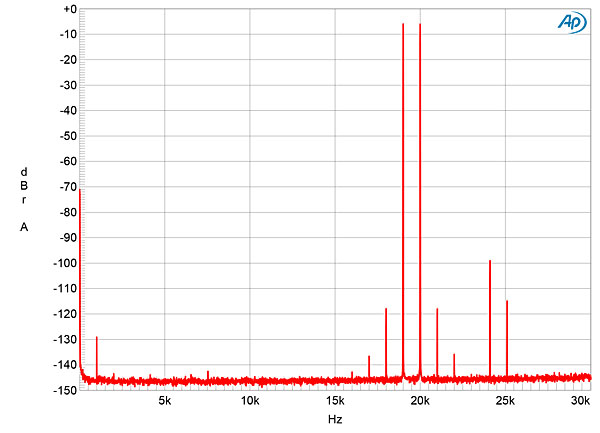
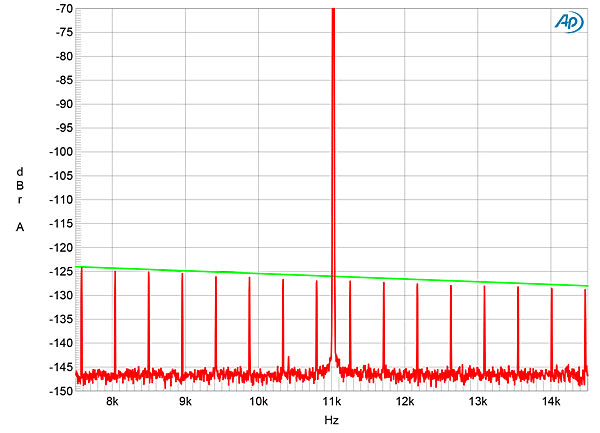
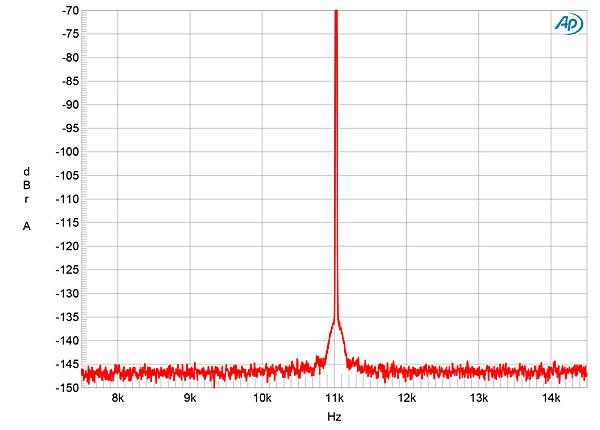
Fig.1 exaSound s88, impulse response (one sample at 0dBFS, 44.1kHz sampling, 4ms time window).
Fig.2 exaSound s88, wideband spectrum of white noise at –4dBFS (left channel red, right magenta) and 19.1kHz tone at 0dBFS (left blue, right cyan) into 100k ohms with data sampled at 44.1kHz (20dB/vertical div.).
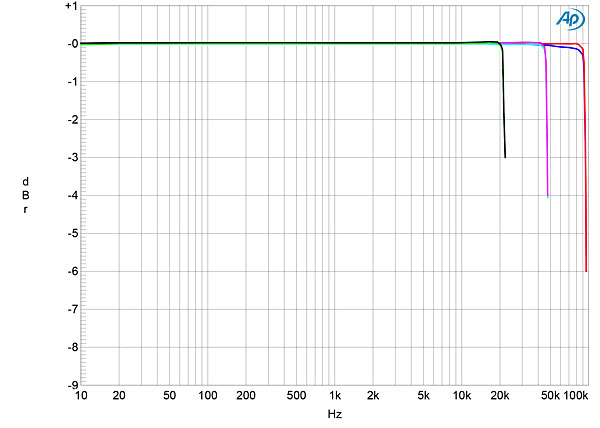
Fig.3 shows the exaSound's frequency response with network data sampled at 44.1kHz, 96kHz, and 192kHz. At each rate, the response is flat almost up to the Nyquist frequency with after that a very sharp rolloff. Channel separation was excellent at >87dB in both directions across the audioband.
Fig.3 exaSound s88, network data, frequency response at –12dBFS into 100k ohms with data sampled at: 44.1kHz (left channel green, right gray), 96kHz (left cyan, right magenta), and 192kHz (left blue, right red) (1dB/vertical div.).
Fig.4 exaSound s88, spectrum with noise and spuriae of dithered 1kHz tone at 0dBFS with 24-bit coaxial S/PDIF data (left channel blue, right red) (10dB/vertical div.).
With dithered data representing a 1kHz tone at –90dBFS, an increase in bit depth from 16 to 24 reduced the s88's noise floor by 30dB (fig.5). This implies a resolution of 21 bits, which is among the highest I have found. When I played undithered 16-bit data representing a tone at exactly –90.31dBFS, the waveform (fig.6) was symmetrical, there was negligible DC offset, the three DC voltage levels described by the data were well-resolved, and the minimum-phase ringing at the voltage transitions could be seen. However, slightly more high-frequency noise is visible in this graph with the right channel (red trace) than the left (blue).
Fig.5 exaSound s88, spectrum with noise and spuriae of dithered 1kHz tone at –90dBFS with: 16-bit coaxial S/PDIF data (left channel cyan, right magenta), 24-bit data (left blue, right red) (20dB/vertical div.).
Fig.6 exaSound s88, waveform of undithered 1kHz sinewave at –90.31dBFS, 16-bit USB data (left channel blue, right red).
The s88 produced very low levels of harmonic distortion with full-scale data. Fig.7 reveals that the second and third harmonics lie close to –120dB (0.0001%). This spectrum was taken with the APx555 and from the exaSound's balanced outputs driving a high 200k ohms load. When I reduced the load impedance to the current-hungry 600 ohms, the harmonics didn't rise significantly. Intermodulation distortion with an equal mix of 19 and 20kHz tones, each lying at –6dBFS, was similarly very low (fig.8), with the difference tone at 1kHz lying at –126dB (0.00005%).
Fig.7 exaSound s88, 24-bit coaxial S/PDIF data, spectrum of 50Hz sinewave, 10Hz–1kHz, at 0dBFS into 200k ohms (left channel blue, right red; linear frequency scale).
Fig.8 exaSound s88, 24-bit, 44.1kHz network data, HF intermodulation spectrum, DC–30kHz, 19+20kHz at 0dBFS into 100k ohms (left channel red; linear frequency scale).
I examined the s88's rejection of word-clock jitter via the USB input with the 16-bit Miller-Dunn J-Test signal. All the odd-order harmonics of the undithered low-frequency, LSB-level squarewave lay at the correct levels, indicated by the sloping green line in fig.9, and no other sidebands can be seen surrounding the high-level tone at one-quarter the sample rate. Repeating the analysis with 24-bit J-Test data gave a clean spectrum (not shown). When I used 24-bit J-Test sent to the exaSound over the network, the spectrum remained clean (fig.10), but the central spike broadened a little at its base due to the presence of random low-frequency jitter.
Fig.9 exaSound s88, high-resolution jitter spectrum of analog output signal, 11.025kHz at –6dBFS, sampled at 44.1kHz with LSB toggled at 229Hz: 16-bit USB data (left channel red). Center frequency of trace, 11.025kHz; frequency range, ±3.5kHz.
Fig.10 exaSound s88, high-resolution jitter spectrum of analog output signal, 11.025kHz at –6dBFS, sampled at 44.1kHz with LSB toggled at 229Hz: 24-bit network data (left channel red). Center frequency of trace, 11.025kHz; frequency range, ±3.5kHz.
Other than the problem I found with the TosLink input and the intermittent noise in the right channel, both of which might well be a fault with the review sample and are likely to be resolved by the time this review hits newstands—the exaSound s88 performed extremely well on the test bench.—John Atkinson