Sidebar 3: Measurements
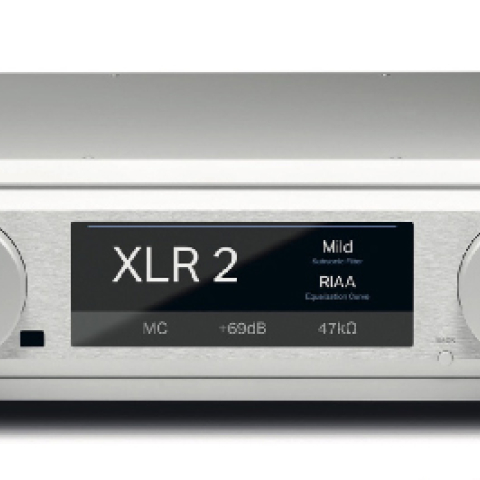
I measured the EMT 128 phono preamplifier (serial number U-102) with my Audio Precision SYS2722, repeating some of the testing with the magazine's higher-performance Audio Precision APx500. The results were consistent with both systems.
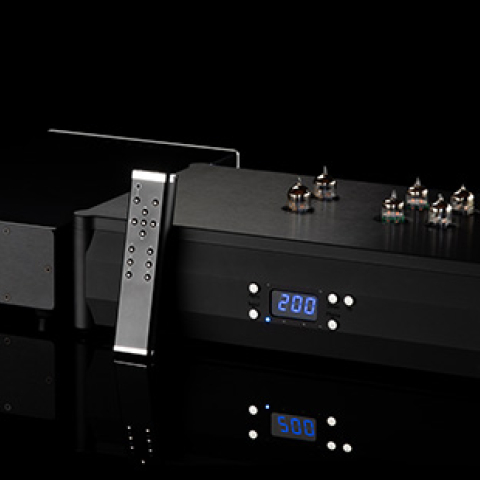
The output impedance, specified as 500 ohms, was a relatively low 320 ohms at 20Hz, 312 ohms at 1kHz, and 246 ohms at 20kHz. The 128 inverted absolute polarity; either the XLR output jacks are connected with pin 3 "hot" or there is an odd number of anode-coupled amplification stages. (Each channel uses three subminiature tubes.) The gain at 1kHz was 62.5dB with the internal jumpers set to "–6," which I understand was how MF auditioned the preamplifier. With the jumpers set to "0," the gain at 1kHz was 68.9dB. Though these figures are slightly below the specified gains of 64dB and 70dB, my measurements will be reduced by the voltage-divider action of the SYS2722's output impedance of 20 ohms and the EMT's input impedance at 1kHz, which was 191 ohms. The input impedance at 20Hz was slightly lower, at 169 ohms, but the impedance was much lower at the top of the audioband, at 29 ohms.
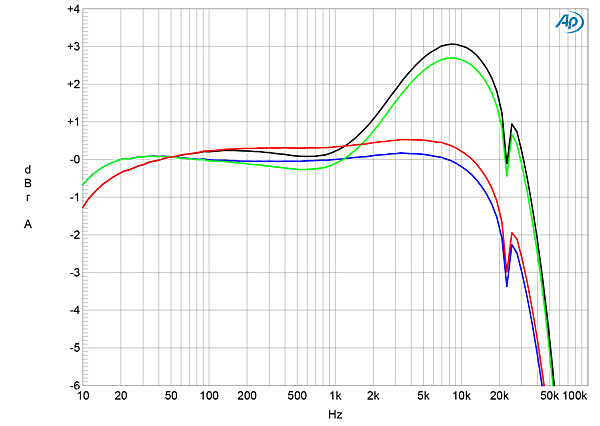
The EMT 128's RIAA correction was superbly flat from 30Hz to 10kHz, though the right channel (fig.1, red trace) was 0.3dB higher than the left (blue trace) in the midrange and treble. The response was down by 1dB at 10Hz and 20kHz, with a slight peak at 25kHz, perhaps due to the output transformer, disturbing the ultrasonic rolloff. The response with the equalization set to "DIN 78" (fig.1, green and gray traces) peaked by 3dB at 10kHz compared with RIAA, but the low frequencies were not attenuated by the expected 3dB at 50Hz (footnote 1).
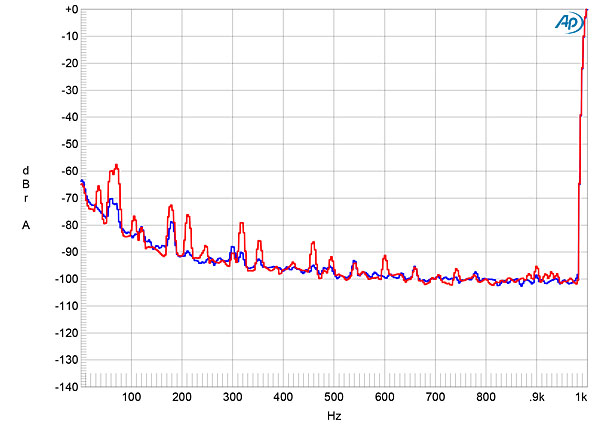
 Channel separation was very good, at 80dB in both directions at 1kHz and below, but it dropped to 40dB at the top of the audioband. Spectral analysis of the EMT's low-frequency noisefloor (fig.2) indicated that random noise components were low in level, though with power supply–related spuriae a little higher in level in the right channel (red trace) than the left (blue). The EMT's unweighted, wideband S/N ratio, referred to an input signal of 1kHz at 500µV, was a good 61.3dB in the left channel, 63.4dB in the right. Restricting the measurement bandwidth to 22Hz–22kHz increased the ratios to 65.5dB, left, and 64.0dB, right, while switching an A-weighting filter into circuit increased both ratios to 76.3dB. These figures were assessed with the gain set to "–6." Setting the gain to "0" decreased the ratios by the expected 6dB.
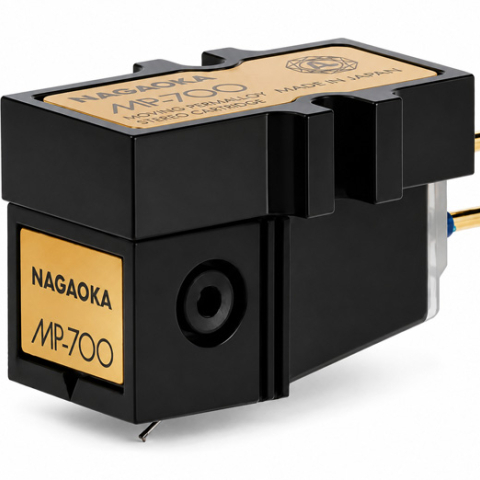
 I note that MF did some of his auditioning with the Miyajima Madake Snakewood (250µV nominal output at 1kHz), which would not have resulted in problems with the EMT's overload margins. The Ortofon Verismo (200µV nominal output) would also have been a good match. But with EMT's Novel Titan phono cartridge, which has what MF told me was "a healthy 1mV output at 5cm/s," the 128's overload margins will be marginal.
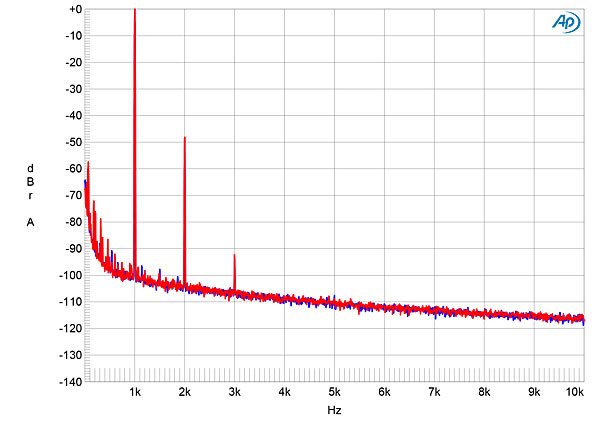
With a 1kHz signal at 500µV, the second harmonic was the only significant distortion product present, at a relatively high –50dB (0.3%, fig.3). At 250µV input, the second harmonic dropped by 5dB, but it rose to –43dB (0.7%) at 1mV, with the third harmonic making an appearance at –80dB (0.01%). As long as it is not accompanied by higher-order harmonics or intermodulation products, the second harmonic is difficult to hear, even with pure tones, as it is musically consonant (footnote 2). However, I suspect that this behavior would endow the EMT preamplifier with a rather full, even lush sound character. These distortion measurements were taken with 100k ohms load impedance. Reducing the load impedance to the current-demanding 600 ohms increased the level of the second harmonic by 10dB. The EMT 128 will work best with a line preamplifier that has an input impedance of 10k ohms or higher.
I note that MF did some of his auditioning with the Miyajima Madake Snakewood (250µV nominal output at 1kHz), which would not have resulted in problems with the EMT's overload margins. The Ortofon Verismo (200µV nominal output) would also have been a good match. But with EMT's Novel Titan phono cartridge, which has what MF told me was "a healthy 1mV output at 5cm/s," the 128's overload margins will be marginal.
With a 1kHz signal at 500µV, the second harmonic was the only significant distortion product present, at a relatively high –50dB (0.3%, fig.3). At 250µV input, the second harmonic dropped by 5dB, but it rose to –43dB (0.7%) at 1mV, with the third harmonic making an appearance at –80dB (0.01%). As long as it is not accompanied by higher-order harmonics or intermodulation products, the second harmonic is difficult to hear, even with pure tones, as it is musically consonant (footnote 2). However, I suspect that this behavior would endow the EMT preamplifier with a rather full, even lush sound character. These distortion measurements were taken with 100k ohms load impedance. Reducing the load impedance to the current-demanding 600 ohms increased the level of the second harmonic by 10dB. The EMT 128 will work best with a line preamplifier that has an input impedance of 10k ohms or higher.
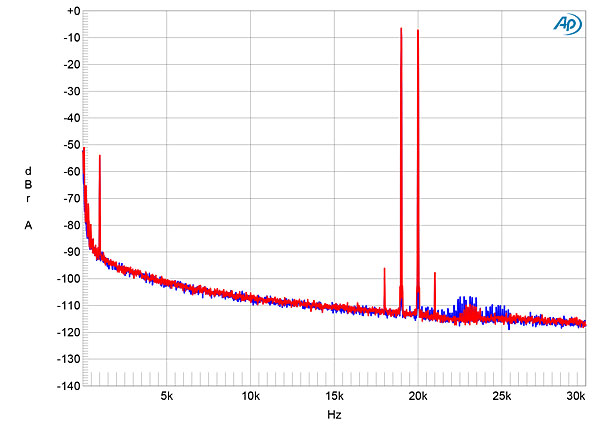
 High-order intermodulation distortion with an equal mix of 19kHz and 20kHz tones at a peak input level equivalent to 1kHz at 250µV was extremely low in level (fig.4). Though the second-order difference product at 1kHz lay at –54dB (0.2%), this will be sufficiently low in level not to have audible consequences.
Footnote 1: This assumes that DIN 78 is indeed the same as IEC N78, as EMT's Micha Huber told Jim Austin in an email. Footnote 2: I created tracks on Stereophile's Test CD 2 so listeners could hear at what percentage of second, third, or seventh harmonic they become aware of the distortion.
Fig.1 EMT 128, response with RIAA correction into 100k ohms (left channel blue, right red) and with DIN 78 correction (left green, right gray) (1dB/vertical div.).
Fig.2 EMT 128, gain set to "–6," spectrum of 1kHz sinewave, DC–1kHz, for 500µV input (linear frequency scale).
Even at the lower gain setting, the EMT 128's overload margins were on the low side, at 9dB at 20Hz, 8.3dB at 1kHz, and 3.5dB at 20kHz, all ref. the nominal MC level of 1kHz at 500µV. These margins were all reduced by 6dB at the higher gain setting.
Fig.3 EMT 128, gain set to "–6," spectrum of 1kHz sinewave, DC–10kHz, into 100k ohms for 500µV input (linear frequency scale).
Fig.4 EMT 128, gain set to "–6," HF intermodulation spectrum, DC–30kHz, 19+20kHz into 100k ohms for 2.5mV peak input (linear frequency scale).
Its performance on the test bench indicates that EMT's 128 phono preamplifier will work best set to its lower gain and with low-output moving coil phono cartridges, like Ortofon's Verismo. I am puzzled, therefore, why its overload margins are low when used with EMT's own Novel Titan.—John Atkinson
Footnote 1: This assumes that DIN 78 is indeed the same as IEC N78, as EMT's Micha Huber told Jim Austin in an email. Footnote 2: I created tracks on Stereophile's Test CD 2 so listeners could hear at what percentage of second, third, or seventh harmonic they become aware of the distortion.