Sidebar 3: Measurements
I examined the Electrocompaniet ECD 2's electrical performance with Stereophile's loan sample of the top-of-the-line Audio Precision SYS2722 system (see www.ap.com and the January 2008 "As We See It"); for some tests, I also used my vintage Audio Precision System One Dual Domain. The ECD 2's performance via USB port was tested using my 2012-vintage Apple MacBook Pro.
Apple's USB Prober utility identified the ECD 2 as having the Product String "Electrocompaniet USB Audio 2.0" and confirmed that it operated in isochronous asynchronous mode with all sample rates from 44.1 to 192kHz, including 88.2 and 176.4kHz, with a 24-bit bit depth. The coaxial inputs locked to S/PDIF datastreams with sample rates of up to 192kHz; the optical inputs did also, though the TosLink specification is not intended to operate above 96kHz.
The ECD 2's volume control operated in accurate 1dB steps. I left it set to "100" for all testing. The maximum output voltage was to specification, at 4.57V balanced and 2.28V unbalanced, the latter 1.15dB greater than the CD standard's recommended 2V. Both sets of outputs preserved absolute polarity (ie, were non-inverting), the XLR jacks being wired with pin 2 hot. The ECD 2's output impedance was inconsequentially higher than the specified 300 ohms for the single-ended output and each phase of the balanced output, at 337 ohms. It was the same at all audio frequencies, however.
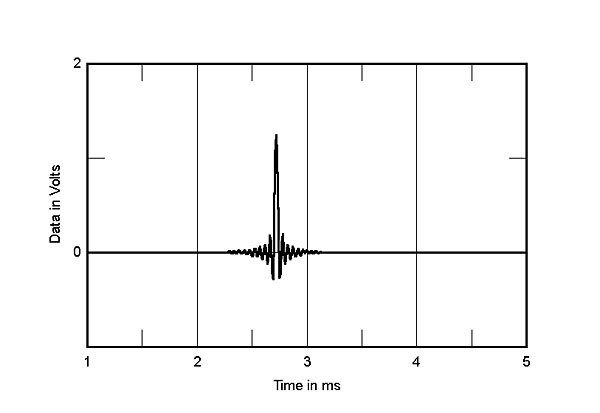
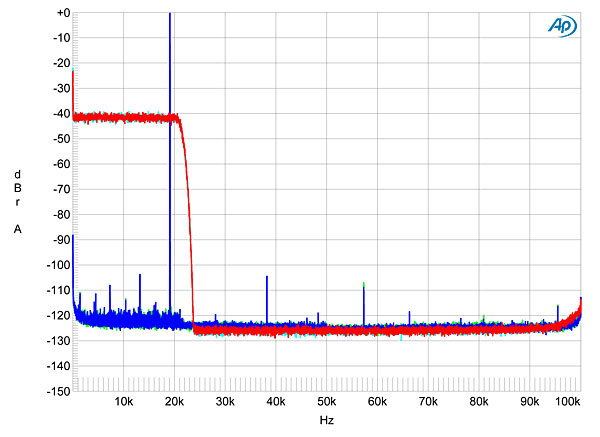
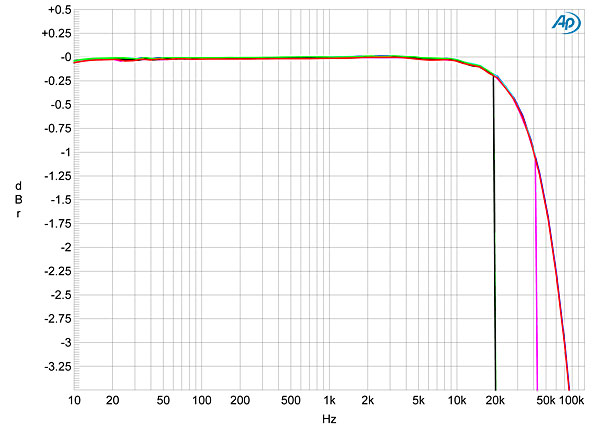
The ECD 2's impulse response with 44.1kHz data (fig.1) revealed its reconstruction filter to be a conventional, linear-phase FIR type. Wideband spectral analysis with white noise sampled at 44.1kHz (fig.2, red trace) indicated that this filter rolled off very rapidly above 21kHz with total suppression of any ultrasonic images of a full-scale tone at 19.1kHz (fig.2, blue trace, footnote 1). Fig.3 shows the ECD 2's frequency response with data sampled at 44.1, 96, and 192kHz. The response follows the same basic shape with all three sample rates, dropping by 0.24dB at the top of the audioband, with then a very steep rolloff just below the Nyquist Frequency (half the sample rate) for each of the two lower sample rates. Note the superb channel matching in this graph. Channel separation (not shown) was superb, at >120dB in both directions below 2kHz and still 107dB at 20kHz.
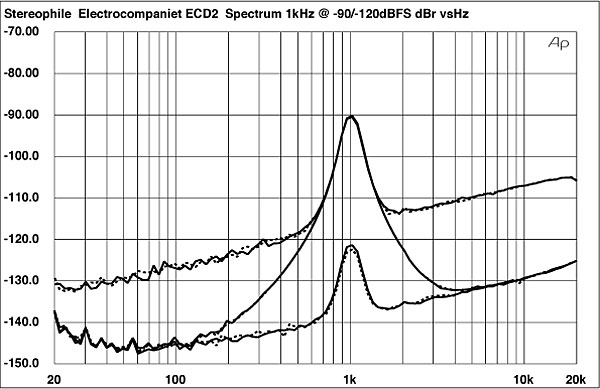
 For consistency with my tests of digital products going back to 1989, my first test of a DAC's resolution is to feed it dithered data representing a 1kHz tone at –90dBFS with 16- and 24-bit word lengths, and sweep a 1/3-octave bandpass filter from 20kHz down to 20Hz. The result is shown in fig.4, with the 16-bit spectrum the top pair of traces and the 24-bit spectrum the middle pair. The increase in bit depth drops the noise floor by up to 25dB in the treble, which suggests that the Electrocompaniet processor offers 20-bit resolution—excellent, and easily enough to allow it to resolve a 24-bit tone at –120dBFS (bottom traces).
Footnote 1: My thanks to Jürgen Reis of MBL for suggesting this means of displaying the performance of a DAC's reconstruction filter.
Fig.1 Electrocompaniet ECD 2, impulse response (4ms time window).
Fig.2 Electrocompaniet ECD 2, wideband spectrum of white noise at –4dBFS (left channel blue, right magenta) and 19.1kHz tone at 0dBFS (left cyan, right red), with data sampled at 44.1kHz (10dB/vertical div.).
Fig.3 Electrocompaniet ECD 2, frequency response at –12dBFS into 100k ohms with data sampled at: 44.1kHz (left channel green, right gray), 96kHz (left cyan, right magenta), 192kHz (left blue, right red) (0.25dB/vertical div.).
Fig.4 Electrocompaniet ECD 2, 1/3-octave spectrum with noise and spuriae of dithered 1kHz tone at –90dBFS with 16-bit data (top) and 24-bit data (middle), and at –120dBFS with 24-bit data (bottom) (right channel dashed).
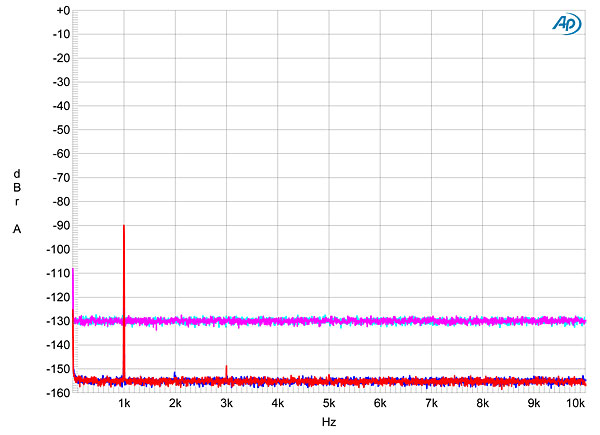
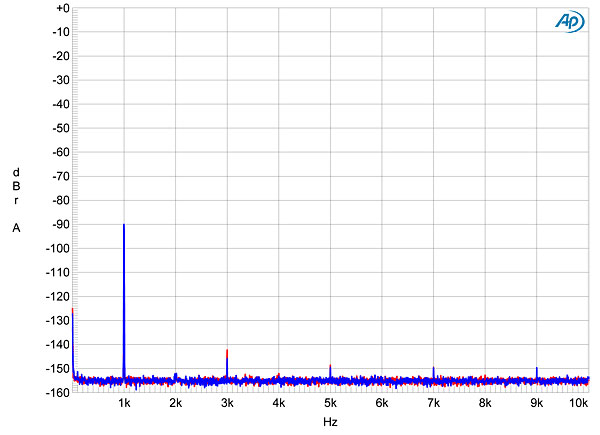
Repeating the spectral analysis with a narrowband FFT technique (fig.5), for which I extended the graph floor to –160dBFS (!) to show the ECD 2's output, confirmed the superbly high resolution, though now a trace of odd-order distortion is evident with the 24-bit representation of the 1kHz tone at –90dBFS. Repeating this test with USB data confirmed that the ECD 2's USB input correctly accepts 24-bit data, though the odd-order harmonics were slightly higher in level (fig.6).
Fig.5 Electrocompaniet ECD 2, spectrum with noise and spuriae of dithered 1kHz tone at –90dBFS with: 16-bit data (left channel cyan, right magenta), 24-bit data (left blue, right red) (10dB/vertical div.).
Fig.6 Electrocompaniet ECD 2, spectrum with noise and spuriae of dithered 1kHz tone at –90dBFS with 24-bit USB data (left blue, right red) (10dB/vertical div.).
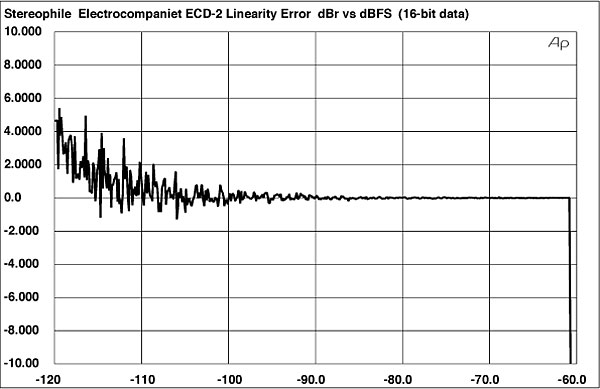
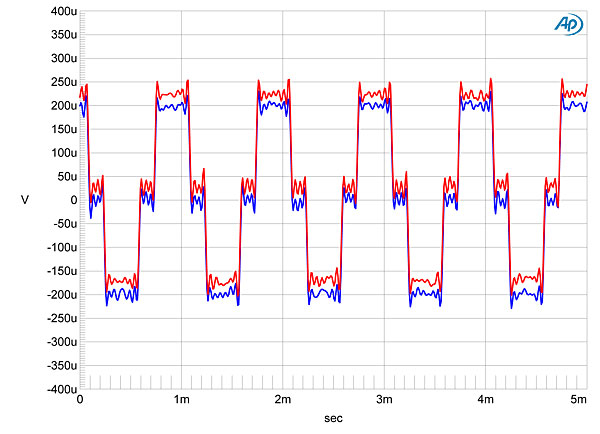
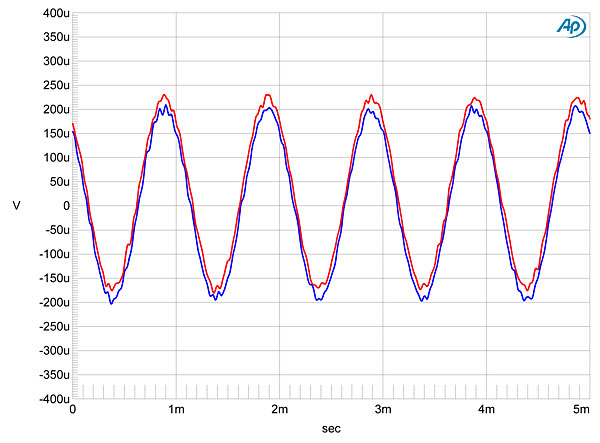
Linearity error with 16-bit data (fig.7) was negligible to below –100dBFS, and with its very low level of analog noise, the ECD 2's reproduction of an undithered tone at exactly –90.31dBFS was superb (fig.8). The waveform is symmetrical, and the three DC voltage levels described by the data are well defined. The result with undithered 24-bit data was an excellent-looking sinewave (fig.9).
Fig.7 Electrocompaniet ECD 2, linearity error with 16-bit USB data (10dB/vertical div.).
Fig.8 Electrocompaniet ECD 2, waveform of undithered 1kHz sinewave at –90.31dBFS, 16-bit data (left channel blue, right red).
Fig.9 Electrocompaniet ECD 2, waveform of undithered 1kHz sinewave at –90.31dBFS, 24-bit data (left channel blue, right red).
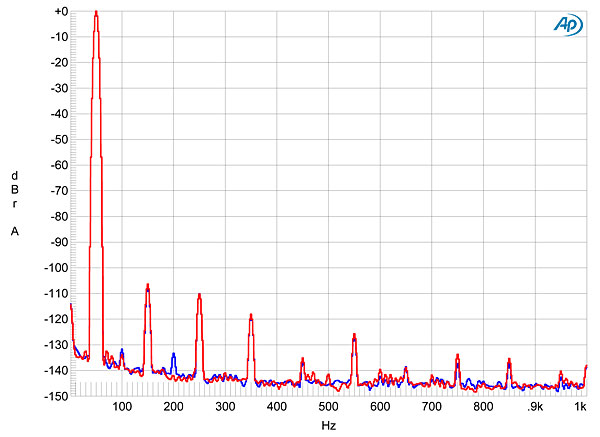
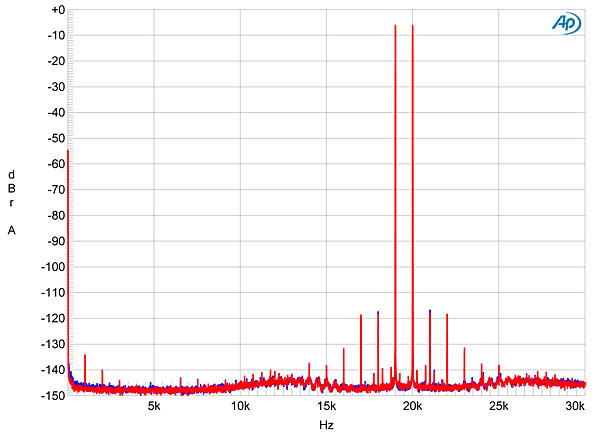
Harmonic (fig.10) and intermodulation (fig.11) distortion were very low, the former dominated by the subjectively benign low-order products. These two graphs were taken into the high 100k test load. Dropping the load impedance to the punishing 600 ohms didn't change the picture, suggesting that the Electrocompaniet's output stage is bombproof.
Fig.10 Electrocompaniet ECD 2, spectrum of 50Hz sinewave, DC–1kHz, at 0dBFS into 100k ohms (left channel blue, right red; linear frequency scale).
Fig.11 Electrocompaniet ECD 2, HF intermodulation spectrum, DC–30kHz, 19+20kHz at 0dBFS into 100k ohms (left channel blue, right red; linear frequency scale).
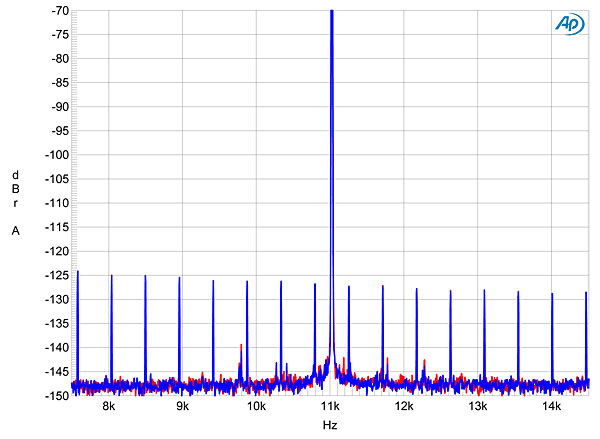
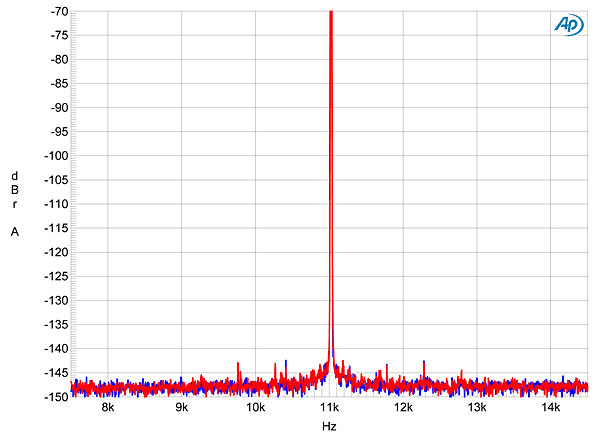
Testing the ECD 2 via a TosLink input for its rejection of word-clock jitter, using a 16-bit version of the Dunn-Miller J-Test signal, all the narrowband spectral analysis showed was the presence at the correct levels of the high-order odd harmonics of the low-frequency, LSB-level squarewave (fig.12). A few very low-level sidebands are evident at –140dBFS, but these disappeared with 16-bit USB data (not shown). Tested via its USB port with a 24-bit representation of the J-Test signal (fig.13), the ECD 2's output was virtually free of jitter-related sidebands, and the spectral spike that represents the tone at one-fourth the sample rate was well defined, lacking the "shoulders" that would indicate the presence of random low-frequency jitter.
Fig.12 Electrocompaniet ECD 2, high-resolution jitter spectrum of analog output signal, 11.025kHz at –6dBFS, sampled at 44.1kHz with LSB toggled at 229Hz: 16-bit data via TosLink from AP SYS2722 (left channel blue, right red). Center frequency of trace, 11.025kHz; frequency range, ±3.5kHz.
Fig.13 Electrocompaniet ECD 2, high-resolution jitter spectrum of analog output signal, 11.025kHz at –6dBFS, sampled at 44.1kHz with LSB toggled at 229Hz: 24-bit data via USB from MacBook Pro (left channel blue, right red). Center frequency of trace, 11.025kHz; frequency range, ±3.5kHz.
Summing up the Electrocompaniet ECD 2's measured performance is easy: It's close to the state of the art for a digital/analog processor!—John Atkinson
Footnote 1: My thanks to Jürgen Reis of MBL for suggesting this means of displaying the performance of a DAC's reconstruction filter.