My heart is not broken. It is collapsed like the sun into the frozen Meadowlands. Sometimes, alone in bed at night, I get this awful, screaming pain in the side of my bony chest, in that empty space where I imagine you to be. It's not often that I do this, sit here. Listen to the same sad songs over and over again, sing along, cry, think of how these words were written for us. It's probably not a good habit to be getting into, but it seems I just can't stop. It's been more than two weeks now, and it isn't wearing off. Twelve songs, 40 minutes, over and over again. I can't stop. Remember when you said that no one else could ever love me like you loved me? I don't know if that was a gift or a curse, but I believe it is true.
I can't stop.
Okay, just as you have suddenly turned into a full-on cupcake addict, I am now a full-on Ryan Adams addict. Girl, I am so messed up on Ryan Adams. I definitely have a problem. I have zero self-control when it comes to the Cardinal. Maybe it's not the same thing. Maybe that sounds weird coming from me, but oh well. Dude makes me feel in touch with parts of myself that I turned my back on because I thought I had to grow up or become normal or something. He reminds me of me. And I kind of wish I could go back to being me again, whoever that is.
I have been listening to this damn album.
Cardinology. Isn't that a strange title? I mean,
what is cardinology? The study of being a cardinal? The act of being a cardinal? A way of life?
Cardinology. Like
cardiology. A study of the heart? It is so easy to listen to. It is so easy to love. When I saw it in the store, I hesitated before buying it. Maybe I knew that it would lead to this. But I bought it anyway, most likely as a way of sharing something with you.
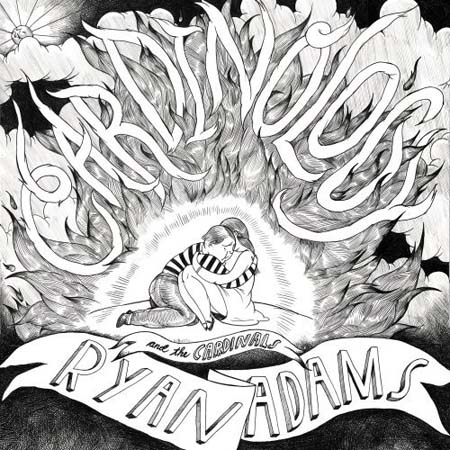
The limited-edition LP package comes with a bonus 45RPM single and a download card for 320kbps MP3s of the entire album taken from a vinyl transfer. The LP is pressed on clear, red wax. The artwork for the compact disc shows a neon blue cardinal symbol soaring upon a black background, but the artwork for the vinyl is something else. A black and white cartoon of young lovers sitting on a hill, all tangled in long-limbed embrace, like everything that matters in this enormous, frightening world exists right there between their desperate arms.
Leah Hayes, charming vocalist of Brooklyn's Scary Mansion, is responsible for the artwork. Her 16-page comic book accompanies the album, using Adams' lyrics as dialogue and lending a special insight into what seem to be extremely personal songs. Hayes and Adams are friends (I think), and Hayes may know better than any of us, better even than the brokenhearted and lonely, what sorrows these songs tell.
But maybe I'm wrong. Maybe it's all some joke and Adams has me fooled. But it doesn't really matter, does it? Every time I listen to these songs, I find myself wanting to call you. And no other songs have made me sing so much, have made me cry so much. In his very good essay, "
What Makes a Great Singer?" (RS 1066), Jonathan Lethem writes:
The beauty of the singer's voice touches us in a place that's as personal as the place from which that voice has issued. If one of the weird things about singers is the ecstasy of surrender they inspire, another weird thing is the debunking response a singer can arouse once we've recovered our senses. It's as if they've fooled us into loving them, diddled our hard-wiring, located a vulnerability we thought we'd long ago armored over. Falling in love with a singer is like being a teenager every time it happens.
Lethem is right. And with this curiously named album, Ryan Adams is fucking me up, shredding me apart, and piecing me back together. Listening to this album is like going to therapy or confessing my sins. I don't want to think about these things, I don't want to feel these things. But I listen to the songs, and I'm pried open and transformed into a small child. It hurts and then it feels good and then it hurts some more. I feel like a fool for loving this album as much as I do, but I can't help it. I get the feeling that Adams is going through the same shit. He strips away layers of armor and reminds himself that he is okay, that everything is okay. In "Go Easy," he laments:
You would like those flowers on the hills
And the sunlight in the fall
Even the coyotes call
Funny how my mind counts each day
By the times I thought of you
Funny how the numbers sway
Then he confesses:
If only to say this to you now,
I love you still and I always will
If only to say this to myself,
I will always love you, I will always love you,
And finally he advises, he consoles:
So go easy on yourself
Go easy, go easy, go easy, go easy
I know these words, I've had these thoughts, measured the days. Sometimes I stop what I'm doing and realize that it's been hours and hours since I last thought of you, and I feel so sorry. I'm sorry. The same sort of imagery and back and forth inner musings are presented throughout
Cardinology with what seems to be a brutal and beautiful honesty. In "Sink Ships," Adams sings:
I can still hear you laughing, coming up the rickety stairs
Laughing as the springtime filled your lungs with air
Grey smoke rung out like the patches of your hair
Like violets, like birds inside of bells
Is Adams singing about girlfriend Carrie Hamilton who died of cancer in 2002? I want to think so, and, at the same time, I hate to think so. Troubles and regrets are laid bare, and humble solutions are offered as simple refrains. Adams is content to keep moving in time to the music rolling in his mind. Even during "Magick"—a big, fat rock and roll song that could easily find a home in any SUV commercial or halftime show—I find myself wondering if Adams is serious when he sings:
So turn the radio on
So turn the radio up
So turn the radio up loud and get down
Let your body move
Let your body sway
It's magick!
Somewhere in those simple, infectious lines, is Adams letting loose a little truth? How does the same guy write "Crossed Out Name" (I kiss her mouth and I know / For everything there is a word / For everything but this)? At first, "Magick" seems tacky and out of place, but is Adams being honest? Haven't you wanted to just listen to the music and watch the record go round? I have. It
is magic.
I am deeply intrigued by this brief album. I play it over and over again, wondering what it's all about, thinking it's about me. The songs are short, compact, and powerful. This is the most efficient songwriting I've ever heard from Ryan Adams, or from anyone else. Concise verses quickly lead to memorable refrains, as if each song is one great string of effortless hooks. Adams makes entire choruses out of single lines, even single words. His performances here are outstanding. He's a master of those tricks common to many other great vocalists: stuffing too many syllables into a line, breaking a line at some strange but perfect point, turning a simple sound—a "hmm" or a hum—into something exquisite, stretching a note for so damn long you have no idea which way he'll turn with it.
The band is
loose. These songs are nothing complicated—anyone with some musical training can figure out the chords and changes—but they are played so very well. There is space. I listen to these songs and I hear parts that don't exist. As if Adams and the Cardinals decided to let the listener fill in the blanks. The instrumentation is simple: electric, acoustic, and pedal steel guitars; bass; drums; sometimes Wurlitzer; sometimes piano; violin on the gorgeous closer, "Stop"—all anchored by Adams' brilliant voice and some perfectly placed backing vocals.
Cardinology was recorded and mixed at Electric Lady Studios, produced and engineered by Tom Schick, with additional engineering by Noah Goldstein. The album was mastered by Bob Ludwig. The sound is as interesting as the music, and nearly as honest and bare. You can almost see the seams. It almost sounds as if they
forgot to polish things off, but I feel certain that that is not the case. They did not forget. They chose to complement the songs' sincerity by keeping the recording natural.
Cardinology sounds most alive. It sounds urgent without suffering from disorganization.
In "Stop," Adams sings of deep pain:
I know a sickness so ancient and cross
No crucifix could ever fix enough...
But he knows that even this is nothing that can't be overcome:
If you wanna make it stop,
Then stop.
Cardinology is about the pain of loving someone, the pain of losing someone, the pain of feeling alone. Here, too, Adams reminds us that we are okay, reminds me that I am okay:
Look around,
There's so many of us,
There's so many of us, and you are not alone
Ever
If you want it to stop, then stop, he says. But I can't stop. I can't stop. For now, I suppose, I just don't want to stop.