Sidebar 3: Measurements
Our review samples of Doshi Audio's Monoblock V3.0 amplifier were well traveled, having been shown at the Rocky Mountain Audio Fest in Denver in 2017, and at AXPONA and Munich High End in 2018, before making their way to Washington and Jason Victor Serinus. Unfortunately, they then didn't survive their transcontinental trip from Jason's place to mine at the hands of UPS. Although the boxes seemed undamaged, they must have been dropped at some point: neither amp worked. Fortunately, Nick Doshi was able to drive up from Virginia to Brooklyn at short notice to repair them. (A solder joint had been fractured in one amplifier, resulting in a blown fuse when I turned it on; the other amp had a broken binding post.)
Once the Monoblock V3.0s had been repaired, I measured them using my Audio Precision SYS2722 system (see the January 2008 "As We See It"). Before doing so, I checked the bias current for each of the four Tung-Sol KT150 output tubes in each amp using the front-panel display and the four trim pots on the top panel, and set all four to the recommended 190mV.
The Monoblock V3.0 has both balanced (Buffered) and single-ended (DIR.SE) inputs, and is specified as having an input sensitivity of 1.4V for its full 160W power into 4 ohms—as supplied, the amplifier is set up for a 4 ohm load—which is equivalent to an RMS voltage of 25.3V. This is a voltage gain of 25.1dB. Into 8 ohms I measured a higher gain, 29.2dB, with both the balanced and unbalanced inputs on both samples. Both inputs preserved absolute polarity (ie, were non-inverting), the XLR jack wired with pin 2 hot. The input impedance is specified as 47k ohms for both balanced and unbalanced inputs. I measured 45k ohms at 20Hz and 1kHz for the single-ended inputs, this dropping inconsequentially to 37k ohms at 20kHz. The balanced input impedance was 20k ohms from 20Hz to 20kHz.
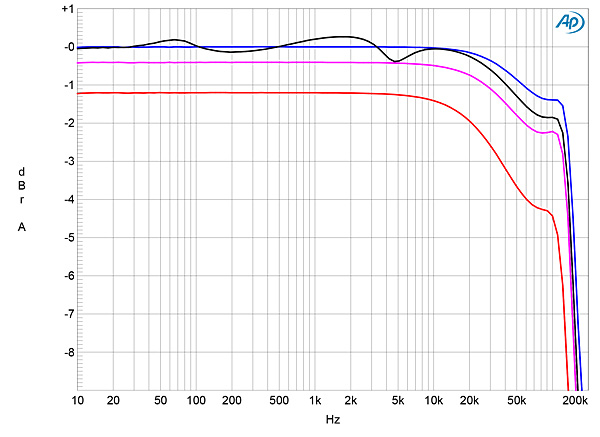
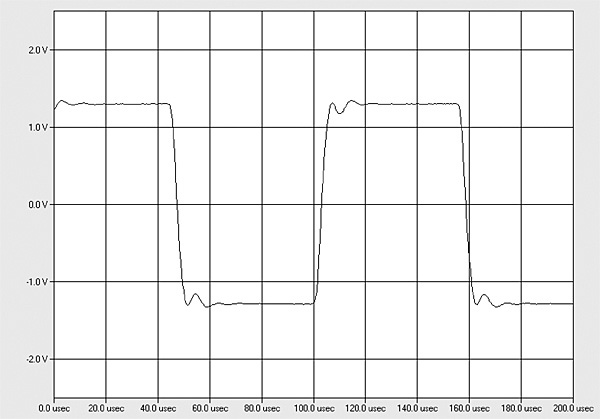
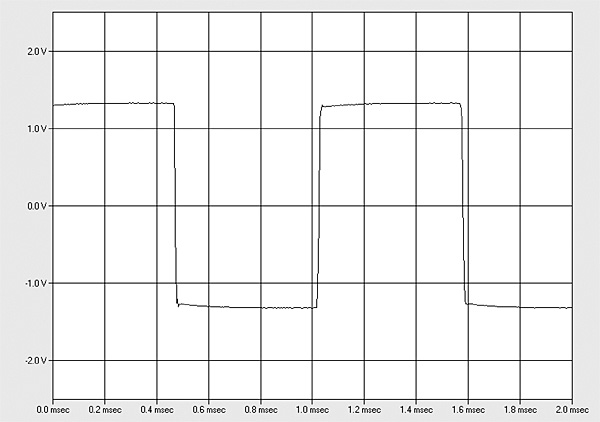
The output impedance for serial no. 1803 was 0.56 ohm at 20Hz and 1kHz, rising to 0.73 ohm at 20kHz. The impedance for serial no. 1805 was a little lower, at 0.39 ohm at 20Hz and 1kHz, and 0.57 ohm at 20kHz. As a result, the modulation of the Doshi's frequency response driving our standard simulated loudspeaker was a moderate ±0.25dB, before rapidly rolling off above 20kHz (fig.1, gray trace). The ultrasonic rolloff began a little earlier into lower impedances, the response into 2 ohms being down by 0.8dB at 20kHz (red trace). There is a suppressed peak just above 100kHz in these responses, which correlates with some ringing on the tops and bottoms of a 10kHz squarewave (fig.2). The 1kHz squarewave was superbly square (fig.3)—the Monoblock V3.0's Sowter output transformer is of high quality.
 The Doshi amplifier's distortion signature at moderate powers into 8 ohms is almost pure third harmonic (fig.8). However, the second harmonic rose in level at higher powers into 8 ohms (fig.9), and was dominant at high power into 4 ohms (fig.10). When I fed the Monoblock V3.0 an equal mix of 19 and 20kHz tones with the signal peaking at 67Wpc into 4 ohms (fig.11), the decrease in the circuit's linearity at very high frequencies resulted in some higher-order products, but the difference product at 1kHz lay at a respectably low –71dB (0.03%).
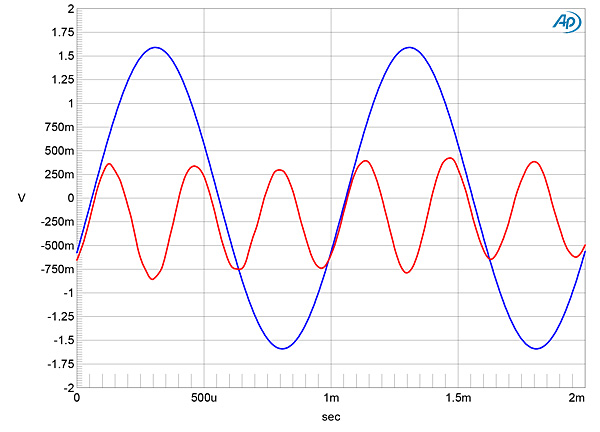
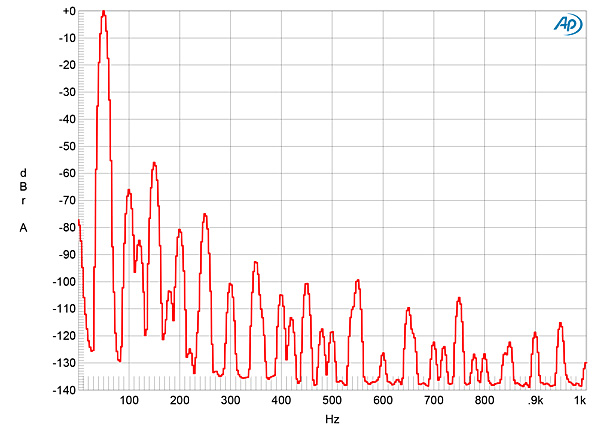
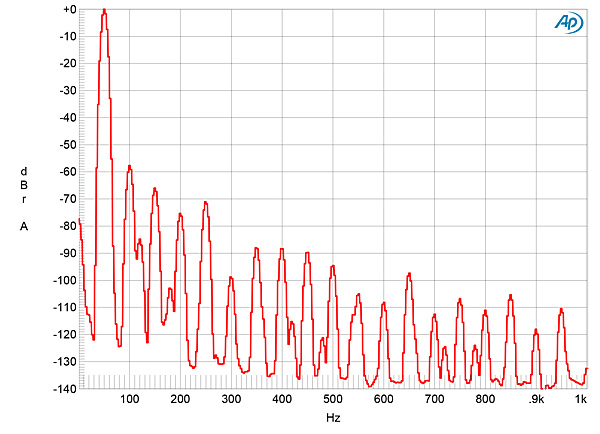
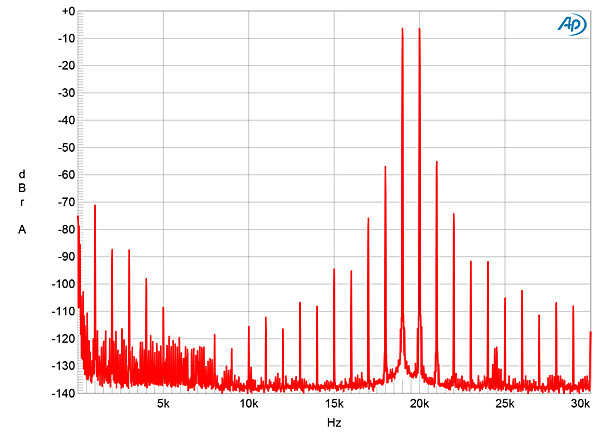
Fig.1 Doshi Monoblock V3.0, frequency response at 2.83V into: simulated loudspeaker load (gray), 8 ohms (blue), 4 ohms (magenta), 2 ohms (red) (1dB/vertical div.).
Fig.2 Doshi Monoblock V3.0, small-signal, 10kHz squarewave into 8 ohms.
Fig.3 Doshi Monoblock V3.0, small-signal, 1kHz squarewave into 8 ohms.
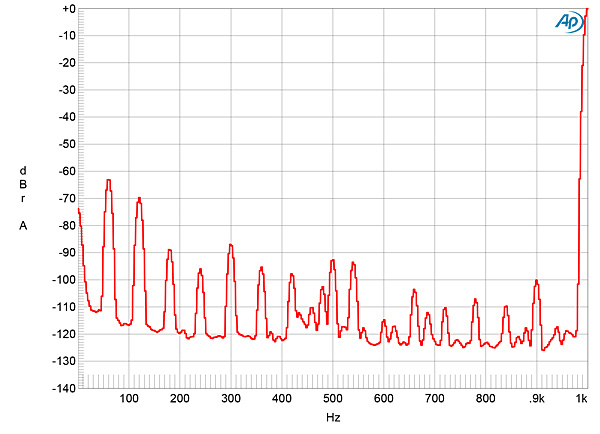
The unweighted, wideband signal/noise ratio, taken with the single-ended inputs shorted to ground, was 64dB, ref. 1W into 8 ohms. This ratio was not affected by the rear-panel ground-lift switch, but improved to 84.4dB with an A-weighting filter in circuit. Spectral analysis of the low-frequency noise floor (fig.4) revealed AC-supply–related harmonics at 60Hz and its harmonics, which correlated with the 64dB unweighted S/N ratio.
Fig.4 Doshi Monoblock V3.0, spectrum of 1kHz sinewave, DC–1kHz, at 1W into 8 ohms (left channel blue, right red; linear frequency scale).
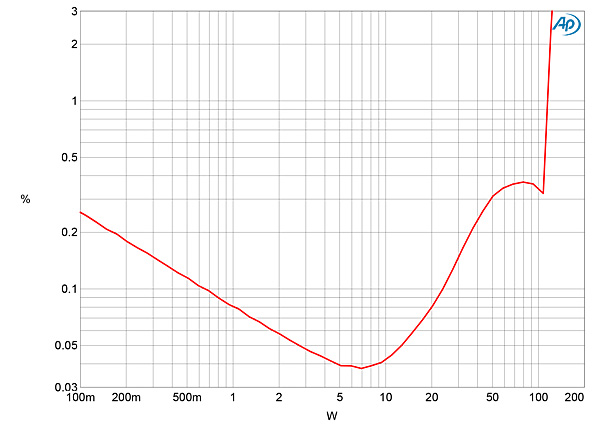
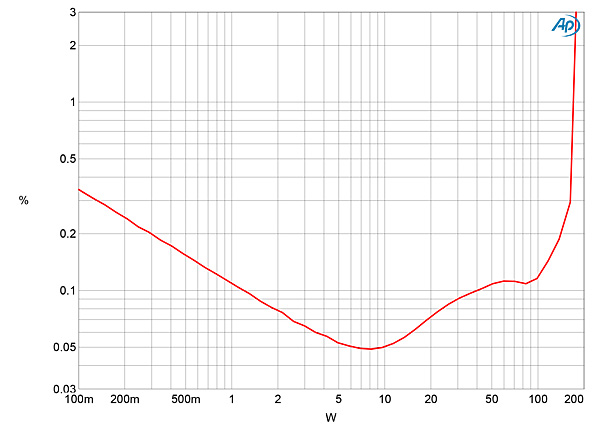
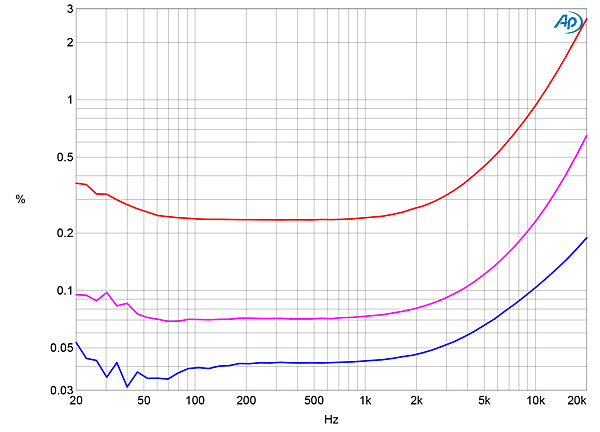
We define clipping as being when the THD+noise in the output reaches 1%. My measurements of the Doshi's clipping power were 110W into 8 ohms (20.4dBW, fig.5) and 170W into 4 ohms (19.3dBW, fig.6), the latter slightly higher than the specified 160W (19dBW). Because the traces in these graphs indicate that the THD+N percentage is dominated by noise below 8W or so, I examined how the Doshi's THD+N varied with frequency at 8.95V (equivalent to 10W into 8 ohms, 20W into 4 ohms, and 40W into 2 ohms), to be sure I was looking at actual distortion. The THD+N was low into 8 and 4 ohms (fig.7, blue and magenta traces), but rose into 2 ohms (red) and in the top two audio octaves. The distortion doesn't rise at low frequencies—a tribute to the output transformer's core being sufficiently massive not to become saturated.
Fig.5 Doshi Monoblock V3.0, distortion (%) vs 1kHz continuous output power into 8 ohms.
Fig.6 Doshi Monoblock V3.0, distortion (%) vs 1kHz continuous output power into 4 ohms.
Fig.7 Doshi Monoblock V3.0, THD+N (%) vs frequency at 8.95V into: 8 ohms (blue), 4 ohms (magenta), 2 ohms (red).
Fig.8 Doshi Monoblock V3.0, 1kHz waveform at 10W into 8 ohms, 0.043% THD+N (blue); distortion and noise waveform with fundamental notched out (red, not to scale).
Fig.9 Doshi Monoblock V3.0, spectrum of 50Hz sinewave, DC–1kHz, at 33W into 8 ohms (linear frequency scale).
Fig.10 Doshi Monoblock V3.0, spectrum of 50Hz sinewave, DC–1kHz, at 67W into 4 ohms (linear frequency scale).
Fig.11 Doshi Monoblock V3.0, HF intermodulation spectrum, DC–30kHz, 19+20kHz at 67W peak into 4 ohms (linear frequency scale).
The Doshi Monoblock V3.0 power amplifier's measured performance indicates conservative audio engineering. And I continue to be impressed by the quality of its output transformer.—John Atkinson