Sidebar 4: Measurements
I performed the measurements on a different sample of the DeVore Fidelity O/baby from those that had been auditioned by Ken Micallef. It had the serial number B0510001. I used DRA Labs' MLSSA system with a calibrated DPA 4006 microphone to measure the speaker's behavior in the farfield and an Earthworks QTC-40 mike for the nearfield responses.
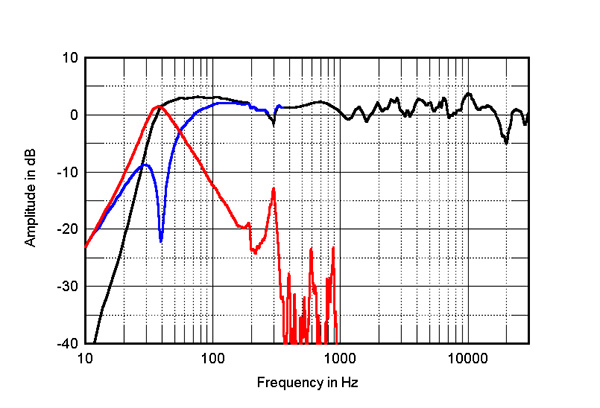
While the manual offers comprehensive advice on setting up the O/baby speakers, it doesn't mention the optimal listening axis. As the tweeter is 20" above the bottom of the front baffle and the matching stands are 12" high, that places the tweeter axis 32" from the floor. This is slightly below what we have found to be the average ear height of a seated listener. While I performed a complete set of farfield measurements on the tweeter axis, I also looked at the speaker's behavior 5° above that axis. The black trace above 350Hz in fig.3 shows the DeVore's farfield output averaged across a 30° horizontal window centered on the tweeter axis. There is a slight excess of energy in the presence region, but the small response peaks are balanced by small dips. The response 5° above the tweeter axis was very similar.
With its high sensitivity and easy-to-drive impedance, the DeVore O/baby will work well with low-powered amplifiers. Its measured behavior suggests that careful setup will be necessary to optimize the treble balance.—John Atkinson
Footnote 1: EPDR is the resistive load that gives rise to the same peak dissipation in an amplifier's output devices as the loudspeaker. See "Audio Power Amplifiers for Loudspeaker Loads," JAES, Vol.42 No.9, September 1994, and stereophile.com/reference/707heavy/index.html.
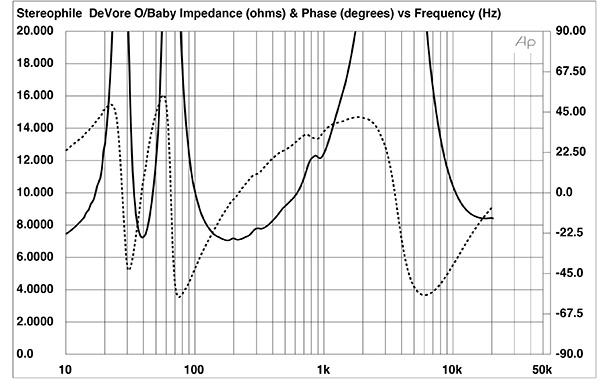
Fig.1 DeVore O/baby, electrical impedance (solid) and phase (dashed) (2 ohms/vertical div.).
DeVore specifies the O/baby's impedance as 8 ohms, with a minimum value of 6.75 ohms at 200Hz. Measured with Dayton Audio's DATS V2 system, the speaker's impedance magnitude (fig.1, solid trace) lies above 10 ohms for almost the entire audioband, dropping below 8 ohms only in the lower midrange and, briefly, in the midbass region. The minimum value was 7.1 ohms at 210Hz. The electrical phase angle (fig.1, dotted trace) is occasionally high, which will have an effect on the equivalent peak dissipation resistance, or EPDR (footnote 1). This lies below 4 ohms from 43–50Hz, from 85–148Hz, and from 8–14kHz. The minimum EPDR is 3.6 ohms at 46Hz and 3.33 ohms at 108Hz. Despite its high average impedance, which is close to 16 ohms, the O/baby will probably work best with a tube amplifier's 4 ohm output transformer tap.
The DeVore O/baby's specified sensitivity is a high 90dB/W/m. My B-weighted estimate was lower, at 87.5dB(B)/2.83V/m. However, as this voltage is equivalent to 0.5W into 16 ohms, the SPL at 1m with 1W will be close to the specified figure.
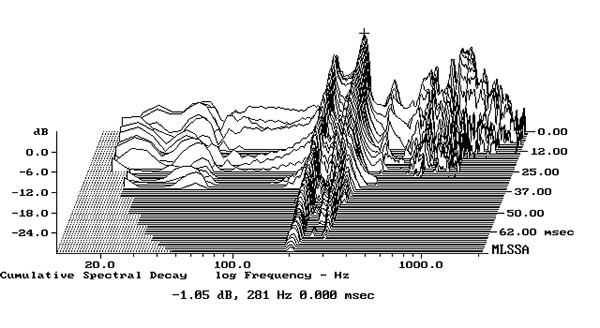
Fig.2 DeVore O/baby, cumulative spectral-decay plot calculated from output of accelerometer fastened to the center of the side panel (measurement bandwidth, 2kHz).
There are some discontinuities in the midrange in the impedance traces, which imply the presence of cabinet resonances of various kinds. The enclosure's panels did seem lively when I rapped them with my knuckles, the back panel emitting a lower-pitched "bonk" than the sides and top. Using a plastic-tape accelerometer, I found high-Q modes on all the panels at 199Hz, 281Hz, 406Hz, and 1203Hz. The mode at 281Hz was the strongest on the sidewalls (fig.2), that at 199Hz was strongest on the back panel, and that at 1203Hz strongest on the top of the enclosure. The latter mode's high frequency, coupled with the relatively small radiating area, will work against audibility. However, as the lower-frequency modes are in regions where music can have high energy, it is possible that they will affect sound quality.
Fig.3 DeVore O/baby, anechoic response on tweeter axis at 50", averaged across 30° horizontal window and corrected for microphone response, with the nearfield woofer (blue) and port (red) responses, and their complex sum (black), respectively plotted below 350Hz, 900Hz, and 350Hz.
The saddle centered on 39Hz, lying between two low-frequency peaks in the impedance magnitude trace, suggests that this is the tuning frequency of the reflex port at the bottom of the back panel. Measured in the nearfield, the woofer's response (fig.3, blue trace) has the expected minimum-motion notch at that frequency, which is when the back pressure from the port resonance holds the diaphragm stationary. The port's nearfield response (red trace) peaks between 25Hz and 60Hz in textbook fashion, but while its upper-frequency rolloff is initially clean, a strong resonant mode is present at 300Hz, with lower-level modes between 500Hz and 900Hz. The audible consequences of this behavior will be ameliorated by the fact that the port fires to the speaker's rear, but the mode at 300Hz results in a discontinuity in the woofer's output.
This mode also affects the complex sum of the woofer and port outputs (fig.3, black trace below 350Hz). The small excess in the bass will be due to the nearfield measurement technique, which assumes that the drive units are placed on a baffle that extends to infinity in both vertical and horizontal planes. The O/baby offers excellent low-frequency extension for a relatively small speaker.
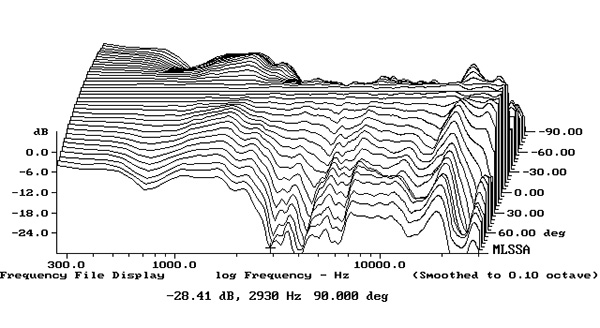
Fig.4 DeVore O/baby, lateral response family at 50", normalized to response on tweeter axis, from back to front: differences in response 90–5° off axis, reference response, differences in response 5–90° off axis.
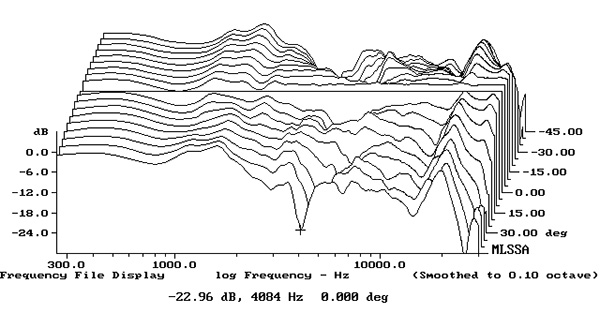
Fig.5 DeVore O/baby, vertical response family at 50", normalized to response on tweeter axis, from back to front: differences in response 45–5° above axis, reference response, differences in response 5–45° below axis.
The O/baby's horizontal dispersion (fig.4) reveals that the output in the presence region rolls off to each side of the tweeter axis, which will tend to even out the perceived balance in this region. However, the exact amount of toe-in will be crucial in ensuring that the DeVore speaker doesn't sound overpolite. Other than that, the dispersion is relatively well-controlled up to the top octave, where the tweeter's radiation pattern narrows due to the wide baffle. In the vertical plane (fig.5), the tweeter-axis response is maintained 5° above the tweeter axis, but large suckouts develop below the tweeter axis and more than 10° above that axis.
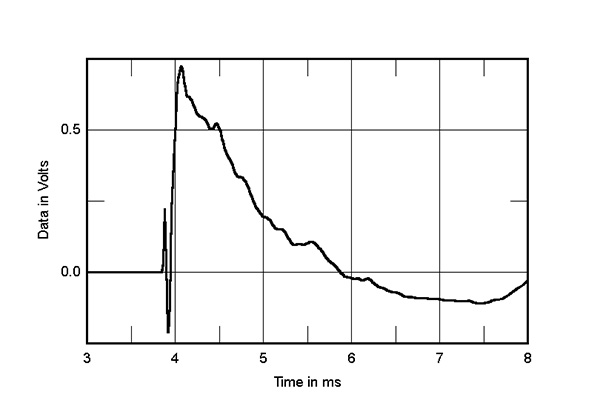
Fig.6 DeVore O/baby, step response on tweeter axis at 50" (5ms time window, 30kHz bandwidth).
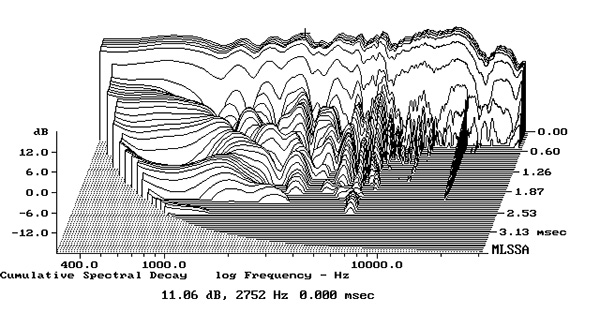
Fig.7 DeVore O/baby, cumulative spectral-decay plot on tweeter axis at 50" (0.15ms risetime).
In the time domain, the O/baby's step response (fig.6) indicates that the tweeter and woofer are both connected in positive acoustic polarity. The tweeter's output arrives first at the microphone, and the decay of its step blends smoothly with the start of the woofer's step, which implies an optimal crossover implementation. The decay of the woofer's step is overlaid with a small amount of ringing, which correlates with some low-level ridges of delayed energy in the DeVore's cumulative spectral-decay (waterfall) plot (fig.7; ignore the apparent low-level ridge of delayed energy just below 16kHz, which is due to interference from the MLSSA host PC's video circuitry.) However, the initial decay is commendably clean, especially in the region covered by the tweeter.
Footnote 1: EPDR is the resistive load that gives rise to the same peak dissipation in an amplifier's output devices as the loudspeaker. See "Audio Power Amplifiers for Loudspeaker Loads," JAES, Vol.42 No.9, September 1994, and stereophile.com/reference/707heavy/index.html.