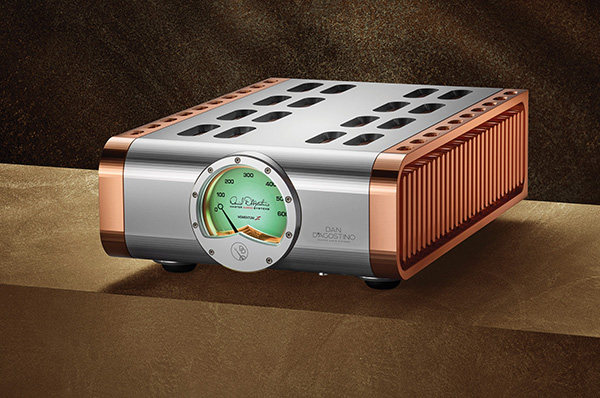
Meet the Momentum Z mono amplifier. Other than this one, all photos in this story are by Jason Victor Serinus.
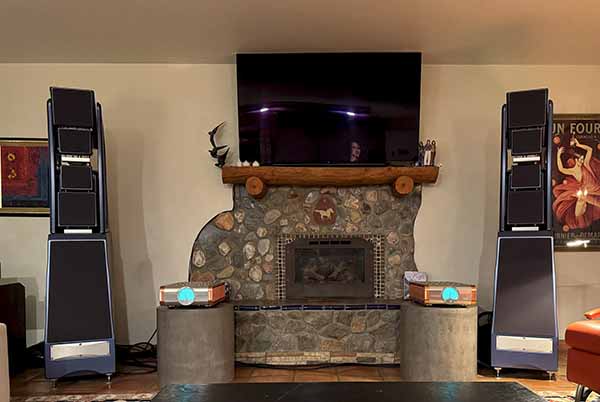
On January 12, 2026, Dan D'Agostino Master Systems (DDMAS) welcomed approximately 52 international audio dealers and distributors, along with four members of the audio press, to the unveiling of the new Momentum Z mono amplifier ($125,000/pair) at the Dan D'Agostino factory in Cave Creek, Arizona. This 15th Anniversary event included: a fabulous welcome dinner in the finest and most sophisticated "steakhouse" I've ever visited (not that I've visited many); an extended product introduction; a factory tour; a barbecue dinner at the home of co-founders Dan (Chief Design Officer) and Petra (Chief Operating Officer) D'Agostino; and a freewheeling, everyone's-the-DJ listening session in the D'Agostino living room that revealed how hard you can drive the Momentum Z.
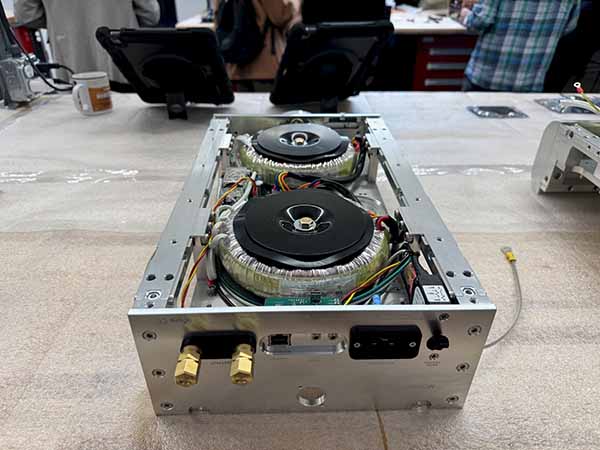
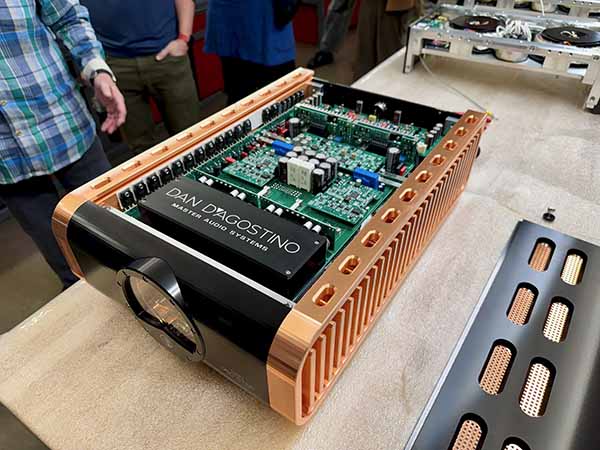 In a press release, the company explained that the Momentum Z, which replaces the Momentum M400 MxV, weighs 100lb, has dual 1200VA linear toroidal transformers, and is specified to output 500W in 8 ohms, 1000W into 4 ohms, and a whopping 2000W into 2 ohms. The specified frequency response is –1dB over a wide 1Hz–200kHz range and 0.1dB over the audioband.
 The Momentum Z is the first Dan D'Agostino amplifier to feature JFETs in the input stage. "At the very front end of an amplifier, where the delicate musical signal first enters the circuit, the choice of device is critical"—so reads the press release. "JFETs excel in this role, offering ultra-high input impedance and exceptionally low noise, which together preserve every nuance of the source signal."
 That cascoded JFET input circuit, though, has a naturally low input impedance; it's specified as 300 ohms. Is that a bug or a feature? It's a feature! It matches up well with recent and upgraded D'Agostino preamplifiers. So the company added an option for use with more traditional amplifiers. Users can flip a switch to select either 1M ohm (input intended for most preamplifiers and direct-connected D/A processors) or the low-Z input for best sound with those recent D'Agostino preamps. The output impedance is specified at a low 0.05 ohm, 20Hz to 20kHz.
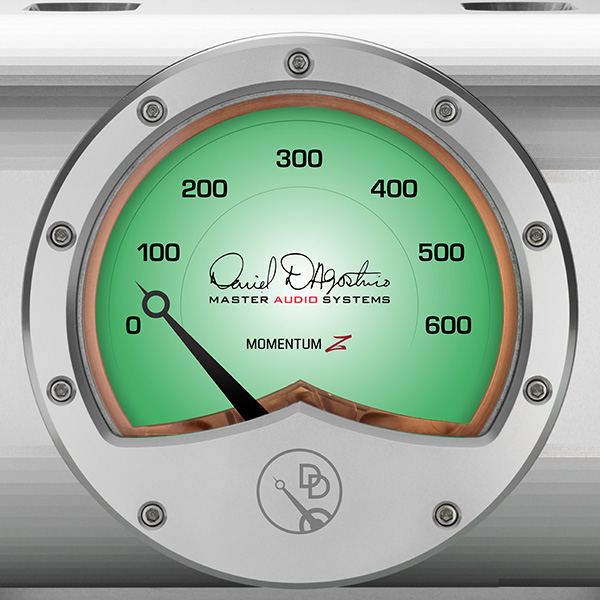 The Momentum Z's "Dual Domain Meter Display" retains what the company describes as "the Momentum's classic Swiss watch appearance but with a distinctly modern twist." While its power meter wand operates in the analog domain, it appears on a 3.5" LCD that serves as both a power meter and message display.
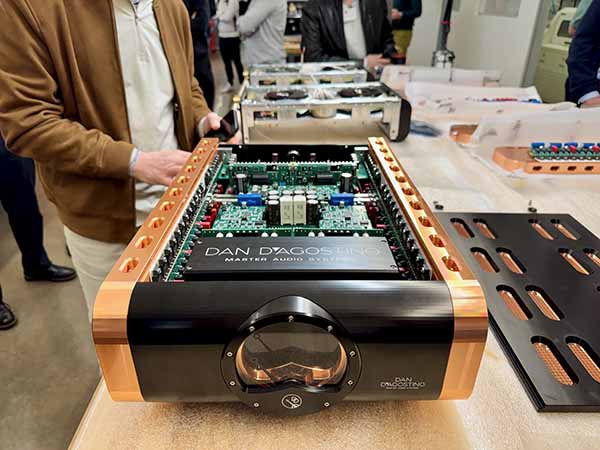 "The regulator is also smart. When you turn the amplifier on, three LEDs light up in sequence. The regulator senses how much current and voltage the amplifier has. It also senses bias and temperature. If you short the output, it can shut off the amplifier immediately—way faster than any protection device—before you hear any sound. The beauty of it is that it's not in the audio chain."
Dan said that at low volume levels, the Momentum Z will sound as though it's playing louder because you can hear all the low bass notes, highs, width, space, and impact that the amp can produce at higher volume.
"The regulator is also smart. When you turn the amplifier on, three LEDs light up in sequence. The regulator senses how much current and voltage the amplifier has. It also senses bias and temperature. If you short the output, it can shut off the amplifier immediately—way faster than any protection device—before you hear any sound. The beauty of it is that it's not in the audio chain."
Dan said that at low volume levels, the Momentum Z will sound as though it's playing louder because you can hear all the low bass notes, highs, width, space, and impact that the amp can produce at higher volume.
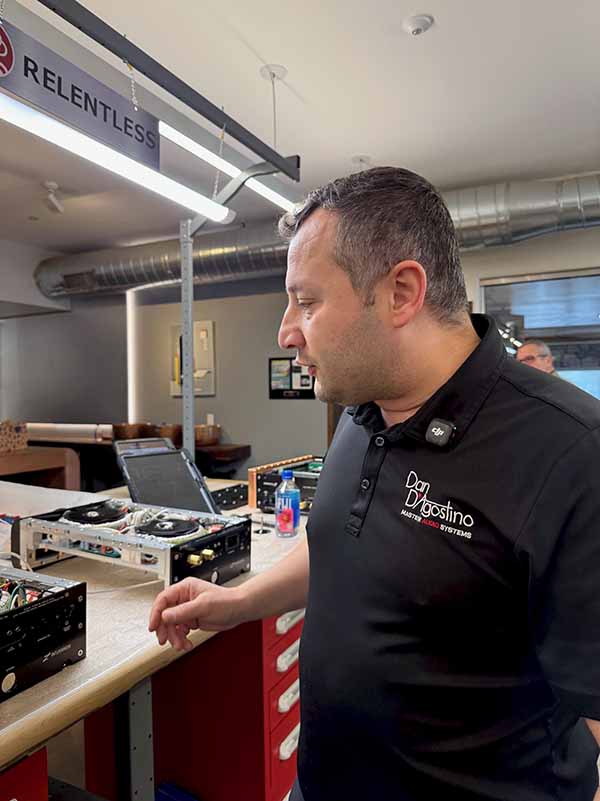 Later in the afternoon, Burhan Coskun, Vice President of Engineering (seen above), packed additional information into a 12-minute talk. "Using two transformers creates a very low noise floor, ultra-low distortion, and more power," he said. "We separate the internals into two 'floors,' with 99.9% cadmium-plated copper between them to isolate the floors from magnetic fields. The cadmium plating supplies additional cooling and aids fast communication."
The Momentum Z is available in either silver or black. Measuring 13.5" W x 5" H x 20.5" D, it is 1 wider, 1 inch shallower and ¼ inch shorter than the M400 MxV. Gain is 27dB, maximum output voltage is 190 V peak-to-peak, and peak output current is 60A peak-to-peak. Power consumption is 17W at standby, 35W at idle, and 3200W at maximum. output
Later in the afternoon, Burhan Coskun, Vice President of Engineering (seen above), packed additional information into a 12-minute talk. "Using two transformers creates a very low noise floor, ultra-low distortion, and more power," he said. "We separate the internals into two 'floors,' with 99.9% cadmium-plated copper between them to isolate the floors from magnetic fields. The cadmium plating supplies additional cooling and aids fast communication."
The Momentum Z is available in either silver or black. Measuring 13.5" W x 5" H x 20.5" D, it is 1 wider, 1 inch shallower and ¼ inch shorter than the M400 MxV. Gain is 27dB, maximum output voltage is 190 V peak-to-peak, and peak output current is 60A peak-to-peak. Power consumption is 17W at standby, 35W at idle, and 3200W at maximum. output