The Minus K suspension meant I could pretty much pound on both the HRS platform and the Helix One Mk2's base and hear nothing through the speakers. It's a really effective isolation device! A stethoscope placed anywhere on the 'table revealed zero motor and/or bearing noise.
Explosive, visceral sonics
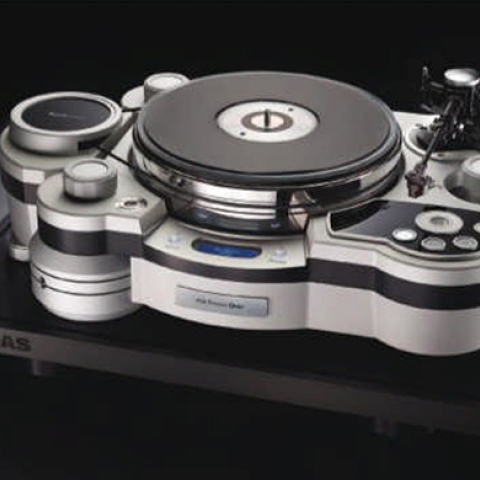
Not surprisingly, the Döhmann Helix One Mk2's sound was more similar to the Continuum Caliburn's than it was to the TechDAS Air Force One Premium's; the TechDAS sounded smoother and, you might say, more elegant, refined, and relaxed—probably something to do with the air-bearing platter, though of course that's just speculation. That's not to say that the Air Force One was overly smooth, or that it softened transients—or that the Helix One Mk2 2 or the Continuum produce harsh transients or overly etched edge definition, or that the latter two were anything but top-to-bottom well-refined, suave, and unflappable sounding. I love how much some people hate far-flung metaphors, so here's one: The Air Force One Premium's sound is an immersion blender soup. The Caliburn's and Helix One Mk2's is more food-processor finely chopped. One is smoother and more velvety while the other is more chunky and textured. Both taste great!
In the original Helix One review, I compared a track from the double-45rpm edition of The Ray Brown Trio's album Soular Energy, originally issued in 1985 by Concord Records (Analogue Productions APJ 268-45). So I did it again this time.
With the SAT armboard on the Helix One Mk2, I was able to easily switch the arm between the Mk2 and the Caliburn, making the turntable the only variable in the chain. I digitized at 24/96 resolution the track "Teach Me Tonight," in which the group plays the melody with an insistent, hard-hitting, heavily percussive style.
 While the two recordings sounded more similar than different, especially timbrally, Gene Harris's piano sustain was somewhat more generous through the Continuum, while the Helix One Mk2's attack was a bit faster and tighter. The same was true of Brown's bass, which via the Continuum had slightly more sustain and "float" following a somewhat softer, suppler attack.
The $150,000 turntable produced somewhat more bass extension and power at the very bottom, as well as slightly more metallic shimmer and sustain on the cymbals. The Helix One Mk2's cymbal attack was a bit tighter and crisper, followed by weaker sustain. Both turntables produced satisfying decay into blackness—one area where I think these designs beat the air-bearing ones.
Both files produced dynamic slam and control to spare, and both snapped back to black between notes to produce almost alarmingly present, three-dimensional, intensely layered images floating in space. In comparison to these two 'tables, the Air Force One's refined nature produced a somewhat more polite, slightly laid back, though still extremely well-organized spatial picture.
Setting aside comparisons, the Helix One Mk2's presentation of Mobile Fidelity's double 45rpm Ultradisc One-Step pressing of Thelonious Monk's Monk's Dream (UD1S 2-011) startled throughout, but especially as he wrapped up the solo tune "Body and Soul" with a surprise upper-register, single- chord attack followed by a flourish of gentle note-tickling. (There's probably a musical term for that that I don't know.) It all rang timbrally, texturally, and dynamically true, without extraneous artifacts.
This turntable exudes complete authority and control, and never leaves you feeling that there's more to be extracted from the grooves (especially with the SAT onboard!) or that anything is being withheld dynamically, spatially, or in terms of detail resolution. It put Monk's piano right in the room.
Unfortunately, the opening tune on my sample of this record, which turned out to be wavy/warped, proved unplayable on the Döhmann 'table, but playable on the vacuum hold-down Air Force One and Caliburn. In fact, I didn't even know the LP was warped until I tried playing it on the Helix One Mk2. I hope Döhmann fulfills the vacuum hold-down promise sooner rather than later. It's a feature I refuse to be without.
For a sample of what this turntable can do in terms of deciphering complex passages where a lot's packed into a narrow frequency range, try Angel Olsen's string-and-reverb– drenched All Mirrors (Jagjaguwar JAG344). She's not the first artist to drown her sorrows in strings buried in reverb (Beck did it well on Sea Changes), but on this album, Olsen, her producers, and engineers nail the genre and create pleasing misery you can happily wallow in. The double-LP set, cut at Nashville's Sterling Sound by Joe Nino-Hernes—one of crop of up-and-coming lacquer-cutting engineers—produces musical and emotional sensations that the harder-edged, less-atmospheric, flattened FLAC 24/44.1 streamed file only hints at.
While the two recordings sounded more similar than different, especially timbrally, Gene Harris's piano sustain was somewhat more generous through the Continuum, while the Helix One Mk2's attack was a bit faster and tighter. The same was true of Brown's bass, which via the Continuum had slightly more sustain and "float" following a somewhat softer, suppler attack.
The $150,000 turntable produced somewhat more bass extension and power at the very bottom, as well as slightly more metallic shimmer and sustain on the cymbals. The Helix One Mk2's cymbal attack was a bit tighter and crisper, followed by weaker sustain. Both turntables produced satisfying decay into blackness—one area where I think these designs beat the air-bearing ones.
Both files produced dynamic slam and control to spare, and both snapped back to black between notes to produce almost alarmingly present, three-dimensional, intensely layered images floating in space. In comparison to these two 'tables, the Air Force One's refined nature produced a somewhat more polite, slightly laid back, though still extremely well-organized spatial picture.
Setting aside comparisons, the Helix One Mk2's presentation of Mobile Fidelity's double 45rpm Ultradisc One-Step pressing of Thelonious Monk's Monk's Dream (UD1S 2-011) startled throughout, but especially as he wrapped up the solo tune "Body and Soul" with a surprise upper-register, single- chord attack followed by a flourish of gentle note-tickling. (There's probably a musical term for that that I don't know.) It all rang timbrally, texturally, and dynamically true, without extraneous artifacts.
This turntable exudes complete authority and control, and never leaves you feeling that there's more to be extracted from the grooves (especially with the SAT onboard!) or that anything is being withheld dynamically, spatially, or in terms of detail resolution. It put Monk's piano right in the room.
Unfortunately, the opening tune on my sample of this record, which turned out to be wavy/warped, proved unplayable on the Döhmann 'table, but playable on the vacuum hold-down Air Force One and Caliburn. In fact, I didn't even know the LP was warped until I tried playing it on the Helix One Mk2. I hope Döhmann fulfills the vacuum hold-down promise sooner rather than later. It's a feature I refuse to be without.
For a sample of what this turntable can do in terms of deciphering complex passages where a lot's packed into a narrow frequency range, try Angel Olsen's string-and-reverb– drenched All Mirrors (Jagjaguwar JAG344). She's not the first artist to drown her sorrows in strings buried in reverb (Beck did it well on Sea Changes), but on this album, Olsen, her producers, and engineers nail the genre and create pleasing misery you can happily wallow in. The double-LP set, cut at Nashville's Sterling Sound by Joe Nino-Hernes—one of crop of up-and-coming lacquer-cutting engineers—produces musical and emotional sensations that the harder-edged, less-atmospheric, flattened FLAC 24/44.1 streamed file only hints at.
 Why does vinyl produce that from a digital recording? I don't know. I'm just listening to the strings floating across the stage on a cushion of reverb-drenched air, her voice portrayed boldly and three-dimensionally out front, center stage, in fine, convincing focus, supported by a well-defined bottom end foundation. In the digital stream, this all turns to cardboardy flatness. Added distortion? Like I care!
Conclusion
Why does vinyl produce that from a digital recording? I don't know. I'm just listening to the strings floating across the stage on a cushion of reverb-drenched air, her voice portrayed boldly and three-dimensionally out front, center stage, in fine, convincing focus, supported by a well-defined bottom end foundation. In the digital stream, this all turns to cardboardy flatness. Added distortion? Like I care!
Conclusion
As with the Caliburn concept, Döhmann's newer design attempts to isolate the outside world while draining away internal vibrations that can interfere at the stylus/vinyl interface. Consequently, it gets those vibration measurements right. The Caliburn's $150,000 heroics include (among other features) an 80lb-plus "nested" cast–magnesium-alloy platter and cast-magnesium chassis (said to have been chosen because magnesium has natural damping properties), plus an American-made cogless motor and sophisticated computer-driven motion-controller system. The entire assemblage originally sat on a crazy magnetic repulsion stand—that is, until the designer discovered Minus K, which produced better results in a much more user- and designer-friendly, compact, and self-contained "off the shelf" package.
The sonic result of all of this was something very special. It produced liberated, explosive, out-of-the-box, nonmechanical sound that was neither overdamped nor out of control.
When I first auditioned it, the Caliburn was startlingly better than any turntable I'd ever heard, and it's still up there with the best. It's not leaving the premises.
Mr. Döhmann's goals for the new 'table were the same as for the old, though he wanted something more practical and less difficult and costly to manufacture.
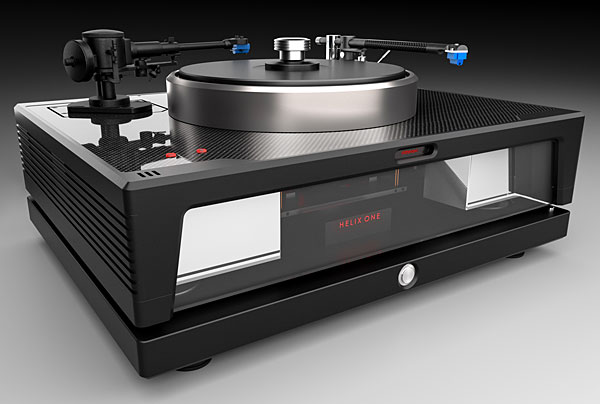
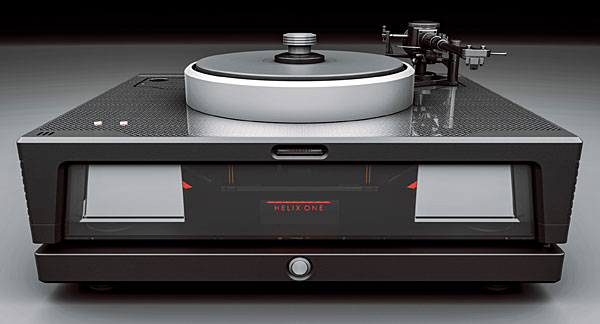
With the Helix One Mk2, Döhmann did for an entire turntable design what the above-mentioned Minus K enhancement did for the Caliburn, replacing a massive, difficult-to-cast, carefully configured chassis with an easier-to-construct, lighter-weight "plate" system built within a massive frame, which accomplished the same vibration dissipation without overdamping.
The Mk2 iteration of the Döhmann Helix One turntable produced only one surprise: slightly worse speed measurements; otherwise, the new PowerBase is a useful ergonomic upgrade, while the carbon fiber top looks better. The armboard is improved. User-friendly pushbutton speed control is a big plus, as is the easier setup produced by whatever was done to eliminate the original 'table's need for brass balancing weights.
The other major story here is the business side of things—something to which reviews of costly audio gear should pay more attention: Like the 'table itself, Döhmann Audio has been reorganized around a central core, with single-point assembly, testing, and distribution. Hopefully, stability and good vibrations will follow.
If $50k is your price point, there are a few really great 'tables out there. The Döhmann Helix One Mk2 is up there with the best.
Not surprisingly, the Döhmann Helix One Mk2's sound was more similar to the Continuum Caliburn's than it was to the TechDAS Air Force One Premium's; the TechDAS sounded smoother and, you might say, more elegant, refined, and relaxed—probably something to do with the air-bearing platter, though of course that's just speculation. That's not to say that the Air Force One was overly smooth, or that it softened transients—or that the Helix One Mk2 2 or the Continuum produce harsh transients or overly etched edge definition, or that the latter two were anything but top-to-bottom well-refined, suave, and unflappable sounding. I love how much some people hate far-flung metaphors, so here's one: The Air Force One Premium's sound is an immersion blender soup. The Caliburn's and Helix One Mk2's is more food-processor finely chopped. One is smoother and more velvety while the other is more chunky and textured. Both taste great!
While the two recordings sounded more similar than different, especially timbrally, Gene Harris's piano sustain was somewhat more generous through the Continuum, while the Helix One Mk2's attack was a bit faster and tighter. The same was true of Brown's bass, which via the Continuum had slightly more sustain and "float" following a somewhat softer, suppler attack.
Why does vinyl produce that from a digital recording? I don't know. I'm just listening to the strings floating across the stage on a cushion of reverb-drenched air, her voice portrayed boldly and three-dimensionally out front, center stage, in fine, convincing focus, supported by a well-defined bottom end foundation. In the digital stream, this all turns to cardboardy flatness. Added distortion? Like I care!
ConclusionAs with the Caliburn concept, Döhmann's newer design attempts to isolate the outside world while draining away internal vibrations that can interfere at the stylus/vinyl interface. Consequently, it gets those vibration measurements right. The Caliburn's $150,000 heroics include (among other features) an 80lb-plus "nested" cast–magnesium-alloy platter and cast-magnesium chassis (said to have been chosen because magnesium has natural damping properties), plus an American-made cogless motor and sophisticated computer-driven motion-controller system. The entire assemblage originally sat on a crazy magnetic repulsion stand—that is, until the designer discovered Minus K, which produced better results in a much more user- and designer-friendly, compact, and self-contained "off the shelf" package.