The Mk2 features an internal "mechanical crossover" system that addresses frequencies above 100Hz by providing a smooth mechanical pathway for higher frequency vibrations to travel away from critical areas and dissipate. The motor, platter bearing, and armboard are on separate, interlocking plates (think of leaves on a tree, or think of the bearing as the sun, with the motor and armboards as "planets"), precisely mounted within the turntable in carefully optimized locations away from the center to further isolate the stylus/record interface from unwanted, internally produced vibrations (footnote 3).
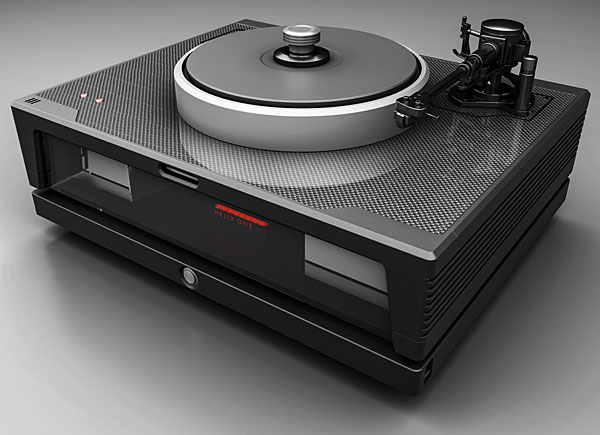
The original Helix One also incorporated most of these design details, but some of them—the plates, for example—are said to have been improved. The Mk2 differs in a few other significant ways, beginning with a higher-performance power supply, which is no longer located in an outboard, amplifier-sized chassis but rather housed in a sleek new "PowerBase," upon which the massive turntable chassis rests. Newly developed RF-absorption technology is said to have been incorporated into the PowerBase to prevent noise and electronic interference from entering the signal path.
The PowerBase's large, center-mounted pushbutton switch is for a future, retrofittable vacuum hold-down feature that was promised at the time of the original Helix One review. I'm not sure what's holding it up, but if you buy a Helix One Mk2 now, you probably should not expect the vacuum hold-down update to follow quickly (though if it does, all the better).
The new 'table retains a somewhat simplified version of the unique "floating" armboard technology originally found in Mark Döhmann's earlier designs, which physically isolates the board while maintaining (it is claimed) positional stability. The main armboard is of a new energy-diffusing composite material developed by an American military supplier and used for bulletproofing. One such board comes standard with the Mk2; the second armboard is made of aluminum. Both positions can accommodate arms up to 12" in length.
The motor is an all-new, custom-designed, Swiss-manufactured, high-torque design, controlled by a custom, software-based, closed-loop servo control system located in the PowerBase, which monitors and calibrates speed more than 130,000 times per second. The original Helix One's motor occasionally developed reliability and noise issues. Mr. Döhmann ended up traveling to customers' homes to replace them.
 Also new is a rear-panel–mounted pushbutton Up/Down speed-adjustment feature. The original turntable's speed was factory-set, though adjustable via computer, remotely over the Internet. The Mk2's motor can also be adjusted and diagnosed over the Internet.
The platter-and-bearing system appear identical to the original's, a 30lb triple-sandwich platter of a nonferrous alloy layered with an "engineered thermoplastic" that's balanced and shaped to accommodate lead-in groove and record label areas, topped with a permanent, thin damping mat. The spindle is of brass, while the bearing features a single ceramic ball and a thrust pad located at the squat bearing's bottom, which puts the point of rotation smartly centered within the platter.
Platter drive is via a dual-groove machined-aluminum pulley and platter, over which fits a pair of dissimilar-diameter O-rings, each with a different degree of hardness so that each "beats" differently, with the motor-control system doing the final smoothing.
Other new features include revised electronics designed to automatically turn off when not in use, a new lighting-control system, and a stabilizer designed to minimize Minus K suspension bounce when flipping over a record. Gone are the original Helix One's brass balancing weights; they're no longer necessary, thanks to a suspension design change.
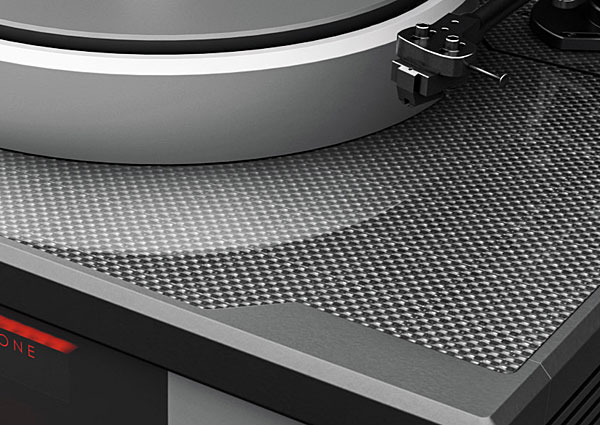
The Helix One Mk2 is a big turntable: 23.6" × 18.9" × 9.8". It looks and "handles" like no other turntable, and its design has almost nothing to do with the hypothetical "basic" turntable described in my opening paragraph. Not everyone I know likes the look, but I surely do.
Supplied in a smooth, satiny-black anodized-aluminum finish, the standard 'table costs $49,000, or $55,600 in plated nickel and titanium, the coating done by a company that plates military parts for fighter jets. The two versions are said to be sonically identical.
Döhmann can supply armboards cut for just about any tonearm and recommends, for starters, the Thrax-manufactured Schröder CB arm, which costs $5500 for the 9" version and $6000 for the 11" one. Döhmann supplied me with a 9" CB arm with a carbon-fiber armtube, which I used for part of the review. I also used my SAT CF1-09, for which I borrowed an armboard.
Also new is a rear-panel–mounted pushbutton Up/Down speed-adjustment feature. The original turntable's speed was factory-set, though adjustable via computer, remotely over the Internet. The Mk2's motor can also be adjusted and diagnosed over the Internet.
The platter-and-bearing system appear identical to the original's, a 30lb triple-sandwich platter of a nonferrous alloy layered with an "engineered thermoplastic" that's balanced and shaped to accommodate lead-in groove and record label areas, topped with a permanent, thin damping mat. The spindle is of brass, while the bearing features a single ceramic ball and a thrust pad located at the squat bearing's bottom, which puts the point of rotation smartly centered within the platter.
Platter drive is via a dual-groove machined-aluminum pulley and platter, over which fits a pair of dissimilar-diameter O-rings, each with a different degree of hardness so that each "beats" differently, with the motor-control system doing the final smoothing.
Other new features include revised electronics designed to automatically turn off when not in use, a new lighting-control system, and a stabilizer designed to minimize Minus K suspension bounce when flipping over a record. Gone are the original Helix One's brass balancing weights; they're no longer necessary, thanks to a suspension design change.
The Helix One Mk2 is a big turntable: 23.6" × 18.9" × 9.8". It looks and "handles" like no other turntable, and its design has almost nothing to do with the hypothetical "basic" turntable described in my opening paragraph. Not everyone I know likes the look, but I surely do.
Supplied in a smooth, satiny-black anodized-aluminum finish, the standard 'table costs $49,000, or $55,600 in plated nickel and titanium, the coating done by a company that plates military parts for fighter jets. The two versions are said to be sonically identical.
Döhmann can supply armboards cut for just about any tonearm and recommends, for starters, the Thrax-manufactured Schröder CB arm, which costs $5500 for the 9" version and $6000 for the 11" one. Döhmann supplied me with a 9" CB arm with a carbon-fiber armtube, which I used for part of the review. I also used my SAT CF1-09, for which I borrowed an armboard.
 This is not a Schröder arm review, but I'm well familiar with the CB, having used one on the original Helix One as well as for my OMA plinth/Technics SP10R review in the February 2019 Stereophile. Though somewhat spartan—there's no arm rest, which designer Frank Schröder claims negatively affects sonics—it offers complete adjustability and performs well above its reasonable price point. It's a really fine sounding, sonically "tunable" arm.
Setup and use
This is not a Schröder arm review, but I'm well familiar with the CB, having used one on the original Helix One as well as for my OMA plinth/Technics SP10R review in the February 2019 Stereophile. Though somewhat spartan—there's no arm rest, which designer Frank Schröder claims negatively affects sonics—it offers complete adjustability and performs well above its reasonable price point. It's a really fine sounding, sonically "tunable" arm.
Setup and use
A friend helped hoist the turntable's PowerBase and main chassis onto my HRS SXR Signature rack. The entire assemblage weighs around 200lb—the precise weight is not specified, but buyers are advised to place it on a platform capable of supporting 210lb. I'll skip the setup details, since that will likely be done by a dealer, other than to say that, though somewhat unusual, it's a straightforward process thanks to an excellent instruction manual that includes photos. Using the Helix One Mk2 is equally uncomplicated; that said, when putting on and removing a record and screwing on and off the record weight, you have to get used to the Minus K isolation system's "bounce." It feels the same as it did on the original Helix One. Some people will never get used to it and won't like it. It didn't bother me. The high-torque motor gets the platter up to speed quickly. One illuminated button selects 33.3rpm, the other 45, and that's all there is to it once you've adjusted the Minus K's very sensitive "float height" using the rear-mounted adjustment knob.
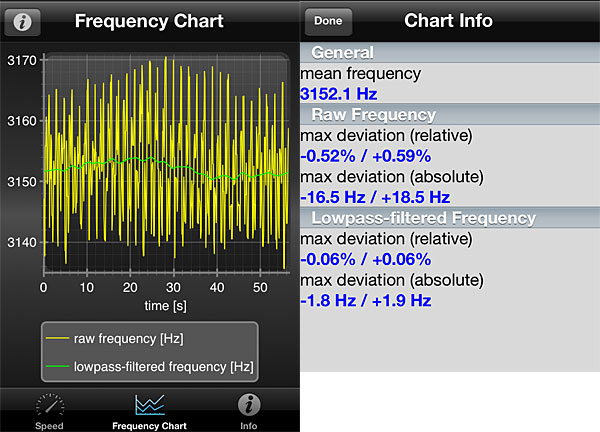
The Mk2's speed measurements were somewhat disappointing compared to the original Helix One. The original's low-pass–filtered relative maximum deviation was –0.03%, +0.02%, while the low-pass–filtered absolute maximum deviation was –0.9Hz, +0.8Hz. Those were very good numbers. This time, the low-pass–filtered maximum deviation numbers were ±0.06 (fig.1): still good, but two or three times worse, while the absolute low-pass–filtered maximum deviation was –1.8Hz, +1.9Hz, which is about two times worse.
 In any case, this minor drop in speed consistency, measured late in the review process, was not noted during the months I spent listening to the Helix One Mk2—even on long, sustained notes.
Footnote 3: For more details about this acronym-rich mechanical environment, click here.
Also new is a rear-panel–mounted pushbutton Up/Down speed-adjustment feature. The original turntable's speed was factory-set, though adjustable via computer, remotely over the Internet. The Mk2's motor can also be adjusted and diagnosed over the Internet.
This is not a Schröder arm review, but I'm well familiar with the CB, having used one on the original Helix One as well as for my OMA plinth/Technics SP10R review in the February 2019 Stereophile. Though somewhat spartan—there's no arm rest, which designer Frank Schröder claims negatively affects sonics—it offers complete adjustability and performs well above its reasonable price point. It's a really fine sounding, sonically "tunable" arm.
Setup and useA friend helped hoist the turntable's PowerBase and main chassis onto my HRS SXR Signature rack. The entire assemblage weighs around 200lb—the precise weight is not specified, but buyers are advised to place it on a platform capable of supporting 210lb. I'll skip the setup details, since that will likely be done by a dealer, other than to say that, though somewhat unusual, it's a straightforward process thanks to an excellent instruction manual that includes photos. Using the Helix One Mk2 is equally uncomplicated; that said, when putting on and removing a record and screwing on and off the record weight, you have to get used to the Minus K isolation system's "bounce." It feels the same as it did on the original Helix One. Some people will never get used to it and won't like it. It didn't bother me. The high-torque motor gets the platter up to speed quickly. One illuminated button selects 33.3rpm, the other 45, and that's all there is to it once you've adjusted the Minus K's very sensitive "float height" using the rear-mounted adjustment knob.
Fig.1 Döhmann Helix One Mk2, speed stability data and speed stability (raw frequency yellow; low-pass filtered frequency green). The Helix One Mk2's speed stability was not as good as the original Helix One, which had very good speed stability. Maybe it got bumped in shipping?
I made those measurements with the Minus K system both active and disabled, and got similar results. I'm not sure what accounts for this—perhaps something got bumped in shipping? Hopefully, the manufacturer will get the unit back in time to inspect, measure, and explain.
Footnote 3: For more details about this acronym-rich mechanical environment, click here.