 Cycles can be seen in the fortunes of companies. Likewise cycles can be seen in the performance of companies' products. A particular range will appear to have got it just right, whatever "it" is. The designer may have hit a winning streak and thus steal a lead over the competition. C-J set a new state-of-the-art preamp standard in the late '80s with their Premier Seven, and some of that expertise and experience are beginning to pay off in the shape of new high-performance preamplifiers at realistic prices. Moreover, the pressure was on to develop better power amplifiers to match. Two important products have emerged from all this in C-J's moderately priced FET range, namely the PF-1 preamplifier and the matching MF-200 power amp. By audiophile standards, these are moderately priced at $1295 and $1995, respectively.
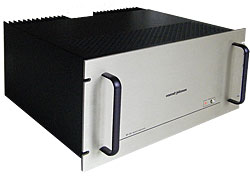
What do you get for your money? Well, the MF-200 is quite substantial at a solid, continuous 200Wpc, both channels driven, with sufficient current reserves to drive a wide range of loudspeaker loadings. The power amplifier is a large item, weighing almost 60 lbs. Fitted with rack handles, the panel is finished in matching satin gold alloy, neatly lettered and fitted with one control: on/off. Again, the rear panel sports a captive mains lead; inputs are gold-plated phono, the outputs heavy-duty, gold-plated 5-way binding posts. Finned heatsinks are conveniently located at the back of the unit. It does not run too hot in normal use.
Technology
Cycles can be seen in the fortunes of companies. Likewise cycles can be seen in the performance of companies' products. A particular range will appear to have got it just right, whatever "it" is. The designer may have hit a winning streak and thus steal a lead over the competition. C-J set a new state-of-the-art preamp standard in the late '80s with their Premier Seven, and some of that expertise and experience are beginning to pay off in the shape of new high-performance preamplifiers at realistic prices. Moreover, the pressure was on to develop better power amplifiers to match. Two important products have emerged from all this in C-J's moderately priced FET range, namely the PF-1 preamplifier and the matching MF-200 power amp. By audiophile standards, these are moderately priced at $1295 and $1995, respectively.
What do you get for your money? Well, the MF-200 is quite substantial at a solid, continuous 200Wpc, both channels driven, with sufficient current reserves to drive a wide range of loudspeaker loadings. The power amplifier is a large item, weighing almost 60 lbs. Fitted with rack handles, the panel is finished in matching satin gold alloy, neatly lettered and fitted with one control: on/off. Again, the rear panel sports a captive mains lead; inputs are gold-plated phono, the outputs heavy-duty, gold-plated 5-way binding posts. Finned heatsinks are conveniently located at the back of the unit. It does not run too hot in normal use.
Technology
The MF-200 is a low-feedback design intended to capture some of the character of tube technology. The MF-200's input is straightforward, comprising a differential J-FET pair buffered by an emitter follower. A voltage amplifier with current-source load leads to a complementary MOSFET driver. Three pairs of high-current MOSFETs make up the output stage. All sections prior to the final output are fed from regulated DC so that pure clipping is defined by the driver and not by the output. Faster recovery should result. Though the MF-200 is a feedback design, it is stated to use "uncommonly low feedback." Generously sized electrolytic reservoir capacitors are present in the shared power supply, while the critical large-value feedback decoupling component is a film type. No "electronic" protection is present; the unit relies on the natural robustness of the output devices, and on 5A voltage rail fuses. Sound
In the context of raw power delivery, I found the MF-200 to be load-tolerant, handling the range of test speakers well. Neither the Quad ESL-63 nor the Apogee Duetta Signature caused it any bother (as the lab results will later confirm). It is a genuinely powerful amplifier, as big as anyone is ever likely to require.
In this condition the performance fell back to the merely "normal" for its price group. This aspect presented a difficult prospect for the reviewer—how to judge a product with this kind of two-level performance? For this, you'll have to wait for (or turn to) the conclusion. The conclusions are complex, dictated by the unusual nature of these two products. The designer's goal of natural, musical dynamics has necessitated a level of individuality and distinction which makes these products less universal and easy to use than much of the competition.