Sound Quality
Brutally honest sums it up. Some might use words like "analytical" and "detailed," but those words typically point towards some fault of the headphones being overly bright. I'm not entirely sure this is the case. Because these headphones create a sense of space and image so incredibly well, I tend to believe they've got to be delivering a very coherent and well balanced signal. No headphone, in my experience, sounds as much like a scientific audio instrument as the HD 800. If you are an audio professional an have an application where using an open headphone is possible, the Sennheiser HD 800 would be my highest recommendation. They are simply unmatched in giving you the ability to peer into the mix. Now the bad part: these are not "fun" headphones. There are a lot of great sounding high-end headphones out there that beautifully editorialize in one way or another: the bass punch and warmth of the Audez'e LCD-3; the speed and air of the Stax SR-009; the lush yet crisp attack of a Grado RS1--all legitimately attempt to deliver a signature sound pleasing to listeners of particular aural taste-buds. Finding headphones the tickle your fancy is part of the fun of headphilia--I'll certainly admit to reaching for some of the above headphones to lush up my old Eddie Lang records. But they're not accurate ... and the Sennheiser HD 800 is. The problem is, raw accuracy and speed can be exhausting. You wouldn't want to take a Formula 1 car out for a lovely Sunday drive through the park, or worse yet, in typical rush hour traffic. It can be likewise difficult to sit back for a relaxing listening session to some old recordings with the HD 800. Headphone audiophiles have found that matching up the HD 800 with a smooth sounding tube headphone amp like the Eddie Current "Balancing Act" can lush up these cans a bit and yield a better listening experience. Recabling with one of the Cardas headphone cables will provide a slightly smoother experience as well. But the most effective thing I've found is a fairly simple modification you can make yourself from a bit of adhesive foam and felt. You can find the article on how to mod your HD 800 here.
Measurements
 THD+noise plots show a headphone with very low distortion. The slightly upward slope towards the bass of the 100dB traces indicates a slight loss of low frequency performance, which can also be seen in the downward curving top of the 30Hz squarewave, and the slight downward slope of the frequency response curve below 100Hz.
Electrical impedance and phase curves show a nominally 300 Ohm headphone, but with a fairly large and wide primary driver resonance impedance change that peaks out at around 100Hz at 600 Ohms. Though headphone amp matching with these headphones seems a hit and miss affair, an impedance swing that large to me would indicate the need for a headphone amp with a lower than 30 Ohm output impedance--but I know it doesn't quite work that way with these headphones.
The isolation plot shows these are very open headphones, with virtually no isolation. With 254mVrms needed to achive 90dBspl (and the fact that they don't have a mini-plug) these will not be driven well from portable players. These are not iPod headphones, though with a proper amp you could use them portably in quiet environments.
Summary
THD+noise plots show a headphone with very low distortion. The slightly upward slope towards the bass of the 100dB traces indicates a slight loss of low frequency performance, which can also be seen in the downward curving top of the 30Hz squarewave, and the slight downward slope of the frequency response curve below 100Hz.
Electrical impedance and phase curves show a nominally 300 Ohm headphone, but with a fairly large and wide primary driver resonance impedance change that peaks out at around 100Hz at 600 Ohms. Though headphone amp matching with these headphones seems a hit and miss affair, an impedance swing that large to me would indicate the need for a headphone amp with a lower than 30 Ohm output impedance--but I know it doesn't quite work that way with these headphones.
The isolation plot shows these are very open headphones, with virtually no isolation. With 254mVrms needed to achive 90dBspl (and the fact that they don't have a mini-plug) these will not be driven well from portable players. These are not iPod headphones, though with a proper amp you could use them portably in quiet environments.
Summary
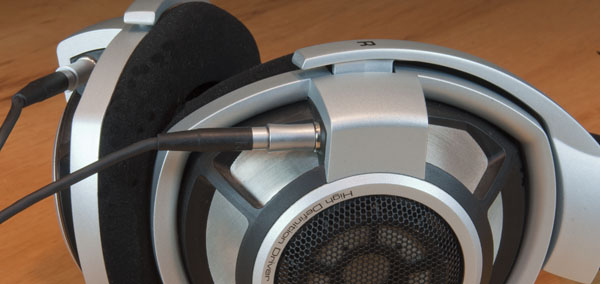
 When I set up my lab, the only headphones I knew I had to buy were a pair of Sennheiser HD 800s--they are as close to perfect as a headphone gets. I think they are a must for any serious audio professional who has any work where open headphones could be used. They make an ideal headphone for mastering applications where even the tiniest sound must be laid bare. My only caution is that they may be perceived as slightly bright and analytical--though I think the perception is as likely to come from not being accustomed to the unbelievable transient response, as it is from an actual tonal imbalance. They might be a tad hot between 6kHz and 10kHz, though.
Audiophiles will likewise love these headphones, especially after a small modification. I would currently place them in a trio of "World's Best Headphones," each of which has it's own idiosyncrasies. The other two are: the Stax SR-009, which is brilliantly beautiful sounding with an incredible ability to deliver sonic texture, but they're wickedly expensive ($5000 and need a $5000 amp) and don't image as well as the HD 800; and the Audez'e LCD-3, which have the best bass performance and deliver a very comfortable and pleasing listening experience, but are quite expensive and may vary unit to unit a bit.
The Sennheiser HD 800s are going up on my "Wall of Fame" as one of the best reference headphones. They were the first headphone in my lab, and I can't see ever being without a pair. They have my highest recommendation.
Resources
When I set up my lab, the only headphones I knew I had to buy were a pair of Sennheiser HD 800s--they are as close to perfect as a headphone gets. I think they are a must for any serious audio professional who has any work where open headphones could be used. They make an ideal headphone for mastering applications where even the tiniest sound must be laid bare. My only caution is that they may be perceived as slightly bright and analytical--though I think the perception is as likely to come from not being accustomed to the unbelievable transient response, as it is from an actual tonal imbalance. They might be a tad hot between 6kHz and 10kHz, though.
Audiophiles will likewise love these headphones, especially after a small modification. I would currently place them in a trio of "World's Best Headphones," each of which has it's own idiosyncrasies. The other two are: the Stax SR-009, which is brilliantly beautiful sounding with an incredible ability to deliver sonic texture, but they're wickedly expensive ($5000 and need a $5000 amp) and don't image as well as the HD 800; and the Audez'e LCD-3, which have the best bass performance and deliver a very comfortable and pleasing listening experience, but are quite expensive and may vary unit to unit a bit.
The Sennheiser HD 800s are going up on my "Wall of Fame" as one of the best reference headphones. They were the first headphone in my lab, and I can't see ever being without a pair. They have my highest recommendation.
Resources
Wes Philip's review here on the HD 800.
Head-Fi HD 800 appreciation thread and Skylab review.
Sennheiser HD 800 product page and brochure pdf.
Brutally honest sums it up. Some might use words like "analytical" and "detailed," but those words typically point towards some fault of the headphones being overly bright. I'm not entirely sure this is the case. Because these headphones create a sense of space and image so incredibly well, I tend to believe they've got to be delivering a very coherent and well balanced signal. No headphone, in my experience, sounds as much like a scientific audio instrument as the HD 800. If you are an audio professional an have an application where using an open headphone is possible, the Sennheiser HD 800 would be my highest recommendation. They are simply unmatched in giving you the ability to peer into the mix. Now the bad part: these are not "fun" headphones. There are a lot of great sounding high-end headphones out there that beautifully editorialize in one way or another: the bass punch and warmth of the Audez'e LCD-3; the speed and air of the Stax SR-009; the lush yet crisp attack of a Grado RS1--all legitimately attempt to deliver a signature sound pleasing to listeners of particular aural taste-buds. Finding headphones the tickle your fancy is part of the fun of headphilia--I'll certainly admit to reaching for some of the above headphones to lush up my old Eddie Lang records. But they're not accurate ... and the Sennheiser HD 800 is. The problem is, raw accuracy and speed can be exhausting. You wouldn't want to take a Formula 1 car out for a lovely Sunday drive through the park, or worse yet, in typical rush hour traffic. It can be likewise difficult to sit back for a relaxing listening session to some old recordings with the HD 800. Headphone audiophiles have found that matching up the HD 800 with a smooth sounding tube headphone amp like the Eddie Current "Balancing Act" can lush up these cans a bit and yield a better listening experience. Recabling with one of the Cardas headphone cables will provide a slightly smoother experience as well. But the most effective thing I've found is a fairly simple modification you can make yourself from a bit of adhesive foam and felt. You can find the article on how to mod your HD 800 here.
Click on graph's image to download .pdf for closer inspection.
As you can see from the raw frequency response data (lower gray traces in FR graph), which are five sets of measurements taken with the headphones at slightly different positions on the measurement head microphone, the HD 800 changes very little with positional changes. This is the best performance of any headphone I've measured. I'm currently in the process of taking a variety of measurements in order to characterize the performance of my measurement system. The first headphone I'm measuring is the HD 800 because it is virtually immune from changes due to the way I put the headphones on the head, which should allow me to better understand the variability of the performance of the measurement system itself over time without changes due to operator variability. In other words, the extreme stability of the HD 800 performance with positional change on the head is just another indicator of how precise and highly engineered these headphone are.
The compensated frequency response (upper blue and red trace on FR plot) shows a remarkably flat headphone below 1kHz. A gentle upward bowing arc is seen between 60Hz and 1kHz, and the bass shows a very mild drop below 60Hz. Below 1kHz, the HD 800 exhibits nearly perfect performance, and is only bested (in terms of having a flat frequency response and good bass extension) by the planar magnetic headphones from Audez'e and HiFiMAN, and possibly the Stax SR-009. Above 1kHz, the HD 800 rolls off some; other than the modest bump at 7kHz, I would say the curve is near perfect as some treble roll-off is desirable.
The bump in frequency response at 7kHz, and the clear leading edge spike of the 300Hz square-wave may be an indicator of a slightly over-articulate sound. It's difficult to say whether those features are actually excessive, however, because they are near ideal. I think I heard a slight over-emphasis between 5kHz and 10kHz during pink noise listening, but it was slight. More important are the fairly clean and noise free 300Hz square wave and impulse response. The lack of a strong second upward spike after the initial transient, in my experience, indicates a coherent sound and good imaging, which these headphones have in spades.
When I set up my lab, the only headphones I knew I had to buy were a pair of Sennheiser HD 800s--they are as close to perfect as a headphone gets. I think they are a must for any serious audio professional who has any work where open headphones could be used. They make an ideal headphone for mastering applications where even the tiniest sound must be laid bare. My only caution is that they may be perceived as slightly bright and analytical--though I think the perception is as likely to come from not being accustomed to the unbelievable transient response, as it is from an actual tonal imbalance. They might be a tad hot between 6kHz and 10kHz, though.
Audiophiles will likewise love these headphones, especially after a small modification. I would currently place them in a trio of "World's Best Headphones," each of which has it's own idiosyncrasies. The other two are: the Stax SR-009, which is brilliantly beautiful sounding with an incredible ability to deliver sonic texture, but they're wickedly expensive ($5000 and need a $5000 amp) and don't image as well as the HD 800; and the Audez'e LCD-3, which have the best bass performance and deliver a very comfortable and pleasing listening experience, but are quite expensive and may vary unit to unit a bit.
The Sennheiser HD 800s are going up on my "Wall of Fame" as one of the best reference headphones. They were the first headphone in my lab, and I can't see ever being without a pair. They have my highest recommendation.
ResourcesWes Philip's review here on the HD 800.
Head-Fi HD 800 appreciation thread and Skylab review.
Sennheiser HD 800 product page and brochure pdf.