John Atkinson wrote about the Black in October 2015 (Vol.38 No.10):
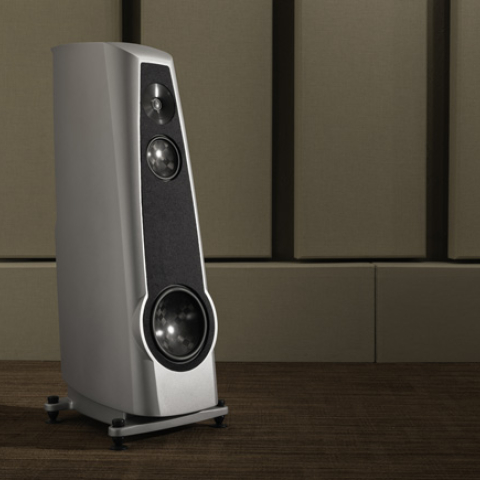
"You don't know what you've got till it's gone," sang the young Joni Mitchell, but she was wrong. When I packed up the Ayre Acoustics KX-R Twenty preamplifier and pair of MX-R Twenty monoblocks, after having reviewed the latter for our August issue, I was well aware that this was the best amplification system I had experienced. The question was, how was I to replace them? I had some new amplifiers on deck for review, but as I still had in-house Bel Canto Design's three-piece, $50,000 Black system, which Michael Fremer very favorably reviewed in July, I set up the Black in place of the Ayres, driving the GamuT RS7 speakers I had reviewed for the September issue (footnote 1).
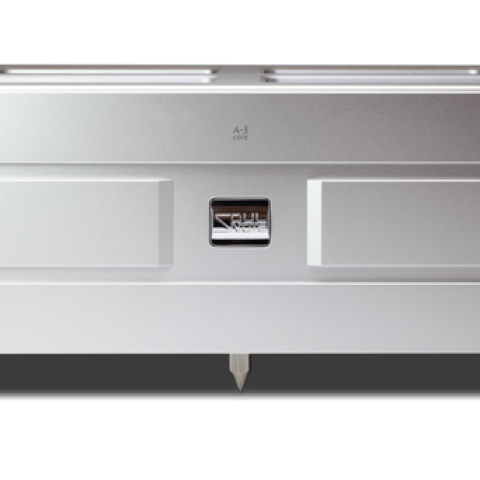
To place into context these Follow-Up comments: The Black system costs $50,000 and doesn't need a D/A processor, being able to accept both digital and analog inputs. To match the Black's capabilities with comparable Ayre electronics would cost $27,500 for the KX-R Twenty, $29,500/pair for the MX-R Twentys, and $3250 for Ayre's QB-9 DSD DAC, for a system price of $60,250. The Ayre system also needs cables between DAC, preamp, and power amps; the Bel Canto system's ASC1 box—which is the Black's preamplifier/DAC unit—sends digital data to the two MPS1 power-amp boxes via ST-optical links that are included in the price.
The MPS1 uses a custom version of Bruno Putzeys's Hypex Ncore class-D output module. I had already been impressed by a somewhat different version of this module in June 2014, when I reviewed MBL's Corona C15 monoblock amplifier. After the Black components had been powered up a day or so, I settled down in my chair for some serious listening, using their apodizing Filter 2 setting and a USB connection from my Mac mini.
Listening
Two things struck me immediately. First was how much the Bel Canto system's overall sound differed from the Ayres' (more on this later). Second was the impact of the low frequencies. The bass drum that punctuates the lurchingly rhythmic section just before the 7:00-minute mark in Elgar's overture In the South (Alassio), with Alexander Gibson conducting the Scottish National Orchestra (ALAC file ripped from CD, Musical Heritage Society MHS 11052K), was superbly well defined but had plentiful weight. And when the organ's bass pedals enter at the climax of the preceding work on this album, Elgar's overture Cockaigne ("In London Town"), my room was filled with clean, powerful, descending low-frequency quarter notes that amply supported the musical message. This early DDD CD, recorded by Chandos in 1982, has a rather threadbare balance overall, especially in the violins. But when this recording was decoded and amplified by the Bel Canto Black, I found it easy to disregard the digital artifacts in favor of the vast sweep of sound the system produced. The orchestral image was wide and deep, with individual instruments superbly well defined. In his review, Michael Fremer noted that "The Black's re-creation from digital sources of three-dimensional imaging and soundstaging was the most intense and compelling I've heard, with well-carved images presented against 'black' backdrops." I can't say it any better myself. Bel Canto's John Stronczer had told me that he feels that the Black gives the best sound quality when used as a network-connected device. Once I was satisfied that I was familiar with the Black's sonic character via USB, I connected the ASC1 to our home network using an AudioQuest Vodka Ethernet cable. I then downloaded Bel Canto's Black app to my iPad Mini, which duplicates the remote control's functions via Bluetooth. For a Mac to get the best sound quality via an Ethernet connection, Stronczer recommends JRiver Media Center as a UPnP server. However, using JRMC 19 on my Mac mini, I couldn't hear any significant difference between that and the USB connection.
I had a couple of operational difficulties with the Black. First, whether I was using my i7 Mac mini or the Antipodes DX as the data source, the ASC1 proved fussy about USB-cable quality when playing files with sample rates greater than 48kHz. A 3m length of Belkin Gold USB cable, which had been problem-free with other USB D/A processors, gave spits and dropouts with the ASC1. An AudioQuest Coffee USB cable proved problem-free with sample rates up to 192kHz—but I had this cable only in a 1.5m length: The fact that the AudioQuest was shorter may have been significant.
Measuring
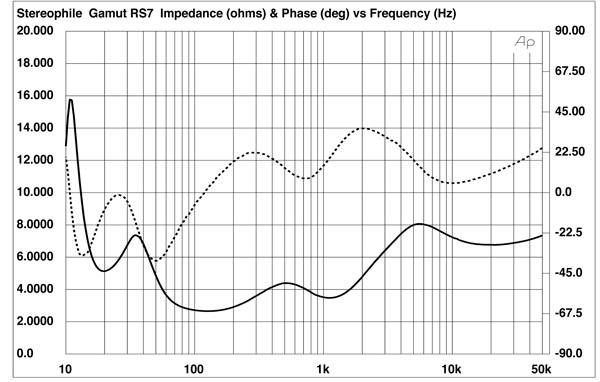
Second, when preparing the measurements section that accompanied our July review, I had inadvertently driven the MPS1 monoblocks fully into clipping for a few seconds, before I could switch off the Audio Precision's analog-signal generator. This was because I hadn't realized that a single push on the front-panel power button merely turns off the LED, but does not put the amplifier into Standby—for which the button must be pushed and held down for three seconds: I'd only pressed the buttons long enough for the LEDs to go dark. Then, when I loaded a new test procedure, I drastically overdrove the MPS1s—which were not in standby, and emitted nasty mechanical buzzing sounds. As you can see in the measurements, when I subsequently tried to measure the maximum power output, the MPS1's protection circuit operated about 3dB below the specified maximum. When I asked Stronczer if this had been a result of the abuse the amplifier had suffered, he said he thought not. However, when I listened to the Black, I found that, after 30 minutes or so of driving the GamuT RS7 speakers with consistently loud music, and with the volume control set to "86," one of the two MPS1 units that I had tested (serial no. MPS36134) turned itself off. The GamuT is relatively difficult to drive—its impedance (fig.1) remains below 3 ohms for the entire upper bass, a region where music has a lot of energy—but even so, I suspected that the protection circuit of this sample was being triggered prematurely.
I wrote earlier how different the Bel Cantos system's sound quality was from that of the Ayre electronics. The Ayre combo had a robust overall sound—before being broken in, its sound was a little too robust—with a rhythmically coherent character that emphasized musical values. With every recording I played, the Ayres got the overall musical picture right. By contrast, the Black presented individual audio objects within the soundstage with superb detail, but those objects were not quite as well integrated into the whole as they were with the Ayre. In my complex recording of the Minnesotan male-voice choir Cantus performing Peter Hamelin's setting of "Casey at the Bat," from Cantus (ALAC files from CD, Cantus CTS-1207), the Black presented every detail—the full choir, a barbershop trio, a solo singer, crowd noises, the dialog between the umpire and Casey, the sounds of bat hitting ball and ball hitting glove, birds singing in the trees, a tolling bell—within its clearly identifiable acoustic. (I had recorded the work both in the supportive acoustic of the Washington Pavilion, in Sioux Falls, South Dakota, and outdoors, in a field in Goshen, Indiana.) The Ayre system was not quite as superb at presenting the tiniest recorded details, with a soundstage that was not quite as distant as it was with the Bel Canto. But despite my familiarity with this recording, the experience of listening to it through Ayre's QB-9, KX-R Twenty, and MX-R Twentys was a little more like the first time I heard Erick Lichte's and my final mix, back in 2007.
If the Ayre system was more simpatico with the heart, the Bel Canto Black appealed more to the head. I could readily live with either—if I had this kind of money!— John Atkinson
Footnote 1: For full system details, see my review of the Antipodes DX music server elsewhere in this issue.
Two things struck me immediately. First was how much the Bel Canto system's overall sound differed from the Ayres' (more on this later). Second was the impact of the low frequencies. The bass drum that punctuates the lurchingly rhythmic section just before the 7:00-minute mark in Elgar's overture In the South (Alassio), with Alexander Gibson conducting the Scottish National Orchestra (ALAC file ripped from CD, Musical Heritage Society MHS 11052K), was superbly well defined but had plentiful weight. And when the organ's bass pedals enter at the climax of the preceding work on this album, Elgar's overture Cockaigne ("In London Town"), my room was filled with clean, powerful, descending low-frequency quarter notes that amply supported the musical message. This early DDD CD, recorded by Chandos in 1982, has a rather threadbare balance overall, especially in the violins. But when this recording was decoded and amplified by the Bel Canto Black, I found it easy to disregard the digital artifacts in favor of the vast sweep of sound the system produced. The orchestral image was wide and deep, with individual instruments superbly well defined. In his review, Michael Fremer noted that "The Black's re-creation from digital sources of three-dimensional imaging and soundstaging was the most intense and compelling I've heard, with well-carved images presented against 'black' backdrops." I can't say it any better myself. Bel Canto's John Stronczer had told me that he feels that the Black gives the best sound quality when used as a network-connected device. Once I was satisfied that I was familiar with the Black's sonic character via USB, I connected the ASC1 to our home network using an AudioQuest Vodka Ethernet cable. I then downloaded Bel Canto's Black app to my iPad Mini, which duplicates the remote control's functions via Bluetooth. For a Mac to get the best sound quality via an Ethernet connection, Stronczer recommends JRiver Media Center as a UPnP server. However, using JRMC 19 on my Mac mini, I couldn't hear any significant difference between that and the USB connection.
Second, when preparing the measurements section that accompanied our July review, I had inadvertently driven the MPS1 monoblocks fully into clipping for a few seconds, before I could switch off the Audio Precision's analog-signal generator. This was because I hadn't realized that a single push on the front-panel power button merely turns off the LED, but does not put the amplifier into Standby—for which the button must be pushed and held down for three seconds: I'd only pressed the buttons long enough for the LEDs to go dark. Then, when I loaded a new test procedure, I drastically overdrove the MPS1s—which were not in standby, and emitted nasty mechanical buzzing sounds. As you can see in the measurements, when I subsequently tried to measure the maximum power output, the MPS1's protection circuit operated about 3dB below the specified maximum. When I asked Stronczer if this had been a result of the abuse the amplifier had suffered, he said he thought not. However, when I listened to the Black, I found that, after 30 minutes or so of driving the GamuT RS7 speakers with consistently loud music, and with the volume control set to "86," one of the two MPS1 units that I had tested (serial no. MPS36134) turned itself off. The GamuT is relatively difficult to drive—its impedance (fig.1) remains below 3 ohms for the entire upper bass, a region where music has a lot of energy—but even so, I suspected that the protection circuit of this sample was being triggered prematurely.
Fig.1 GamuT RS7, electrical impedance (solid) and phase (dashed) (2 ohms/vertical div.).
Stronczer had suggested that I repeat the high-power testing using a digital source driving the ASC1, which would better represent the Black's actual performance as an integrated system. Therefore, after I finished my listening, I repeated some of the testing on the other MPS1 unit (serial no. MPS09134) using the Audio Precision SYS2722's digital TosLink output connected to the ASC1.
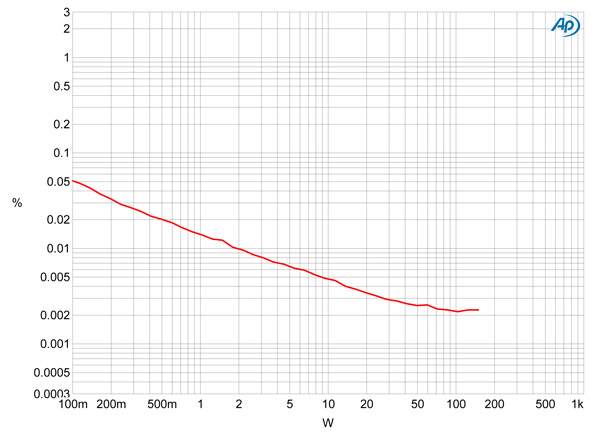
Fig.2 Bel Canto Black, MPS1 analog input, distortion (%) vs 1kHz continuous output power into 8 ohms.
Fig.2 is taken from the original review. It plots the THD+noise percentage against output power into 8 ohms, driving serial no. MPS36134 from its balanced analog input. You can see that the trace cuts off at 150W, due to the operation of the amplifier's protection circuit.
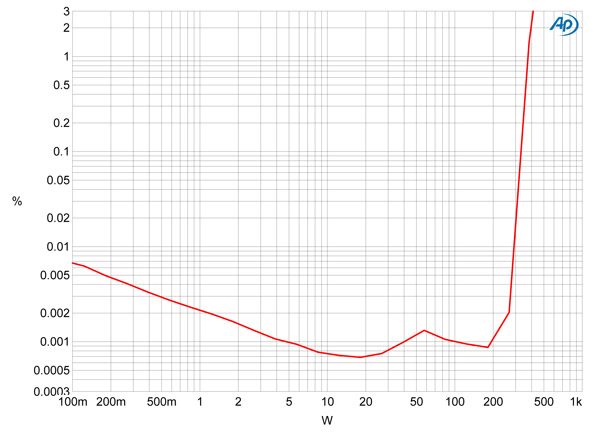
Fig.3 Bel Canto Black, ASC1 digital input, distortion (%) vs 1kHz continuous output power into 8 ohms.
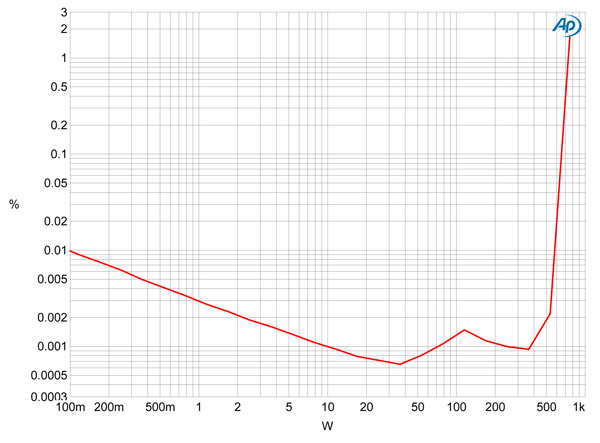
By contrast, fig.3 repeats the measurement using a digital input signal sent to the ASC1 with its volume control set to "100." Not only does the amplifier now clip (defined as 1% THD+N) at 375W into 8 ohms (25.75dBW), which comfortably exceeds the specified power of 300W (24.8dBW), but the level of THD+N at low powers is significantly lower than in fig.1. Repeating the measurement into 4 ohms gave the trace in fig.4. Into 4 ohms, the Black clips at no less than 730W (25.6dBW), and into 2 ohms it delivers close to the specified 1200W (24.8dBW)! In the old phrase, the Black system is a true "power DAC"!
Fig.4 Bel Canto Black, ASC1 digital input, distortion (%) vs 1kHz continuous output power into 4 ohms.
Driven by a digital source, the Bel Canto Black both more than met its power specification and offered the lowest level of noise and distortion at normal powers. However, as these measurements suggest that the system will clip at a level of around –7dBFS with the volume control set to its maximum, keeping the volume at "93" or lower will ensure that the amplifier will not clip on instantaneous peaks.
More ListeningI wrote earlier how different the Bel Cantos system's sound quality was from that of the Ayre electronics. The Ayre combo had a robust overall sound—before being broken in, its sound was a little too robust—with a rhythmically coherent character that emphasized musical values. With every recording I played, the Ayres got the overall musical picture right. By contrast, the Black presented individual audio objects within the soundstage with superb detail, but those objects were not quite as well integrated into the whole as they were with the Ayre. In my complex recording of the Minnesotan male-voice choir Cantus performing Peter Hamelin's setting of "Casey at the Bat," from Cantus (ALAC files from CD, Cantus CTS-1207), the Black presented every detail—the full choir, a barbershop trio, a solo singer, crowd noises, the dialog between the umpire and Casey, the sounds of bat hitting ball and ball hitting glove, birds singing in the trees, a tolling bell—within its clearly identifiable acoustic. (I had recorded the work both in the supportive acoustic of the Washington Pavilion, in Sioux Falls, South Dakota, and outdoors, in a field in Goshen, Indiana.) The Ayre system was not quite as superb at presenting the tiniest recorded details, with a soundstage that was not quite as distant as it was with the Bel Canto. But despite my familiarity with this recording, the experience of listening to it through Ayre's QB-9, KX-R Twenty, and MX-R Twentys was a little more like the first time I heard Erick Lichte's and my final mix, back in 2007.
Footnote 1: For full system details, see my review of the Antipodes DX music server elsewhere in this issue.