"But it is the wildest, most incredible music story of all time and I'm at least mildly flattered that I played a miniscule part in it.
I'm even more pleased that it's all behind me."—Dave Dexter Jr. From his autobiography, Playback
It's almost too easy to make Dave Dexter Jr. the villain in the story of the Beatles' fumbled introduction to America. A devoted denigrator of rock'n'roll who thought it was a passing fad meant for the kiddies, and who also thought John Lennon played "lousy harmonica," he was just one of the many older music fans who were sure that Elvis Presley's hips had been a corrupting influence on America's youth, not to mention on good music.
The head of International A&R at Capitol Records, then owned by the UK's EMI, Dexter was no fan of British acts in general. He also turned down Manfred Mann, The Animals, The Yardbirds, and The Hollies. His tastes ran to jazz and Capitol's big pre-rock'n'roll pop singers including Frank Sinatra and Peggy Lee, though he was eventually banned from Sinatra's recording sessions for irritating the singer. With his flattop buzz haircut, overweening ego, and I-know-better attitude, Dexter is most famous for being the fuddy-duddy who turned down the Beatles' first four singles. He was finally ordered to release "I Want to Hold Your Hand" in December 1963. He was demoted in 1966 and has forever after been mocked and despised for his tin ears and bewildering blunders—and for writing a nasty piece in Billboard following Lennon's murder in 1980, which carried a deck reading, "Lennon's Ego & Intransigence Irritated Those Who Knew Him." Billboard received so much flak that the publication eventually apologized.
Worse still, for Beatles true believers who care about how records sound, was his belief that he "knew the American market" better than anyone else, so he forced the Beatles' UK album releases to be resequenced, re-EQ'd, and shortened before their release. That was the only way, he argued, that they would find success in the States. He even felt that the original cover art needed to be changed.
In Playback, his 1976 autobiography, Dexter claims that at least one Beatle, Paul McCartney, approved of the changes he made to the American versions of the band's early albums. "All I recall him saying was that he and his mates were delighted with the equalization improvements Capitol's engineers had devised for their first [US] record. In running the original Beatles tape through our system as an American master was dubbed, we had extended the high frequencies and added slight reverberation to give the single ["I Want to Hold Your Hand"] a 'hotter' sound" (p.178).
Needless to say, all this happened just before the band achieved worldwide fame. As soon as the Beatles had that leverage, Dexter's vision for the band was overruled, and Capitol subsequently released the original UK albums in the US, reproducing exactly their artwork, mixes, and track sequencing beginning with Sgt. Pepper's in 1967.
"With the dominance of the Beatles came a marked change of attitude on the part of manager Epstein and his foursome," a clearly offended Dexter wrote in Playback: "No longer could I work felicitously with Marvin Schwartz in designing front and back album covers, choosing the photographs and annotation we thought best. Nor did the bedeviled Epstein allow me a choice of masters to be programmed into album form. Each single, each album, was made to specifications conceived by the Beatles' organization in London. Artwork was mailed to the Capitol Tower from Manchester Square. So were the back cover editorial notes. None, I think, was an improvement over what we in California had been doing" (p.180).
Despite the everlasting controversy over Dexter and his questionable decisions, it must be said that the US versions, mono and stereo, are what most Americans remember as their first taste of the Fab Four. Many still prefer the sound and even the artwork of the American releases to their British counterparts. For Beatles superfans and record collectors in general, those original American pressings, with their different sound and cover art, are yet more items to seek out and obsess over. When it comes to the Beatles, nothing is ever settled or universally agreed upon. Ask "Who's your favorite Beatle?" and watch the divisions arise.
The reissue of the Beatles' early American mono albums also reignites one of the eternal audio debates: Which sounds better, mono or stereo?
While this may sound like a quaint bit of history, mono fans still cling to their unshakable belief that the mono mixes have their charms—that the tighter frame and denser mix makes for a more compelling sound. Slightly less heated than the analog-versus-digital controversy (which again, given the improvement in software like ProTools, was settled long ago, at least for recording), the mono/stereo battle rages on in some quarters.
Perhaps the key to Reeves's work on The Beatles 1964 US Albums in Mono was his unfamiliarity with the part Dave Dexter Jr. played in the early Beatles releases on Capitol. "Luckily, I got the education [on Dexter] after the fact rather than before I started," Reeves continues. "The deep knowledge that I have now about Dexter and what these tapes mean to people and the very strong emotions that they have about these releases, pro or con, I think that could have influenced me and some of the decisions I made."
Reeves had trepidations at first, when he saw that the sources he was being asked to use were Scotch brand 201 tapes, which are notorious for disintegrating over time. "They are Scotch, and as soon as I saw that I thought, Well, this is going to be interesting. I'm sure they must have a lot of degradation. Hopefully, no one has baked them in the history while they've been sitting around," he says. He also confirmed that the signal path used in cutting these remasters was completely analog. "I'm happy to report that these assets have been cared for meticulously. There is so much documentation in and around each one of these tapes. And I also had the huge advantage of having the whole UMG archives team behind me making me look good."
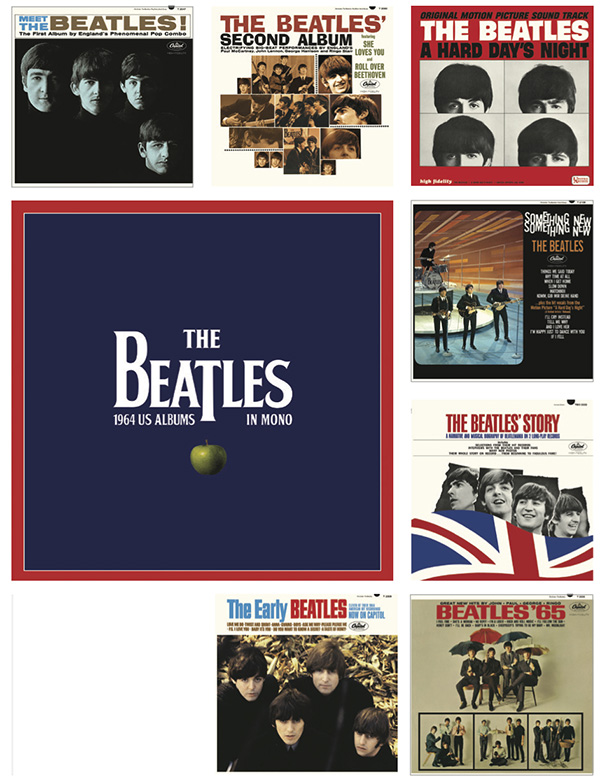
Mono e mono: Clockwise: The Dave Dexter/Capitol Records/US versions of the Beatles albums that constitute the new mono US-LP set.
The ongoing UMG Beatles reissue program (sans Giles Martin this time) has now turned its energies to the mono editions of Dexter's Capitol albums, in a boxed set titled The Beatles 1964 US Albums in Mono. The albums included are Introducing the Beatles, Meet The Beatles! , The Beatle's Second Album, A Hard Day's Night, Something New, The Beatles' Story, Beatles '65, and The Early Beatles. The UK mono masters up to and including The Beatles (The White Album) were released in 2009 as the 11-CD boxed set, The Beatles in Mono.
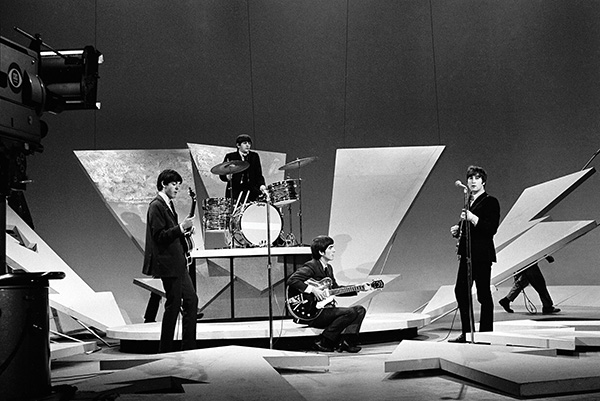
Rehearsing for the Ed Sullivan Show.
Into this fraught sonic arena stepped mastering engineer Kevin Reeves, who has a long history at Capitol Records. Now working out of UMG's East Iris Studios, in Nashville, Tennessee, Reeves started as a runner in Hollywood's Capitol Tower in the 1980s and immediately bought into the magic of his storied surroundings. "I couldn't believe I was there," he told me in a recent interview, with still-fresh incredulity. "I was happy to get sandwiches, polish coffee pots, clean toilets, do whatever I needed to do, 'cause I was in that environment."
Reeves, whose work for UMG has included music from across the spectrum, from John Coltrane to Steely Dan, was trained by a very experienced cadre of mastering engineers. "There was this legendary corner, the back of the Tower, where the mystical arts of mastering were going on. There was Wally Traugott and Ron McMaster, who everyone knows, and all the historic stuff that they did at Capitol. There was Bob Norberg upstairs. And there was Jay Ranellucci, who was with Capitol before they built the Tower, as an engineer. I would see these guys and have conversations with them. I couldn't believe I was seeing them. I'd read their names on albums as a kid."
One key detail that warms Reeves's heart is that he used the same cutting lathe that was once a staple at the Capitol HQ in California. "It's a Neumann VMS70, built in mid-1970 and deployed to the Tower and installed in 1971, where it was until they moved it here to East Iris. I call it Ron McMaster's lathe. He did so much historic stuff on it. Blue Note, Beach Boys, all things in the Capitol ecosystem," Reeves explains. "Ron taught me how to make a good record. He taught me the importance of what you needed to watch, what you needed to listen for. If it weren't for him and Wally, I wouldn't be talking to you about this project. I can't believe this thing has followed me from that room in Capitol back 35 years ago and landed here in Nashville."