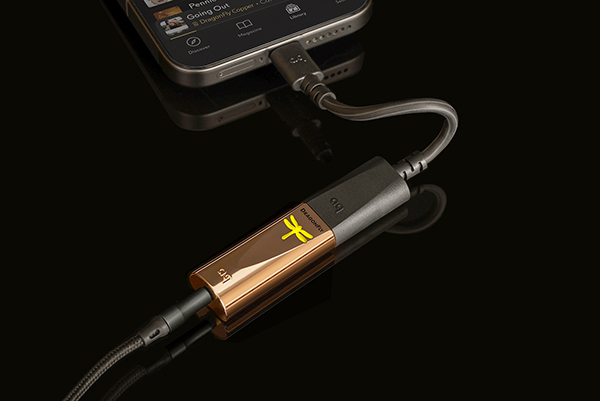
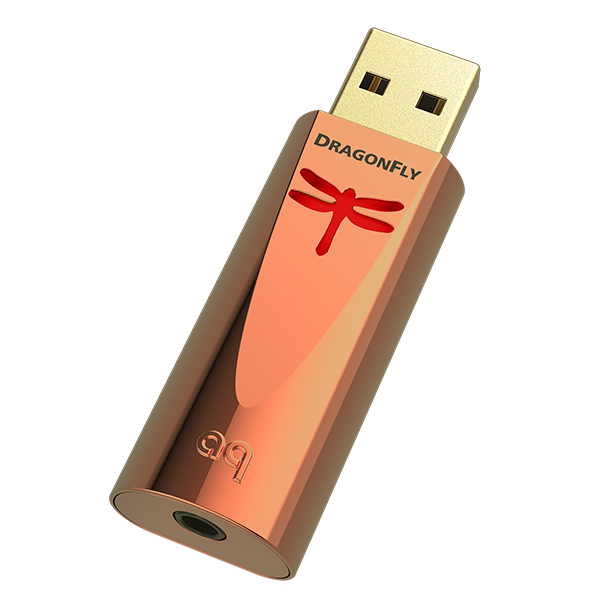
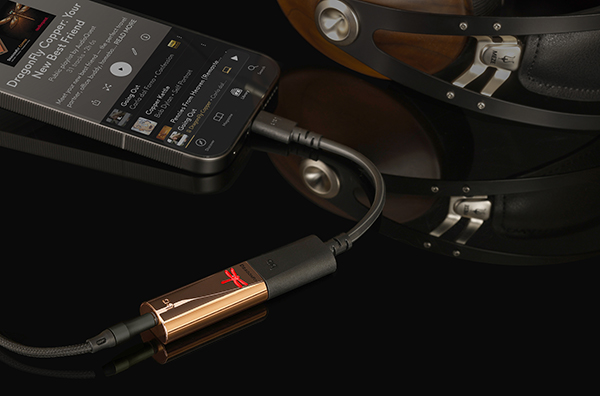
The AudioQuest DragonFly Copper USB-connected DAC/headphone amplifier ($250)—the sixth generation of the popular device—is the most energy-efficient version yet. It also uses the fewest parts on its tiny circuit board.
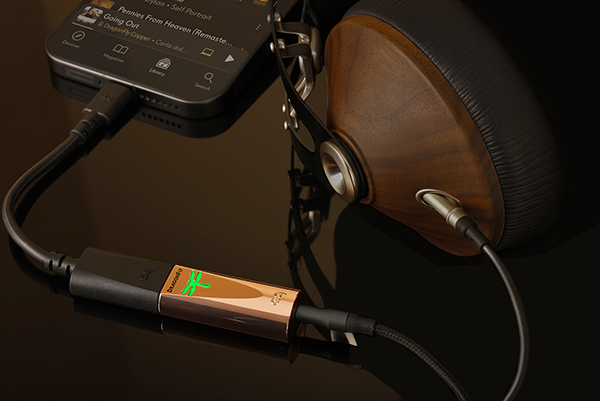
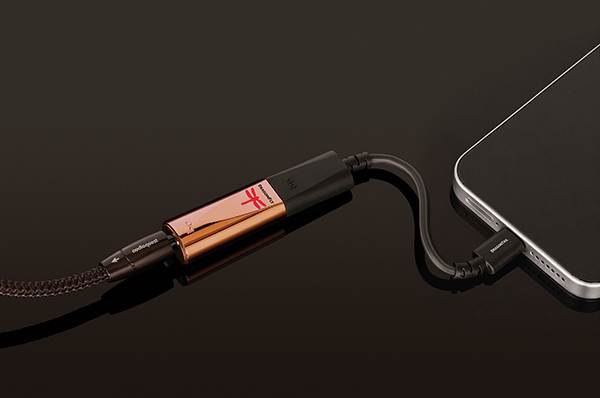
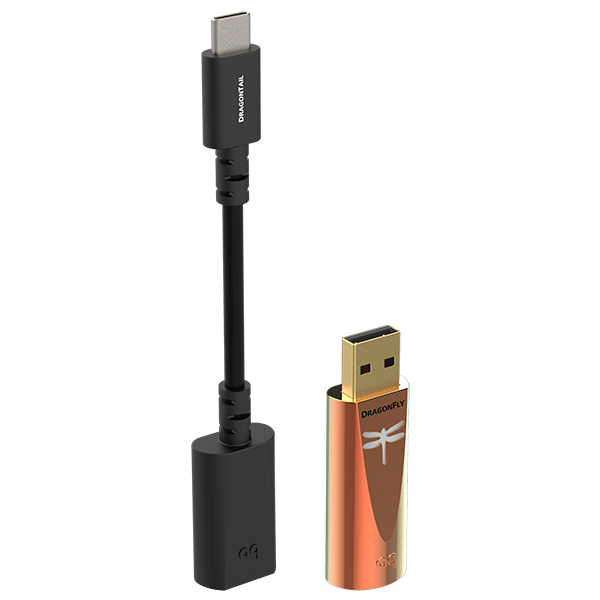
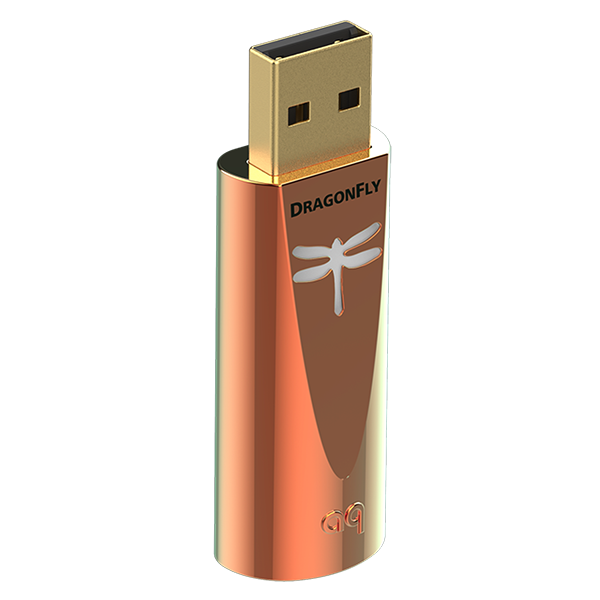
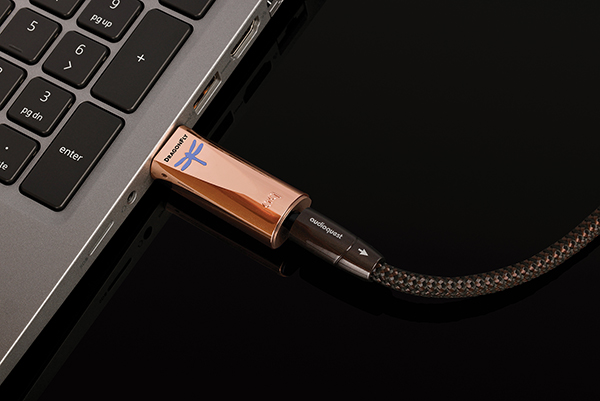
In an acknowledgment to the cellphone-centric world of headphone listening, it ships with the DragonTail USB-A female-to-USB-C male adapter, which plugs into modern cellphones, tablets, and compact computers. The Copper itself plugs directly into USB-A sockets on computers, and it requires no Windows (or Apple, or Linux) driver.
 "Like all AudioQuest products, the award-winning DragonFly has benefited from gradual refinements made possible by better parts, better materials, and AudioQuest's own insatiable desire for better sound," the company said in its product announcement.
Since the original Dragonfly was released in 2012, more than 300,000 have been sold globally, AudioQuest says on its website. That's a big number for a hi-fi component.
"Like all AudioQuest products, the award-winning DragonFly has benefited from gradual refinements made possible by better parts, better materials, and AudioQuest's own insatiable desire for better sound," the company said in its product announcement.
Since the original Dragonfly was released in 2012, more than 300,000 have been sold globally, AudioQuest says on its website. That's a big number for a hi-fi component.
 Designer Gordon Rankin told me he streamlined the latest design down to 28 parts. That compares to 107 in the first DragonFly, which was functionally identical, though sonically very different. One consideration in creating his new circuit was geopolitical: Ukraine supplies more than 80% of the world's acrylic, which apparently is used in film capacitors. As a result, capacitors used in previous versions of the DragonFly were no longer available.
Another consideration was the collapse of MQA, which meant that AudioQuest no longer needed to include it in the DragonFly’s onboard processing. MQA, Rankin said, "required a lot of power." That means more than just more power draw on your smart phone. "More power equals more noise," Rankin said.
Designer Gordon Rankin told me he streamlined the latest design down to 28 parts. That compares to 107 in the first DragonFly, which was functionally identical, though sonically very different. One consideration in creating his new circuit was geopolitical: Ukraine supplies more than 80% of the world's acrylic, which apparently is used in film capacitors. As a result, capacitors used in previous versions of the DragonFly were no longer available.
Another consideration was the collapse of MQA, which meant that AudioQuest no longer needed to include it in the DragonFly’s onboard processing. MQA, Rankin said, "required a lot of power." That means more than just more power draw on your smart phone. "More power equals more noise," Rankin said.
 AudioQuest's Stephen Mejias detailed the DragonFly's history. "Copper is the sixth model of the franchise. The original DragonFly, released in 2012, was v1.0. It was soon followed by v1.2, which refined the circuitry between the DAC and the analog output stage for greater transparency and improved the power supply for a better sense of low [frequency] grip and dynamic contrast," he told Stereophile.
"Later, in 2016, we released DragonFly Black and Red, which were far more comprehensive upgrades over previous models, including new DAC chips, MQA rendering, and, for the first time, the ability to function with portable devices." The earliest DragonFlys were intended for use with laptop computers. "DragonFly Cobalt was released in 2019; it featured a more advanced processor and DAC for improved current draw, more efficient processing, and more natural overall sound."
The DragonFly Copper includes a new 32-bit ESS Sabre DAC/headphone amp chip that delivers twice the output power of the Cobalt. Even so, a new microprocessor from Microchip Technology reduces current draw by 25% and significantly improves supply-chain efficiency by requiring fewer associated parts. The new high-conductivity copper-plated case improves RF-noise shielding. AudioQuest sums up its achievement like this: "Reduced power consumption. Greater power output. Lower noise and distortion. No parts shortages."
AudioQuest's Stephen Mejias detailed the DragonFly's history. "Copper is the sixth model of the franchise. The original DragonFly, released in 2012, was v1.0. It was soon followed by v1.2, which refined the circuitry between the DAC and the analog output stage for greater transparency and improved the power supply for a better sense of low [frequency] grip and dynamic contrast," he told Stereophile.
"Later, in 2016, we released DragonFly Black and Red, which were far more comprehensive upgrades over previous models, including new DAC chips, MQA rendering, and, for the first time, the ability to function with portable devices." The earliest DragonFlys were intended for use with laptop computers. "DragonFly Cobalt was released in 2019; it featured a more advanced processor and DAC for improved current draw, more efficient processing, and more natural overall sound."
The DragonFly Copper includes a new 32-bit ESS Sabre DAC/headphone amp chip that delivers twice the output power of the Cobalt. Even so, a new microprocessor from Microchip Technology reduces current draw by 25% and significantly improves supply-chain efficiency by requiring fewer associated parts. The new high-conductivity copper-plated case improves RF-noise shielding. AudioQuest sums up its achievement like this: "Reduced power consumption. Greater power output. Lower noise and distortion. No parts shortages."
 Rankin—whose own company, Wavelength Audio, makes tube amplifiers and DACs—is widely acknowledged as the first to apply asynchronous isochronous USB (which the DragonFly uses) to audio reproduction. In addition to AudioQuest, Rankin has designed products for Ayre, MBL, and Berkeley and licensed his USB technology (Streamlength) to several others. I asked him how the AudioQuest Dragonfly came to exist.
"I designed all the DragonFly USB DACs, wrote all the software for the controllers and laid out all the circuit boards," Rankin said. "I love designing circuit boards. It's kind of like doing puzzles on how to fit [parts] and route [connections]. [. . .]
"I designed for Ayre, and their sales manager ended up at AudioQuest, and he talked Bill [Low, AudioQuest founder and owner] into bringing me in. We were at [Rocky Mountain Audio Fest]. I think it was 2011, and we were sitting at the table, and their vision was a dongle with two RCA connectors on a mating cable.
Rankin—whose own company, Wavelength Audio, makes tube amplifiers and DACs—is widely acknowledged as the first to apply asynchronous isochronous USB (which the DragonFly uses) to audio reproduction. In addition to AudioQuest, Rankin has designed products for Ayre, MBL, and Berkeley and licensed his USB technology (Streamlength) to several others. I asked him how the AudioQuest Dragonfly came to exist.
"I designed all the DragonFly USB DACs, wrote all the software for the controllers and laid out all the circuit boards," Rankin said. "I love designing circuit boards. It's kind of like doing puzzles on how to fit [parts] and route [connections]. [. . .]
"I designed for Ayre, and their sales manager ended up at AudioQuest, and he talked Bill [Low, AudioQuest founder and owner] into bringing me in. We were at [Rocky Mountain Audio Fest]. I think it was 2011, and we were sitting at the table, and their vision was a dongle with two RCA connectors on a mating cable.
 "When I do these shows, I always have USB sticks in my pocket. [. . .] When AudioQuest pointed out what they wanted, I figured I better take some notes, so I fished around in my pocket to pull out a pen, and a USB stick came out. I said, 'You know, we could make it like this with a 3.5mm port on the other end.' They said, 'But we make cables.' I said, 'Then you can offer a ton of different cables that work with this.'
"The first DragonFly was daunting because they wanted all this stuff [features and capabilities] and really putting it in that size of an enclosure was tough. Finally, I said, 'Hey, I am going to redesign this like I would want it, and I will pay for the design. ' They got my idea, and that ended up being DragonFly v1."
While other USB DAC/headphone amps take advantage of the highest resolution capabilities of modern DAC chips, Audioquest has stuck with a maximum resolution of 24/96, even in the newest DragonFly. Rankin said that's in keeping with his design philosophy.
"I am a minimalist designer at heart," he said. "When I used to design computers, controllers, and networking stuff, I would tell the other engineers that I could do that in less parts than they could. That typically meant my designs worked better and longer with less power and [fewer] failures and, in audio terms, less noise.
"When I do these shows, I always have USB sticks in my pocket. [. . .] When AudioQuest pointed out what they wanted, I figured I better take some notes, so I fished around in my pocket to pull out a pen, and a USB stick came out. I said, 'You know, we could make it like this with a 3.5mm port on the other end.' They said, 'But we make cables.' I said, 'Then you can offer a ton of different cables that work with this.'
"The first DragonFly was daunting because they wanted all this stuff [features and capabilities] and really putting it in that size of an enclosure was tough. Finally, I said, 'Hey, I am going to redesign this like I would want it, and I will pay for the design. ' They got my idea, and that ended up being DragonFly v1."
While other USB DAC/headphone amps take advantage of the highest resolution capabilities of modern DAC chips, Audioquest has stuck with a maximum resolution of 24/96, even in the newest DragonFly. Rankin said that's in keeping with his design philosophy.
"I am a minimalist designer at heart," he said. "When I used to design computers, controllers, and networking stuff, I would tell the other engineers that I could do that in less parts than they could. That typically meant my designs worked better and longer with less power and [fewer] failures and, in audio terms, less noise.
 "My new motto is: Just because you can do something, doesn't mean you should. Perfect example: why do ESS & AKM do all their testing at 48kHz and not the 384kHz or 768kHz that they brag about? [. . .] Because it tests so much better at lower sample rates than higher ones. Increase in core temperature causes the actual number of bits to fall off, [and increases] noise and so forth because of switching and calculations for filters.
"When you plug in a DragonFly, it basically tells the host [device] that it wants to control everything, including the volume. You want switches? Why? Just use the switches on the host"—for example, the volume control buttons on the side of an iPhone. "It knows the software is going to control that internally.
"Optimizing software, hardware, and connections [interfaces] is something I have done for a long time, and I know that the best sonic results are going to come out of that."
Along with the DragonFly Copper, AudioQuest dropped a Qobuz playlist, "DragonFly Copper: Your New Best Friend," in its honor.
"My new motto is: Just because you can do something, doesn't mean you should. Perfect example: why do ESS & AKM do all their testing at 48kHz and not the 384kHz or 768kHz that they brag about? [. . .] Because it tests so much better at lower sample rates than higher ones. Increase in core temperature causes the actual number of bits to fall off, [and increases] noise and so forth because of switching and calculations for filters.
"When you plug in a DragonFly, it basically tells the host [device] that it wants to control everything, including the volume. You want switches? Why? Just use the switches on the host"—for example, the volume control buttons on the side of an iPhone. "It knows the software is going to control that internally.
"Optimizing software, hardware, and connections [interfaces] is something I have done for a long time, and I know that the best sonic results are going to come out of that."
Along with the DragonFly Copper, AudioQuest dropped a Qobuz playlist, "DragonFly Copper: Your New Best Friend," in its honor.
"Like all AudioQuest products, the award-winning DragonFly has benefited from gradual refinements made possible by better parts, better materials, and AudioQuest's own insatiable desire for better sound," the company said in its product announcement.
Designer Gordon Rankin told me he streamlined the latest design down to 28 parts. That compares to 107 in the first DragonFly, which was functionally identical, though sonically very different. One consideration in creating his new circuit was geopolitical: Ukraine supplies more than 80% of the world's acrylic, which apparently is used in film capacitors. As a result, capacitors used in previous versions of the DragonFly were no longer available.
Another consideration was the collapse of MQA, which meant that AudioQuest no longer needed to include it in the DragonFly’s onboard processing. MQA, Rankin said, "required a lot of power." That means more than just more power draw on your smart phone. "More power equals more noise," Rankin said.
AudioQuest's Stephen Mejias detailed the DragonFly's history. "Copper is the sixth model of the franchise. The original DragonFly, released in 2012, was v1.0. It was soon followed by v1.2, which refined the circuitry between the DAC and the analog output stage for greater transparency and improved the power supply for a better sense of low [frequency] grip and dynamic contrast," he told Stereophile.
"Later, in 2016, we released DragonFly Black and Red, which were far more comprehensive upgrades over previous models, including new DAC chips, MQA rendering, and, for the first time, the ability to function with portable devices." The earliest DragonFlys were intended for use with laptop computers. "DragonFly Cobalt was released in 2019; it featured a more advanced processor and DAC for improved current draw, more efficient processing, and more natural overall sound."
The DragonFly Copper includes a new 32-bit ESS Sabre DAC/headphone amp chip that delivers twice the output power of the Cobalt. Even so, a new microprocessor from Microchip Technology reduces current draw by 25% and significantly improves supply-chain efficiency by requiring fewer associated parts. The new high-conductivity copper-plated case improves RF-noise shielding. AudioQuest sums up its achievement like this: "Reduced power consumption. Greater power output. Lower noise and distortion. No parts shortages."
Rankin—whose own company, Wavelength Audio, makes tube amplifiers and DACs—is widely acknowledged as the first to apply asynchronous isochronous USB (which the DragonFly uses) to audio reproduction. In addition to AudioQuest, Rankin has designed products for Ayre, MBL, and Berkeley and licensed his USB technology (Streamlength) to several others. I asked him how the AudioQuest Dragonfly came to exist.
"I designed all the DragonFly USB DACs, wrote all the software for the controllers and laid out all the circuit boards," Rankin said. "I love designing circuit boards. It's kind of like doing puzzles on how to fit [parts] and route [connections]. [. . .]
"I designed for Ayre, and their sales manager ended up at AudioQuest, and he talked Bill [Low, AudioQuest founder and owner] into bringing me in. We were at [Rocky Mountain Audio Fest]. I think it was 2011, and we were sitting at the table, and their vision was a dongle with two RCA connectors on a mating cable.
"When I do these shows, I always have USB sticks in my pocket. [. . .] When AudioQuest pointed out what they wanted, I figured I better take some notes, so I fished around in my pocket to pull out a pen, and a USB stick came out. I said, 'You know, we could make it like this with a 3.5mm port on the other end.' They said, 'But we make cables.' I said, 'Then you can offer a ton of different cables that work with this.'
"The first DragonFly was daunting because they wanted all this stuff [features and capabilities] and really putting it in that size of an enclosure was tough. Finally, I said, 'Hey, I am going to redesign this like I would want it, and I will pay for the design. ' They got my idea, and that ended up being DragonFly v1."
While other USB DAC/headphone amps take advantage of the highest resolution capabilities of modern DAC chips, Audioquest has stuck with a maximum resolution of 24/96, even in the newest DragonFly. Rankin said that's in keeping with his design philosophy.
"My new motto is: Just because you can do something, doesn't mean you should. Perfect example: why do ESS & AKM do all their testing at 48kHz and not the 384kHz or 768kHz that they brag about? [. . .] Because it tests so much better at lower sample rates than higher ones. Increase in core temperature causes the actual number of bits to fall off, [and increases] noise and so forth because of switching and calculations for filters.
"When you plug in a DragonFly, it basically tells the host [device] that it wants to control everything, including the volume. You want switches? Why? Just use the switches on the host"—for example, the volume control buttons on the side of an iPhone. "It knows the software is going to control that internally.