Listening with Headphones
As it did in the big rig, the Arcam irDAC-II's headphone output offered, in absolute terms, a somewhat light balance combined with clean highs and an excellent presentation of recorded detail. It worked well with both the Audeze LCD-X and AudioQuest NightHawk headphones, less so with the Thinksound On2s, where the highs sounded a little aggressive. However, it could readily swing enough volts to drive the high-impedance Sennheiser HD650s to satisfying levels. But I needed to hear how it compared with other D/A headphone amplifiers.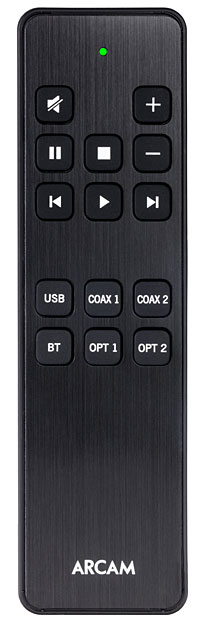 The perfect comparison would have set the irDAC-II against Chord's Mojo D/A headphone amplifier ($599), which I favorably reviewed in February 2016, and felt had a warm sound with a well-fleshed-out midrange. Our review sample had long since been returned to the distributor, however, so I reached for Meridian's Explorer D/A headphone amplifier ($299), which Art Dudley reviewed in September 2013.
I connected the Meridian via USB to my MacBook Pro and played files with Pure Music 3.0. I needed to switch DACs as quickly as possible, so, as the original Explorer has an optical S/PDIF output, I could use it to feed the same data to one of the Arcam's optical inputs. I could then adjust the Meridian's output level with Pure Music's dithered volume control, which also affects the level of the digital data from the Meridian's optical output. Once I'd adjusted the Arcam's output level to match the Meridian's, therefore, I could adjust the volume with Pure Music without worrying that I would interfere with the level matching between the two DACs. All comparisons were performed with AudioQuest's NightHawk headphones.
Art Dudley had written of the Explorer's headphone output that the sound was "a little more opaque" than he expected, and while I've enjoyed using the Meridian on and off since his review, compared with the Arcam's headphone output, yes—it was a little opaque. The individual singers in Eriks Esenvalds's "A Drop in the Ocean," from the Portland State Chamber Choir's 2013 album of that title (16/44.1 AIFF master file), were less distinguishable than with the irDAC-II, the sound a slight touch more midrange-dominant. The Arcam opened up a somewhat cleaner, clearer view into the recorded acoustic, which surprised me—I'd expected the Meridian's use of a minimum-phase reconstruction filter to give it an edge in that respect.
The irDAC-II's low frequencies also sounded a bit cleaner than the Explorer's, with more subjective extension. In "The Afterlife," from Paul Simon's So Beautiful or So What (24/96 ALAC file, Hear Music/HDtracks), the low-pitched drums were better defined and had more impact with the Arcam driving the AQs. With my unreleased recording of organist Jonas Nordwall playing the Toccata from Widor's Organ Symphony 5 (24/88.2 AIFF file), both DACs did surprisingly well with this recording's high levels of very low frequencies. At climaxes, however, the Arcam better preserved the sense of space in the First United Methodist Church of Portland, Oregon.
The perfect comparison would have set the irDAC-II against Chord's Mojo D/A headphone amplifier ($599), which I favorably reviewed in February 2016, and felt had a warm sound with a well-fleshed-out midrange. Our review sample had long since been returned to the distributor, however, so I reached for Meridian's Explorer D/A headphone amplifier ($299), which Art Dudley reviewed in September 2013.
I connected the Meridian via USB to my MacBook Pro and played files with Pure Music 3.0. I needed to switch DACs as quickly as possible, so, as the original Explorer has an optical S/PDIF output, I could use it to feed the same data to one of the Arcam's optical inputs. I could then adjust the Meridian's output level with Pure Music's dithered volume control, which also affects the level of the digital data from the Meridian's optical output. Once I'd adjusted the Arcam's output level to match the Meridian's, therefore, I could adjust the volume with Pure Music without worrying that I would interfere with the level matching between the two DACs. All comparisons were performed with AudioQuest's NightHawk headphones.
Art Dudley had written of the Explorer's headphone output that the sound was "a little more opaque" than he expected, and while I've enjoyed using the Meridian on and off since his review, compared with the Arcam's headphone output, yes—it was a little opaque. The individual singers in Eriks Esenvalds's "A Drop in the Ocean," from the Portland State Chamber Choir's 2013 album of that title (16/44.1 AIFF master file), were less distinguishable than with the irDAC-II, the sound a slight touch more midrange-dominant. The Arcam opened up a somewhat cleaner, clearer view into the recorded acoustic, which surprised me—I'd expected the Meridian's use of a minimum-phase reconstruction filter to give it an edge in that respect.
The irDAC-II's low frequencies also sounded a bit cleaner than the Explorer's, with more subjective extension. In "The Afterlife," from Paul Simon's So Beautiful or So What (24/96 ALAC file, Hear Music/HDtracks), the low-pitched drums were better defined and had more impact with the Arcam driving the AQs. With my unreleased recording of organist Jonas Nordwall playing the Toccata from Widor's Organ Symphony 5 (24/88.2 AIFF file), both DACs did surprisingly well with this recording's high levels of very low frequencies. At climaxes, however, the Arcam better preserved the sense of space in the First United Methodist Church of Portland, Oregon.
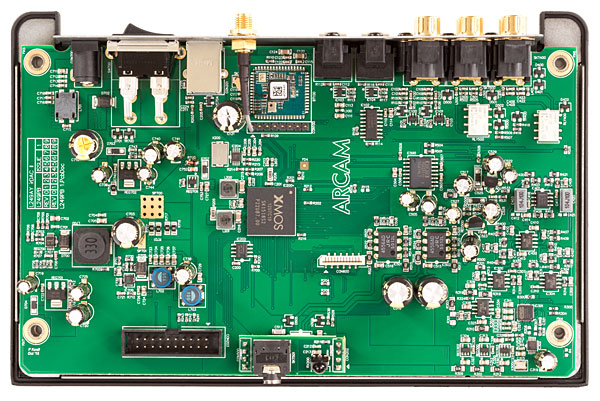 The Meridian is excellent value for money—or it was until it was replaced, at the same price, by the MQA-capable Explorer2, reviewed by Jim Austin in June 2016—but the Arcam adds S/PDIF inputs and edges it out in sound quality.
Listening with Blue Teeth
The Meridian is excellent value for money—or it was until it was replaced, at the same price, by the MQA-capable Explorer2, reviewed by Jim Austin in June 2016—but the Arcam adds S/PDIF inputs and edges it out in sound quality.
Listening with Blue Teeth
I had last listened extensively to Bluetooth-sourced audio with Arcam's rBlink D/A processor. Sam Tellig reviewed the rBlink in December 2013, with a Follow-Up from me in March 2014. I was impressed with the rBlink, concluding that while Bluetooth audio sourced from my MacBook Pro using the aptX codec still didn't approach CD quality, "it was surprisingly listenable for much of the music I heard while auditioning the rBlink," especially with classical recordings. With my iDevices, however, which don't have the aptX codec, the rBlink's treble sounded coarser in loud passages.
That was pretty much my experience with the irDAC-II's Bluetooth input: always listenable, if not completely involving. Listening to Paul Young's early-1980s reading of Marvin Gaye's "Wherever I Lay My Hat (That's My Home)," from No Parlez (256kbps AAC file)—a longtime favorite of mine for Pino Palladino's virtuosic fretless bass playing—the Bluetooth rendition sounded less strained through my Audeze LCD-X headphones when the music was sourced from the MacBook Pro than from my iPhone 6S. Similarly, the soprano voices in Esenvalds's "A Drop in the Ocean" sounded a touch on the shrieky side sourced from my phone. Via Bluetooth and a borrowed Android phone, the Paul Young track sounded pretty much identical to the same music sourced from the MacBook Pro, even—with signals approaching 0dBFS—with the distortion I measured using that phone as the source (see "Measurements" sidebar).
I still don't recommend Bluetooth for serious listening, but for background music, or social occasions at which people want to share the music on their smartphones, Arcam's implementation of it in the irDAC-II worked well.
 Summing Up
I enjoyed my time with Arcam's irDAC-II. It's a good-sounding product at an affordable price. And if you think I damn it with faint praise by describing it as "good," think on this: It's been said that the good is the enemy of the great, and while the high-priced D/A processors I've been living with in my big rig for a long time undoubtedly sound great, even the least expensive of them costs almost an order of magnitude more than the Arcam.
The Arcam doesn't offer MQA decoding, of course, but whether or not that's an issue will depend on the format's catching on—and that, in turn, will depend on whether there will be sufficient "pull" from the potential customer base. The irDAC-II also lacks such useful features as a display of sample rate—but so did my go-to D/A headphone amplifier of many years, the original Benchmark DAC1, which cost $995 without USB input or $1195 with (it was discontinued in 2015). In May 2004 I described the Benchmark as "an audiophile bargain," and my colleague Erick Lichte described it in an e-mail, in a reckless disregard for clichés, as a "Swiss army knife of audio." The Arcam irDAC-II is both of those things—and, at $749, costs significantly less than the Benchmark!
As it did in the big rig, the Arcam irDAC-II's headphone output offered, in absolute terms, a somewhat light balance combined with clean highs and an excellent presentation of recorded detail. It worked well with both the Audeze LCD-X and AudioQuest NightHawk headphones, less so with the Thinksound On2s, where the highs sounded a little aggressive. However, it could readily swing enough volts to drive the high-impedance Sennheiser HD650s to satisfying levels. But I needed to hear how it compared with other D/A headphone amplifiers.
The perfect comparison would have set the irDAC-II against Chord's Mojo D/A headphone amplifier ($599), which I favorably reviewed in February 2016, and felt had a warm sound with a well-fleshed-out midrange. Our review sample had long since been returned to the distributor, however, so I reached for Meridian's Explorer D/A headphone amplifier ($299), which Art Dudley reviewed in September 2013.
I connected the Meridian via USB to my MacBook Pro and played files with Pure Music 3.0. I needed to switch DACs as quickly as possible, so, as the original Explorer has an optical S/PDIF output, I could use it to feed the same data to one of the Arcam's optical inputs. I could then adjust the Meridian's output level with Pure Music's dithered volume control, which also affects the level of the digital data from the Meridian's optical output. Once I'd adjusted the Arcam's output level to match the Meridian's, therefore, I could adjust the volume with Pure Music without worrying that I would interfere with the level matching between the two DACs. All comparisons were performed with AudioQuest's NightHawk headphones.
Art Dudley had written of the Explorer's headphone output that the sound was "a little more opaque" than he expected, and while I've enjoyed using the Meridian on and off since his review, compared with the Arcam's headphone output, yes—it was a little opaque. The individual singers in Eriks Esenvalds's "A Drop in the Ocean," from the Portland State Chamber Choir's 2013 album of that title (16/44.1 AIFF master file), were less distinguishable than with the irDAC-II, the sound a slight touch more midrange-dominant. The Arcam opened up a somewhat cleaner, clearer view into the recorded acoustic, which surprised me—I'd expected the Meridian's use of a minimum-phase reconstruction filter to give it an edge in that respect.
The Meridian is excellent value for money—or it was until it was replaced, at the same price, by the MQA-capable Explorer2, reviewed by Jim Austin in June 2016—but the Arcam adds S/PDIF inputs and edges it out in sound quality.
Listening with Blue TeethI had last listened extensively to Bluetooth-sourced audio with Arcam's rBlink D/A processor. Sam Tellig reviewed the rBlink in December 2013, with a Follow-Up from me in March 2014. I was impressed with the rBlink, concluding that while Bluetooth audio sourced from my MacBook Pro using the aptX codec still didn't approach CD quality, "it was surprisingly listenable for much of the music I heard while auditioning the rBlink," especially with classical recordings. With my iDevices, however, which don't have the aptX codec, the rBlink's treble sounded coarser in loud passages.
Summing UpI enjoyed my time with Arcam's irDAC-II. It's a good-sounding product at an affordable price. And if you think I damn it with faint praise by describing it as "good," think on this: It's been said that the good is the enemy of the great, and while the high-priced D/A processors I've been living with in my big rig for a long time undoubtedly sound great, even the least expensive of them costs almost an order of magnitude more than the Arcam.