How can such tiny resonators do anything? That's what I'd wondered about the Harmonix tuning dots, but they produced results in my old room very similar to what the HFTs were doing here. The HFTs definitely improved the sound in very specific ways having to do with soundstaging and imaging, and not at all to do with harmonics, tonality, or instrumental textures—which was good: I wouldn't want any of that to change.
According to Synergistic Research, everything in your room resonates, and not necessarily in tune with the music. "The resonance of your listening room is literally pushing back on your soundstage, compressing the air and decay of notes and distorting fundamental harmonics in your favorite music." (Don't shoot—I'm only the messenger.) "HFTs literally cancel harmonic noise on any surface they are placed. . . . HFTs replace random out-of-tune resonance with sympathetic resonance that complements the music." Maybe Denney can tell us why the walls resonate out of tune with the music while HFTs resonate sympathetically with the music, and why these tiny resonant devices are powerful enough to overcome what an entire wall is doing.
When a visitor sits in The Chair, I remain off to the side by the equipment rack, where the left speaker dominates the sound—I don't get much of a stereo soundstage, and often can't hear much from the right speaker. After the HFTs were installed, Denney sat in The Chair to assess the results and I stood off to the left. I heard a credible stereo soundstage, though it still favored the left channel—as you'd hear if seated stage right in a hall. When I sat down, I heard or convinced myself that I heard an even more open, spacious sound: there was less room in the room.
Although my big Wilson Audio Alexandria XLF speakers sit close to the side and front walls, almost in the corners, they don't boom, and they do "disappear," producing a wide, deep soundstage that confounds first-time visitors. The HFTs didn't transform this sound. Rather, they enhanced and intensified all of the positive spatial qualities the system and room were already producing. Or you could say that the magician had sawn the lady right in two.
I don't care which—I'm not removing the HFTs from my room. I won't be conducting a double-blind test. And since they come with a money-back guarantee, I don't see how you can go wrong.
After the installation and listening were done, we went to dinner. On the way to the restaurant, my phone rang. I answered. My car's Bluetooth speaker allowed Denney and Walker to hear the caller begin the conversation: "Mikey, I called to tell you something weird. You know those ridiculous little things Ted Denney sells that you stick on the wall? Well, I'm almost ashamed to admit this to you, but they work. I just got a demo, and we did a before and after and then a before, and they work."
This was not a FOT (Friend of Ted) or a PES (Paid Effing Shill) or a WOA (Wacked-Out Audiophile). It was a very well-known and greatly respected member of the ABC (Audio Business Community) not known as a tweaker. I won't name him—any endorsement would be up to him, not me. I did, however, tell him who was listening in. We had a good laugh.
If you need proof that everything in your room resonates—even that empty potato-chip bag on the floor—watch The Visual Microphone: Passive Recovery of Sound from Video, produced by a group of MIT researchers (footnote 5). And on the day I wrote this column, Mo Rocca, host of CBS's Innovation Nation, did a feature story on the subject (footnote 6).
 Synergistic Research Active FEQ
Ted Denney had brought with him three other Synergistic Research accessories. One was the Active FEQ box ($995), which he says generates ultra-low-frequency radio-frequency (RF) pulses that act as low-frequency dither to overpower a listening room's ambient fields of RF and electromagnetic interference (RFI and EMI) produced by a WiFi network, fluorescent and LED lights, etc (footnote 7). You've probably noticed that your system sounds better at night (mine does). Denney claims it's because there's less RFI and EMI at that time of day. I've always chalked it up to less crap on the AC line, but whatever.
Place an FEQ between your speakers, plug in the FEQ's power and ground-plane plugs, and get ready for "for an immediate and unmistakable improvement in sound." If you've already got Synergistic HFTs installed in your room, the LF pulse will excite them and, Denney claims, all sonic hell will break loose.
Well, I've had two FEQs in my system for a few months now, and I've never unplugged them. They were installed after the HFTs and by then I didn't know WTF was causing what.
I played "Bron-Y-Aur Stomp," from Bernie Grundman's LP mastering of Led Zeppelin III, then the more recently remastered version sourced from 24-bit/96kHz masters. After listening, I pulled the FEQs' plugs and listened again. Damned if the stage didn't narrow somewhat, and lose a bit of the vivacious depth and retrieval of ambience I'd heard with the FEQs plugged in. It just sounded more spacious, and especially more transparent, with the FEQs plugged in. So I plugged them in again.
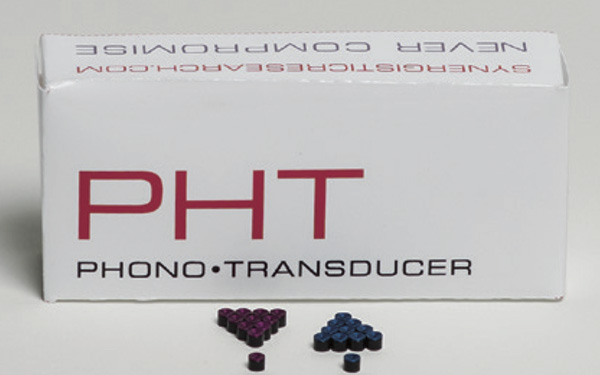 The PHT, pronounced pot
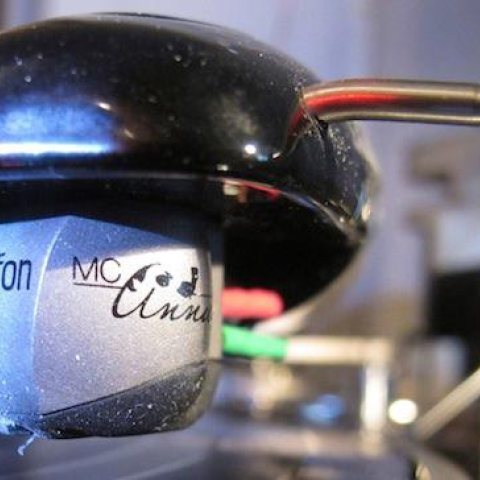
Synergistic's PHT ($199/set of two) is a very tiny, tweezer-ready HFT designed to placed atop a phono cartridge, and is marketed with a nod and wink: "grown in California, legal in all 50 states" (PHT is pronounced pot). Analog vets might remember Apature's line of moving-coil cartridges from the 1980s, which included the models Panama Red, Maui Blue, and Koce (which was white). Think I'm handing you a line? I've got a Koce here. The PHTs "tune" the system directly at the source. Of course, a cartridge is probably the most "tuned" component of an analog audio system. Cartridges are tuned for compliance, "tuned" on the basis of body and cantilever material, etc. Adding another tuning element isn't exactly a radical idea. Synergistic supplied two differently "tuned" PHTs, one blue ("Blue Velvet") and one purple ("Purple Haze"), though Denney says they can be made in an endless variety of "flavors"; he plans to launch a "subscription series." The Cobra tonearm of my Continuum Audio Labs Caliburn turntable doesn't grant access to the cartridge's body, so Denney stuck a blue PHT to one of the screws securing my Lyra Atlas cartridge to the Cobra's headshell—but not until I'd first played "Lullaby of Broadway," from a reissue of Tony Bennett's At Carnegie Hall (2 LPs, Columbia/Analogue Productions AAPP 823). This album's sound is astonishing: a huge, deep, wide, airy soundstage with precise image focus and what I'd thought was the highest level of transparency.
The addition of the HFTs and FEQs had enhanced the sound, but adding that blue PHT produced an ear-popping, Cinerama-like, wraparound soundstage, and an overall sound even less tethered to the speaker positions. The image focus was increased without producing razor sharpness, and there was greater front-to-back separation of sources within the soundstage.
In "All the Things You Are," Bennett's voice jumped forward in three-dimensional relief—almost alarmingly—while the xylophone hovered more convincingly well in front of the speaker plane. Decays were longer, and the backgrounds they faded into were "blacker." The applause produced layered, contoured, front-to-back of the room depth. It was easy enough to remove the PHT and, of course, reset the Lyra's vertical tracking force (VTF). It still sounded great, but with the blue PHT in place the sound was clearly better overall, with improved focus, three-dimensionality, and transparency. A purple PHT produced a less intense but equally noticeable change, mostly in increased midband richness and solidity.
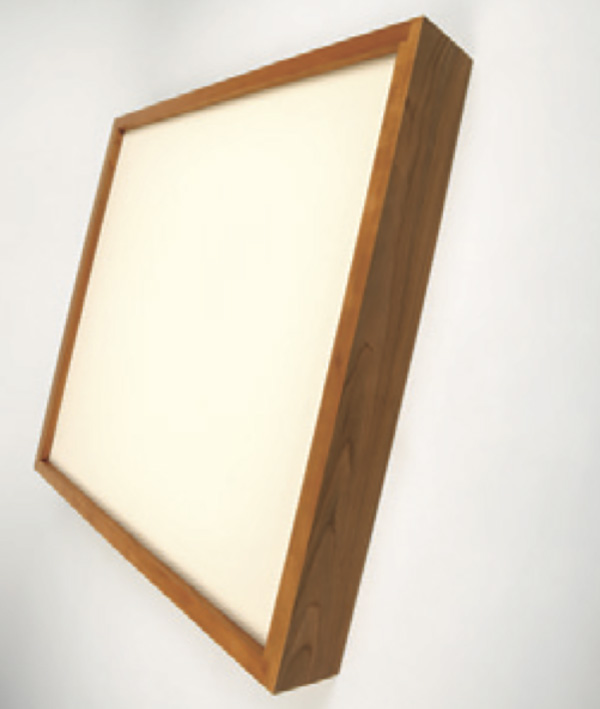 Stillpoints Aperture Room Treatment
Now for a more conventional room acoustics tuning product. Along with an ESS equipment rack, Stillpoints' Bruce Jacobs brought over for review four Aperture Room Treatments, which he says were designed by the acoustician who invented Sonex panels. Each attractive Aperture is a panel of fabric stretched over a wooden frame; it measures 22" × 22" × 3 1/8" thick, weighs 14lb, and costs $650 (footnote 8). The Apertures don't share the exotic contours of some other room treatments, but their effect in my room was dramatic: almost a sonic black hole.
Jacobs placed two Apertures, one atop the other, on the waist-high wall ledge between the speakers (they can also be hung). Despite the fact that my room had already been well treated with Synergistic's HFT and FEQ devices, the Stillpoints made the boundary seem to disappear, greatly enhancing center-image stability, solidity, and focus—areas where I'd thought no improvements were possible.
A second pair of Apertures, placed on the floor against the wall to the side of each speaker, removed the sense of there being any sidewalls at all. While RPG's Skylines had made a modest improvement, the Stillpoints Apertures produced a truly dramatic and positive change in the sound. Your dealer should let you take some home to try out. If your experience with them is like mine, you won't return them.
Footnote 5: See www.youtube.com/watch?v=FKXOucXB4a8. Footnote 6: See www.thehenryford.org/innovationNation/episode8.asp. Footnote 7: See stereophile.com/content/rmaf-2014-john-atkinson-wraps-his-wreport. Footnote 8: Stillpoints, 573 County Road A, Suite 103, Hudson, WI 54016. Tel: (651) 315-4248. Web: www.stillpoints.us
Synergistic Research Active FEQTed Denney had brought with him three other Synergistic Research accessories. One was the Active FEQ box ($995), which he says generates ultra-low-frequency radio-frequency (RF) pulses that act as low-frequency dither to overpower a listening room's ambient fields of RF and electromagnetic interference (RFI and EMI) produced by a WiFi network, fluorescent and LED lights, etc (footnote 7). You've probably noticed that your system sounds better at night (mine does). Denney claims it's because there's less RFI and EMI at that time of day. I've always chalked it up to less crap on the AC line, but whatever.
The PHT, pronounced potSynergistic's PHT ($199/set of two) is a very tiny, tweezer-ready HFT designed to placed atop a phono cartridge, and is marketed with a nod and wink: "grown in California, legal in all 50 states" (PHT is pronounced pot). Analog vets might remember Apature's line of moving-coil cartridges from the 1980s, which included the models Panama Red, Maui Blue, and Koce (which was white). Think I'm handing you a line? I've got a Koce here. The PHTs "tune" the system directly at the source. Of course, a cartridge is probably the most "tuned" component of an analog audio system. Cartridges are tuned for compliance, "tuned" on the basis of body and cantilever material, etc. Adding another tuning element isn't exactly a radical idea. Synergistic supplied two differently "tuned" PHTs, one blue ("Blue Velvet") and one purple ("Purple Haze"), though Denney says they can be made in an endless variety of "flavors"; he plans to launch a "subscription series." The Cobra tonearm of my Continuum Audio Labs Caliburn turntable doesn't grant access to the cartridge's body, so Denney stuck a blue PHT to one of the screws securing my Lyra Atlas cartridge to the Cobra's headshell—but not until I'd first played "Lullaby of Broadway," from a reissue of Tony Bennett's At Carnegie Hall (2 LPs, Columbia/Analogue Productions AAPP 823). This album's sound is astonishing: a huge, deep, wide, airy soundstage with precise image focus and what I'd thought was the highest level of transparency.
Stillpoints Aperture Room TreatmentNow for a more conventional room acoustics tuning product. Along with an ESS equipment rack, Stillpoints' Bruce Jacobs brought over for review four Aperture Room Treatments, which he says were designed by the acoustician who invented Sonex panels. Each attractive Aperture is a panel of fabric stretched over a wooden frame; it measures 22" × 22" × 3 1/8" thick, weighs 14lb, and costs $650 (footnote 8). The Apertures don't share the exotic contours of some other room treatments, but their effect in my room was dramatic: almost a sonic black hole.
Footnote 5: See www.youtube.com/watch?v=FKXOucXB4a8. Footnote 6: See www.thehenryford.org/innovationNation/episode8.asp. Footnote 7: See stereophile.com/content/rmaf-2014-john-atkinson-wraps-his-wreport. Footnote 8: Stillpoints, 573 County Road A, Suite 103, Hudson, WI 54016. Tel: (651) 315-4248. Web: www.stillpoints.us