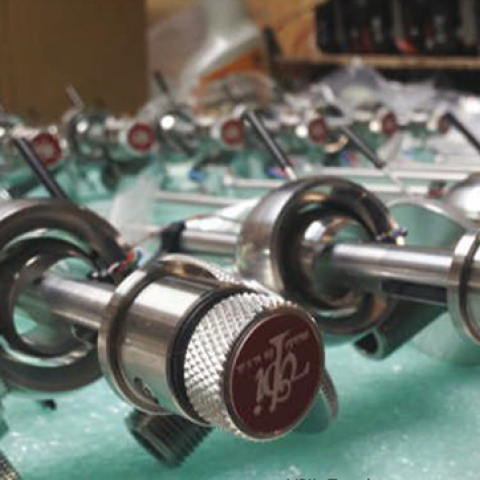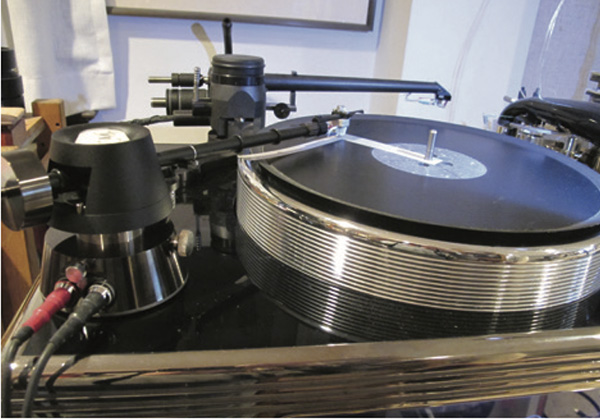
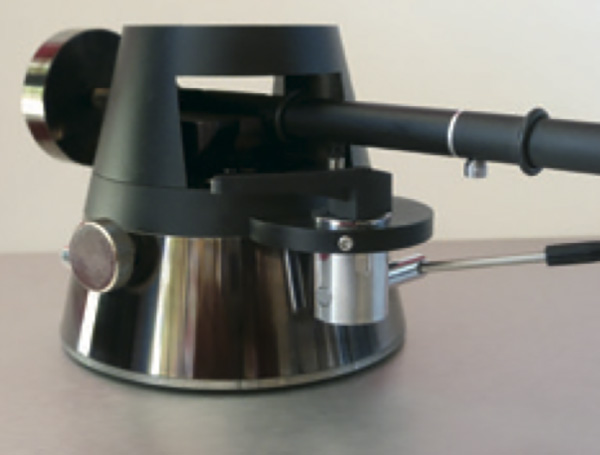
The RF tonearm sits on a massive base that will unbalance sprung-subchassis turntables.
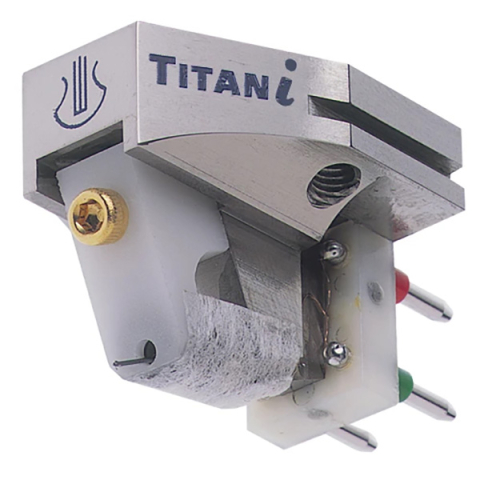
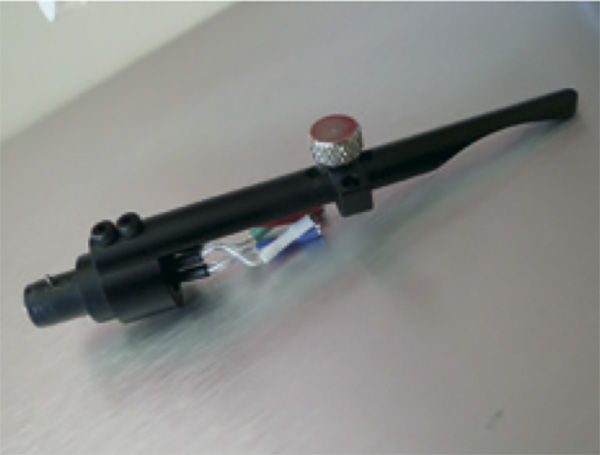
Setting Up the ViV Labs Rigid FloatThough the one-sheet accompanying the Rigid Float 9 says "just put it anywhere," that's not quite true. The tonearm comes with an L-shaped alignment jig that you put over the spindle (the hole is too big and the fit is sloppy). As with SME's alignment system, you line up the straight arm tube directly over the jig, but instead of sliding the arm along a track to set overhang, you set underhang by manually moving the base until the stylus sits in a tiny, almost invisible circle near the end of the L jig. Also as with the SME system, more than a bit of subjectivity is involved in outlining the armtube against the jig below. The arm base's considerable weight makes it unsuitable for spring-suspended turntables. At worst, the weight will collapse many spring suspensions; at best, it will de-level the plinth and require the sort of adjustment of spring compensation that causes Linn owners, for instance, mental breakdowns—unless you can mount the arm on an external pod. A perfectly level pod is required for proper operation; a large bubble level is set into this one's top. I set up the Rigid Float 9 on three turntables: the VPI Classic Direct Drive, the Continuum Audio Labs Caliburn, and the Music Hall MMF 11.1. Cartridges used were the Lyra Helikon SL and Titan i, and the Transfiguration Phoenix.
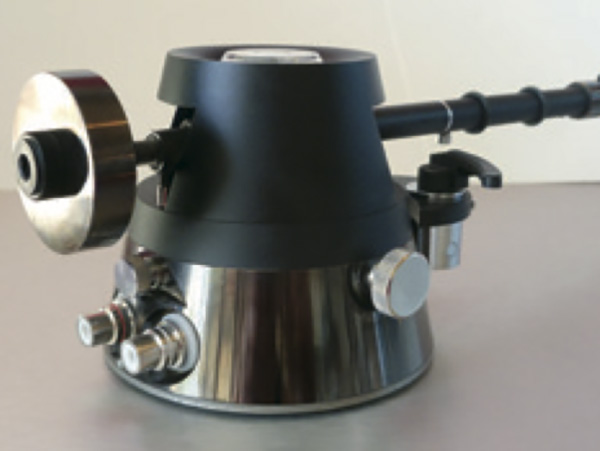 Once I'd installed the cartridge, approximated the VTF, correctly positioned the arm, and set the underhang, it was time to fine-tune the VTF. Here is where I ran into the first problem with the Rigid Float: setting precise VTF proved very difficult. First, the counterweight "system" consists of two weights that fit very loosely on a threaded rod extending from the back of the arm. If you could use both weights, you could snug one up against the other to tighten them; however, balancing each of the three cartridges I tried required only one weight.
At first, I quickly set the Phoenix to about 1.75gm. When I re-checked it after positioning the arm and saw that the VTF was now over 2.2gm, I figured I'd bumped the counterweight, or that it sat so loosely on its threaded shaft that it had rotated on its own. But when I took more time and care in setting VTF, I discovered the problem: the Rigid Float 9 has a very long settling time. I set the VTF to 1.8gm; it appeared to have settled—the tiny circle on the gauge that indicates "settled" had appeared—but instead of removing the gauge, I watched and waited. Over the next 90 seconds, the gauge went from 1.8 to 2.52gm.
I reset VTF so that, when the ViV Lab arm was finished settling, the gauge read 1.8gm. But the Rigid Float really never fully settled—and this was on the unsuspended VPI 'table sitting on a rock-stable HRS base. I took that VTF reading near the outer edge of the platter. When I measured near the inner-groove area, I found a 0.25gm discrepancy. I then raised the gauge about ½" and observed a drop of 0.25gm, which indicated that the arm was, like the Kuzma 4Point, negatively balanced. Unless you play a lot of seriously warped records, that will not be a serious problem, in my opinion.
Once I'd installed the cartridge, approximated the VTF, correctly positioned the arm, and set the underhang, it was time to fine-tune the VTF. Here is where I ran into the first problem with the Rigid Float: setting precise VTF proved very difficult. First, the counterweight "system" consists of two weights that fit very loosely on a threaded rod extending from the back of the arm. If you could use both weights, you could snug one up against the other to tighten them; however, balancing each of the three cartridges I tried required only one weight.
At first, I quickly set the Phoenix to about 1.75gm. When I re-checked it after positioning the arm and saw that the VTF was now over 2.2gm, I figured I'd bumped the counterweight, or that it sat so loosely on its threaded shaft that it had rotated on its own. But when I took more time and care in setting VTF, I discovered the problem: the Rigid Float 9 has a very long settling time. I set the VTF to 1.8gm; it appeared to have settled—the tiny circle on the gauge that indicates "settled" had appeared—but instead of removing the gauge, I watched and waited. Over the next 90 seconds, the gauge went from 1.8 to 2.52gm.
I reset VTF so that, when the ViV Lab arm was finished settling, the gauge read 1.8gm. But the Rigid Float really never fully settled—and this was on the unsuspended VPI 'table sitting on a rock-stable HRS base. I took that VTF reading near the outer edge of the platter. When I measured near the inner-groove area, I found a 0.25gm discrepancy. I then raised the gauge about ½" and observed a drop of 0.25gm, which indicated that the arm was, like the Kuzma 4Point, negatively balanced. Unless you play a lot of seriously warped records, that will not be a serious problem, in my opinion.
 Sound
SoundMultiple variables were at work, so it was difficult to determine what was producing the Viv Lab Rigid Float 9's consistent sound quality. However, the three cartridges all sounded more lush, more full bodied, more richly textured than they do in more traditional tonearms. I don't know about you, but the sound produced by my turntable and tonearm using the Löfgren A offset geometry and carefully set antiskating has never produced obvious unwanted sonic artifacts. In fact, ever since I got really serious about turntable setup—using a precision overhang gauge, a digital microscope, and a WallySkater or a track from Telarc's Omnidisc test LP—and began setting azimuth electronically, whether with Dr. Feickert Analogue software, a digital oscilloscope, or the most primitive but still efficacious voltmeter at the speaker outputs (as described on my turntable-setup DVD), the absence of audible distortion, shifting images, or other unwanted artifacts has always impressed and amazed me. Other than the lifelike sound only vinyl provides, you aren't aware that you're playing vinyl.
 The main event sounded enriched, while the context—the space around the instruments, as well as the space in which all of them were played—was significantly diminished. It was almost as if my system's electronics had been swapped out for warm, rolled-off–sounding tube gear. Instruments and voices were full-bodied, round, and solid. Harmonics were intensified, but transient attack was only slightly softened, which was impressive.
I thoroughly enjoyed spending time with ViV Lab's Rigid Float 9 tonearm. Clearly a result of a designer thinking outside the box, it represents some original thinking, and produced a sound that many will appreciate. But I was seriously troubled by the arm's drifting VTF, which no amount of fiddling seemed to fully resolve. Correct, consistent, repeatable VTF across a record's surface, and quick, nearly instantaneous settling time strike me as crucial, and these were things the Rigid Float seemed incapable of providing.
 Upsetting apple carts
Defective products aren't often encountered in Stereophile reviews. Products found to be defective are returned for working samples, though the fact that the sample was defective is still noted in the review. That standard operating procedure was tripped up by the ViV Laboratory Rigid Float tonearm's unorthodox design and poorly translated instruction manual. The manual states something unusual: "Often the recommended tracking force is not the best because of various conditions. We strongly recommend to try to find the best tracking force frequently." (My italics.) So I assumed that the difficulties I experienced in finding the right vertical tracking force (VTF) were normal. Also, the instructions don't mention a small, knurled aluminum nut that's used to secure the counterweight. So after removing all of the pieces mentioned in the manual, I closed the box and got to work setting up the arm.
 Underhung Sound
The 7" and 9" Rigid Float arms had sonic personalities that seemed to go along with their increased freedom of movement They sounded more open, airy, and extended on top than the first, longer, sample, while the midrange of each was gloriously smooth, and images were rock-solidly three-dimensional. Bass was meaty and full bodied, yet well controlled. Tonally, these arms sounded like Miyajima Labs cartridges, though with less soundstage depth than those cartridges produce. I recently received a copy of No Place to Fall (LP, Monsoon MS 204), an album superbly recorded, live in the studio, by West Coast singer-songwriter Kathleen Grace. Grace has three previous albums to her credit; in this one, she "plants her jazz roots in the soil of classic country music."
The first review sample's tonal presentation was generally similar to these two newer samples, but was far more closed down, obviously colored, and almost claustrophobic. The two correctly functioning samples produced a far better-balanced sound that I'm sure will appeal to some listeners—particularly those of the "vintage gear persuasion." As I wrote about my experience with the first sample of this tonearm, if you love to the exclusion of most everything else the romantic, vintage, midrangey sound that some people insist is "music," the ViV Laboratory Rigid Float is made for you. Assuming the tonearm's sound is a result of its geometry and not its "floating" technology, are the other four arms producing additive sonic effects due to skating issues? My take is that the Rigid Float—either because of its underhung geometry, or its non-grounded bearing system, or both—has a singularly smooth, lush sound that some listeners will instantly crave. Those folks should drop a ViV Lab Rigid Float into their system ASAP and find out for themselves.