Setting up the Simplicity tonearm is far from simple. First you install your cartridge in a slotted headshell that will eventually lock into the arm's pivoting carrier (think of the old Dual system) using low-profile screws (supplied). The screws should be tight enough to prevent easy movement and loose enough to permit further adjustment.
You then slide the headshell into a large jig (supplied) called a Sight Unit, making sure there's enough clearance between the headshell and the carrier's transparent acrylic top plate, to avoid breaking the cartridge's cantilever. Unlike the arm's locking carrier, the Sight Unit tray does not lock the headshell in place (see disaster below). Crosshairs are etched into the Sight Unit's top plate. The idea is to align the cartridge so that the stylus sits at the center of the crosshairs and the cantilever is in line with the vertical crosshair (see photo below).
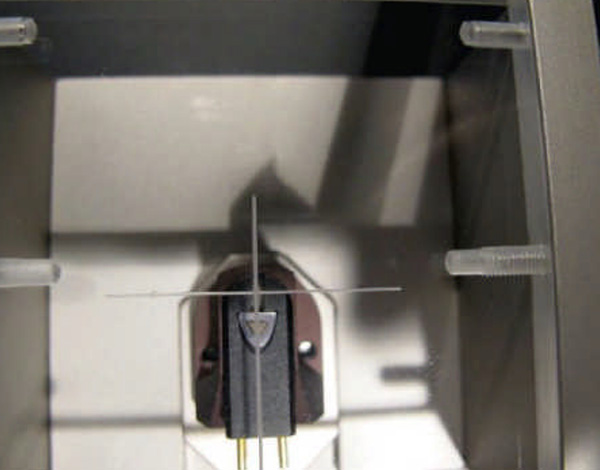
That sounds good; in practice, it was less than effective. For starters, the crosshairs are so thick they pretty much obscure the stylus and its cantilever. Because you can't use a magnifying loupe at the distance required to use the parallax system, the two parts of the system that must be used simultaneously to achieve an accurate result can't be. The alignment I achieved was, at best, a guesstimate. What's more, the cartridge rests on its back during this process, so the amount of stylus deflection caused by VTF can't be taken into account.
Once you've aligned the stylus as best you can, the instructions tell you to "tighten the screws from underneath if needed." Well, of course, if you can slide the cartridge in the slots to make the adjustment, tightening is definitely needed. I raised the structure to access the screws below, and the headshell and cartridge, which I'd mistakenly thought had been secured in Sight Unit slid out and hit the floor. Result: one newly retipped and unplayed Lyra Titan i ($5995) destroyed.
Admittedly, it was partly my fault, but the instructions should not have read "tighten the screws from underneath as needed" unless the Sight Unit securely held the headshell. They should have read "remove headshell, tighten screws, replace, and recheck alignment." But I follow directions to a fault.
I repeated the entire procedure using the latest Transfiguration Phoenix cartridge, then slid the headshell into the headshell carrier, fixing it in place by tightening a tiny setscrew at the carrier's front.
Setting VTF is straightforward, while setting the cartridge's vertical tracking angle (VTA) and stylus rake angle (SRA) are similar to SME's system. It's not for the VTA/SRA obsessive, of which I'm not one. Get me to 92° and I'm done.
You can adjust azimuth by loosening two tiny screws on the Simplicity's cardanic bearing, but the instructions recommend against doing so. I didn't. "If the cartridge is manufactured correctly," the instructions say, "there is no adjustment needed" How often is that the case? Not very often.
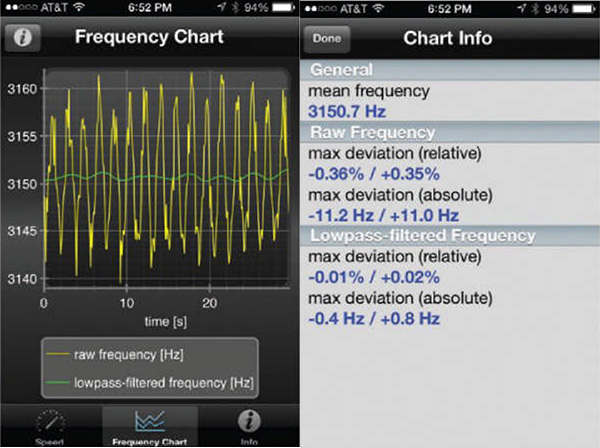
Dr. Feickert Analogue's PlatterSpeed app demonstrated that the physical symmetry of the Thales TTT-Compact's drive system translated into symmetrical speed accuracy (fig.1). At 33 1/3rpm, a 3150Hz tone was reproduced as 3150.7Hz. Low-pass-filtered to remove the effects of record eccentricities, the relative maximum deviation from the average speed was –0.01%/+0.02%, while the maximum absolute deviation was 0.4Hz/+0.8Hz. These are outstanding results (fig.2). At 45rpm, however, even with the increase-speed potentiometer all the way up, the TTT-C's speed was slightly slow. A 4253Hz tone measured 4242.3Hz. Pitch consistency, however, was as good as at 33 1/3. The TTT-C was as immune from external impulses as I can recall any turntable being that I've ever reviewed. A good thump on the HRS base produced only the faintest tap from the speakers, and it was brief and very well controlled. A thump on the 'table's plinth produced the same minimal response. Measuring the Simplicity arm's antiskating deflection using the Wally Tools Skater, which suspends the tonearm by a thread, revealed a serious problem: the Simplicity stuck in whatever position I placed it. A truly free bearing system would allow the arm to swing in the breeze, and let you measure the amount of antiskating deflection with a plumb-bob reference.
In my listening room, the Simplicity's arm stuck only once. But on the first day of the recent Rocky Mountain Audio Fest, in the room of HiFiction's US importer, Aaudio Imports, the Simplicity stuck so often that it was unusable. A replacement arm flown in the next day was equally problematic.
 Listening
I ran the Thales TTT-Compact turntable and Simplicity tonearm using a few different cartridges—the original Clearaudio Goldfinger, the Transfiguration Phoenix, and a retipped Ortofon A90 (the Titan i went back for another retip)—all set up as accurately as I could manage. In assessing the system's sound, it's impossible to separate the arm from the 'table. Overall, the TTT-C's stability of pitch and speed produced rock-solid images and ultraclean transient response. Equally notable were the 'table's rhythm'n'pace—the qualities that make you want to listen to record after record, and that help create a sense of relaxation. This is a very accomplished platter spinner.
The Thales turntable-tonearm combo produced very well controlled, rhythmically taut bass—not the deepest, most extended, or best textured, but whatever it gave up in those terms it more than made up for in solidity and stability. There was great punch from the drums in "The Boy in the Bubble," from Paul Simon's Graceland (LP, Columbia/Legacy 88691914721), but not the full weight. I'll take punch any day over flab or overhang, but I thought the midbass was somewhat attenuated. Still, if you value clarity of line over warmth and weight, you'll get it from this combo.
The midband was tonally neutral and commendably transparent. Except for a top end that was brighter, than I'd expected, though not at all peaky, each of the three cartridges' spectral personalities shone through. The Goldfinger's top end sounded somewhat like the peaky old Clearaudio Insider. A properly set up Ortofon A90 won't sound bright and etchy, but it will sound well extended and somewhat analytical. Here it sounded as if it had a rising top end, but it still wasn't peaky.
Overall, though, the TTT-C and Simplicity combo produced clean, consistent attacks from top to bottom, somewhat less than fully generous sustain, and very impressive decays into black, this last no doubt the result of a very quiet, well-damped drive system. I'd run it with a cartridge on the warm side, though—perhaps a Jan Allaerts, a Mysonic Labs, or a Koetsu.
What about the audible benefit of tangential tracking? The sound across the entire side of an LP was remarkably consistent, particularly in terms of the cleanness of sibilants and percussive transients—but can one really distinguish a (close-to) tangential tracker from a well-set-up pivoted tonearm?
 To answer that question, using the Thales Simplicity and the Kuzma 4Point arms, I made a CD-R of the last 10 minutes of Gershwin's Rhapsody in Blue, from an upcoming and spectacular-sounding reissue of the classic recording by Earl Wild, with Arthur Fiedler and the Boston Pops (LP, RCA Living Stereo/Analogue Productions LSC-2367). It's a severe tracking test, with massive orchestral climaxes interwoven with Wild's piano. The reissue is rich with hall sound but, for whatever reason, not nearly as (over-)reverberant as the original.
I took this CD-R along to the Rocky Mountain Audio Fest, played it in many rooms, and asked people which version was made with a pivoted arm, which with a tangential tracker. No one could tell, and no one heard inner-groove tracking distortion from either.
To answer that question, using the Thales Simplicity and the Kuzma 4Point arms, I made a CD-R of the last 10 minutes of Gershwin's Rhapsody in Blue, from an upcoming and spectacular-sounding reissue of the classic recording by Earl Wild, with Arthur Fiedler and the Boston Pops (LP, RCA Living Stereo/Analogue Productions LSC-2367). It's a severe tracking test, with massive orchestral climaxes interwoven with Wild's piano. The reissue is rich with hall sound but, for whatever reason, not nearly as (over-)reverberant as the original.
I took this CD-R along to the Rocky Mountain Audio Fest, played it in many rooms, and asked people which version was made with a pivoted arm, which with a tangential tracker. No one could tell, and no one heard inner-groove tracking distortion from either.
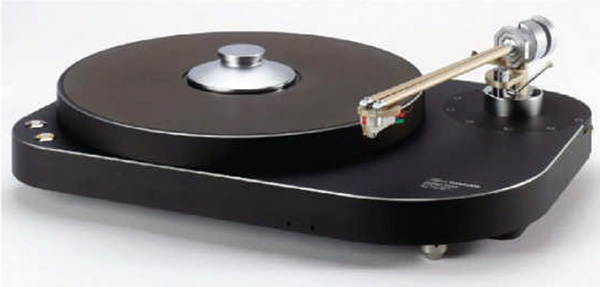 Conclusions
I was impressed by the Thales TTT-C turntable, but would like to hear it again with a familiar tonearm. As an engineering exercise, the Thales Simplicity tonearm is brilliantly designed and executed (footnote 2). However, despite Huber's ingenious, even heroic engineering, the Simplicity, with its high-friction horizontal bearing and what I suspect is a bright sonic signature, is not worth the cost simply to achieve near-tangential tracking—which probably seldom, if ever, produces a significant improvement in the sound.
Footnote 2: Michael Fremer reviewed the Thales Simplicity II tonearm in December 2014; Art Dudley reviewed the Simplicity II in August 2019.—Editor.
The Simplicity Sight Unit tray's thickly etched crosshairs obscure the cartridge's cantilever and stylus.
A parallax sight line is provided by a triangle described by three dimples machined into the plate below, one on either side of the cartridge cutout and one centered at the top. When the top of the vertical crosshair and the sides of the horizontal crosshair align with the three dimples, you're viewing the cartridge from directly above.
Fig.1 (left) TTT-Compact turntable, Feickert app speed readout. The high-pass filtered green line reveals the speed consistency. Fig.2 (right) TTT-Compact turntable, Feickert app data. These are excellent numbers.
A few tests before listeningDr. Feickert Analogue's PlatterSpeed app demonstrated that the physical symmetry of the Thales TTT-Compact's drive system translated into symmetrical speed accuracy (fig.1). At 33 1/3rpm, a 3150Hz tone was reproduced as 3150.7Hz. Low-pass-filtered to remove the effects of record eccentricities, the relative maximum deviation from the average speed was –0.01%/+0.02%, while the maximum absolute deviation was 0.4Hz/+0.8Hz. These are outstanding results (fig.2). At 45rpm, however, even with the increase-speed potentiometer all the way up, the TTT-C's speed was slightly slow. A 4253Hz tone measured 4242.3Hz. Pitch consistency, however, was as good as at 33 1/3. The TTT-C was as immune from external impulses as I can recall any turntable being that I've ever reviewed. A good thump on the HRS base produced only the faintest tap from the speakers, and it was brief and very well controlled. A thump on the 'table's plinth produced the same minimal response. Measuring the Simplicity arm's antiskating deflection using the Wally Tools Skater, which suspends the tonearm by a thread, revealed a serious problem: the Simplicity stuck in whatever position I placed it. A truly free bearing system would allow the arm to swing in the breeze, and let you measure the amount of antiskating deflection with a plumb-bob reference.
ListeningI ran the Thales TTT-Compact turntable and Simplicity tonearm using a few different cartridges—the original Clearaudio Goldfinger, the Transfiguration Phoenix, and a retipped Ortofon A90 (the Titan i went back for another retip)—all set up as accurately as I could manage. In assessing the system's sound, it's impossible to separate the arm from the 'table. Overall, the TTT-C's stability of pitch and speed produced rock-solid images and ultraclean transient response. Equally notable were the 'table's rhythm'n'pace—the qualities that make you want to listen to record after record, and that help create a sense of relaxation. This is a very accomplished platter spinner.
To answer that question, using the Thales Simplicity and the Kuzma 4Point arms, I made a CD-R of the last 10 minutes of Gershwin's Rhapsody in Blue, from an upcoming and spectacular-sounding reissue of the classic recording by Earl Wild, with Arthur Fiedler and the Boston Pops (LP, RCA Living Stereo/Analogue Productions LSC-2367). It's a severe tracking test, with massive orchestral climaxes interwoven with Wild's piano. The reissue is rich with hall sound but, for whatever reason, not nearly as (over-)reverberant as the original.
I took this CD-R along to the Rocky Mountain Audio Fest, played it in many rooms, and asked people which version was made with a pivoted arm, which with a tangential tracker. No one could tell, and no one heard inner-groove tracking distortion from either.
ConclusionsI was impressed by the Thales TTT-C turntable, but would like to hear it again with a familiar tonearm. As an engineering exercise, the Thales Simplicity tonearm is brilliantly designed and executed (footnote 2). However, despite Huber's ingenious, even heroic engineering, the Simplicity, with its high-friction horizontal bearing and what I suspect is a bright sonic signature, is not worth the cost simply to achieve near-tangential tracking—which probably seldom, if ever, produces a significant improvement in the sound.
Footnote 2: Michael Fremer reviewed the Thales Simplicity II tonearm in December 2014; Art Dudley reviewed the Simplicity II in August 2019.—Editor.