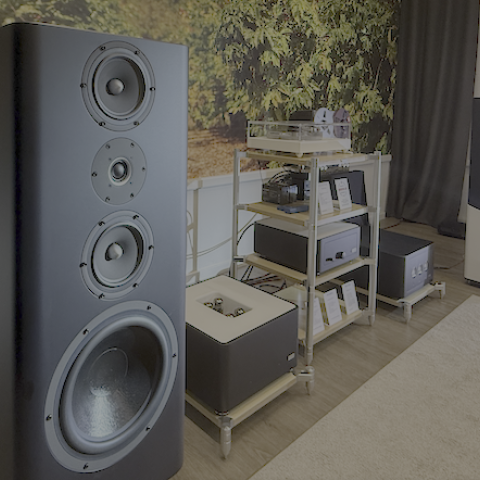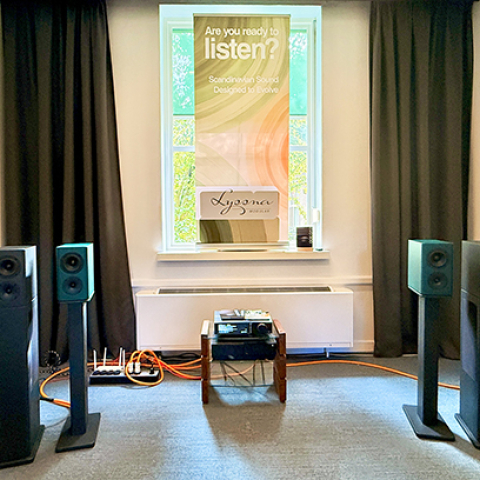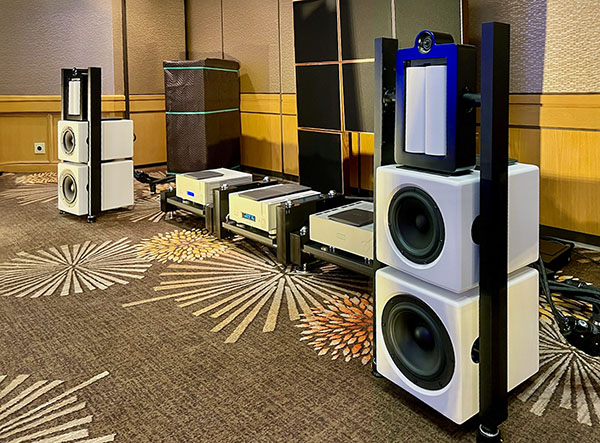
I hadn't come across the distributor Aaudio Imports for a time—I learned they had moved from Colorado, to California—so it was interesting to see what was new in their world. In a rather large room, Laguna 1, the speakers were striking, even unusual looking. They are from AudioNec, a French brand that Aaudio recently began importing.
The AudioNec Evo 2 speakers ($54,000/pair) are modular, with a wideband array dubbed DuoPole (a dipole variant) that's said to cover 400Hz–10kHz. A supertweeter (10kHz–30kHz) with a ring radiator was positioned above the DuoPole within the same metal framework. One, two, or more modular woofer units can be incorporated to extend bass response: Here, the upper (midbass) unit covered 200Hz–400Hz; the bottom (bass) unit 25Hz–200Hz.
DuoPole is a proprietary design that incorporates two vertical, lightweight cylindrical—almost scroll-like—open diaphragms (without an enclosure) fixed within a frame at top and bottom but otherwise free to move. The sound is nearly omnidirectional, akin to a bending-wave transducer, but it's more a dipole/transmission line hybrid. The diaphragms operate by "pinching" instead of "pushing" air as a pistonic driver speaker would—not unlike an Air Motion Transformer (AMT) tweeter. It uses a magnetic motor with neodymium magnets that generate a magnetic field over a Tesla coil in the air gap in the center, according to information that AudioNec provided. The diaphragm's shape serves as "a natural horn flare," for increased efficiency. Indeed, the DuoPole has a sensitivity specified between 95dB and 100dB/W/1m, depending on the speaker model.
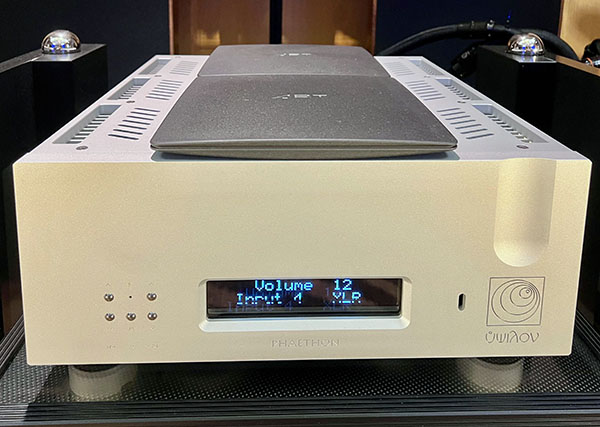
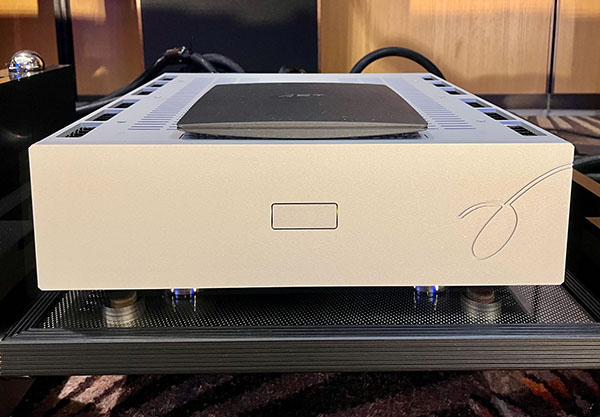 The speakers were powered by an Ypsilon Phaethon SE hybrid integrated amplifier ($50,000), which has a "bridged single ended output stage." Digital source gear included an Ypsilon DAC 1000 ($50,000), an all-tube converter, and a Pink Faun 2.16 Ultra music server and streamer ($35,000).
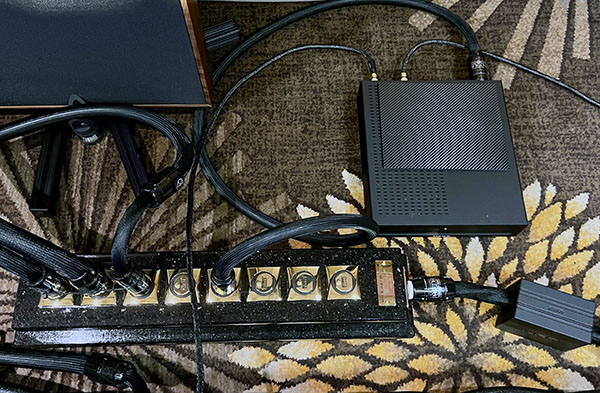
 The Aaudio system also utilized an XACT N1 network switch from Poland, an HB Cable Design PowerSlave Marble MKII power distributor, which is indeed made of marble ($21,500), cabling from Stage III, and a Wilson Benesch R1 carbon fiber modular hi-fi rack ($10,500). And don't forget the accessories: NODE modular gear from the UK for component and cable support, and US maker ART's EMI 6Xs ($6500) and 22X ($11,500) electromagnetic room-treatment accessories.
An organ track excerpt showed solid deep-bass extension. On a listen to Beck's "Paper Tiger," from his classic 2002 album Sea Change, the bass grooves came through cleanly. Strings sounded full and lush, remaining smooth and sweet well up into the treble.
The Aaudio system also utilized an XACT N1 network switch from Poland, an HB Cable Design PowerSlave Marble MKII power distributor, which is indeed made of marble ($21,500), cabling from Stage III, and a Wilson Benesch R1 carbon fiber modular hi-fi rack ($10,500). And don't forget the accessories: NODE modular gear from the UK for component and cable support, and US maker ART's EMI 6Xs ($6500) and 22X ($11,500) electromagnetic room-treatment accessories.
An organ track excerpt showed solid deep-bass extension. On a listen to Beck's "Paper Tiger," from his classic 2002 album Sea Change, the bass grooves came through cleanly. Strings sounded full and lush, remaining smooth and sweet well up into the treble.
 Individuated images of instruments and textural details were conveyed well on Tori Amos's "Past the Mission," from the half-speed remastered reissue of Under the Pink. Her Bösendorfer piano's timbre seemed natural. Music sounded full, three dimensional, and open, easily filling the large room.
The speakers were powered by an Ypsilon Phaethon SE hybrid integrated amplifier ($50,000), which has a "bridged single ended output stage." Digital source gear included an Ypsilon DAC 1000 ($50,000), an all-tube converter, and a Pink Faun 2.16 Ultra music server and streamer ($35,000).
The Aaudio system also utilized an XACT N1 network switch from Poland, an HB Cable Design PowerSlave Marble MKII power distributor, which is indeed made of marble ($21,500), cabling from Stage III, and a Wilson Benesch R1 carbon fiber modular hi-fi rack ($10,500). And don't forget the accessories: NODE modular gear from the UK for component and cable support, and US maker ART's EMI 6Xs ($6500) and 22X ($11,500) electromagnetic room-treatment accessories.
An organ track excerpt showed solid deep-bass extension. On a listen to Beck's "Paper Tiger," from his classic 2002 album Sea Change, the bass grooves came through cleanly. Strings sounded full and lush, remaining smooth and sweet well up into the treble.
Individuated images of instruments and textural details were conveyed well on Tori Amos's "Past the Mission," from the half-speed remastered reissue of Under the Pink. Her Bösendorfer piano's timbre seemed natural. Music sounded full, three dimensional, and open, easily filling the large room.