Tube Power Amp Reviews

Sort By:  Post Date TitlePublish Date

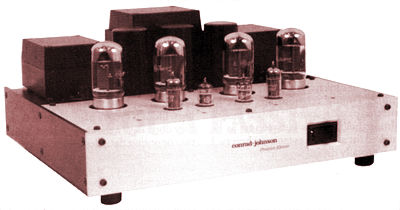
Conrad-Johnson Premier Twelve monoblock amplifier

Conrad-Johnson is one of audio's "marquee" companies, and charges accordingly. The Premier Twelve tube monoblock power amplifier, rated at 140W, sells for a rather steep $3495 each, meaning that unless you listen in mono, be prepared to lay out almost $7000 just for the amplification link in your audio chain. Apparently, many audiophiles feel the money is well spent: according to Conrad-Johnson, the Twelve has been a consistently strong seller during its approximately five-year production history.
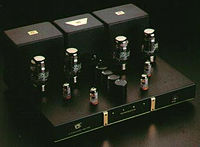
VTL MB750 monoblock power amplifier

How much power do you really need? What does it do for you, anyway? Even before the single-ended renaissance, the prevailing wisdom was that you really didn't need that much power. When I had a pair of Met 7 speakers, even the "1 watt" indicator LED was hardly ever lit. Ditto for my time with a Threshold Stasis Two—all those cool power-indicator LEDs just sat there dark. Besides, everyone knows that power can be had only at tremendous cost, both monetary and in terms of other performance attributes.

Balanced Audio Technology VK-5 preamplifier & VK-60/75 power amplifiers

How important is the use of balanced circuit typology in the design of preamplifiers and power amplifiers? Ask the top audio designers (I didn't, but just play along, okay?) and you'll get a wide variety of opinions. Some reject the balanced approach outright, arguing that it represents a needless duplication of circuit components, and that better results can be achieved if the same attention and resources are devoted to perfecting a single-ended circuit. In his provocatively titled article "Balance:">http://www.stereophile.com//features/335/">Balance: Benefit or Bluff?" (Stereophile, November 1994, p.77), Martin Colloms questioned the advantages of balanced designs, suggesting that while the results may be better in certain respects (eg, noise level), the reproduced sound may suffer in other, perhaps more important ways (eg, rhythm and dynamics).

VTL MB300 & MB450 Signature monoblock amplifiers

Not only does the venerable vacuum tube refuse to lie down and die, as everyone predicted when audio went solid-state; it continues to deliver better performance than anyone had imagined it could. Only a few years ago, we could characterize "the tube sound" as being sweet but soft at the high end, rich but loose in the midbass, deficient in deep bass, and bright and forward, usually with excellent reproduction of depth. Since then, we've seen the introduction of what might almost be called a new generation of tube amplifiers, which rival solid-state units in those areas where tubes used to have weaknesses, but have given up little of the tube's sonic strengths.

Conrad-Johnson Premier Eleven power amplifier

I love being seduced. I'm shocked to learn that not everyone does. The very qualities in live music that excite and intoxicate me are denigrated by many audiophiles as "colorations." It would seem they prefer the lean, chilly sound that they've dubbed "accurate." While I concede that almost all of their preferred audio components have ever-more-extended high frequencies, I'm not certain that that's the same thing as having greater accuracy. It sounds to me—to use Stravinsky's description of electronic music—"spayed for overtone removal." The overtones that I miss are those stripped from the middle ranges—the ones the clinical crowd (footnote 1) disparagingly refers to as the "warmth" region.

Audio Research Classic 60 power amplifier

"The only tubes that I want to see in my household are...the picture tube in my TV and the magnetron in the microwave oven," a Glendale, CA, reader recently wrote, and I guess his feelings reflect those of many when confronted by a supposedly "obsolete" audio technology. Forty years after the invention of the transistor and 20 after the widespread introduction of solid-state amplifiers (footnote 1), it must come as a shock to readers of the mass-market "slicks" that not only do a number of American manufacturers manufacture amplifiers and preamplifiers using tubes, but some of those companies—Counterpoint and Audio Research in particular—are among the more successful. It is the Classic 60 power amplifier from Minnesota-based Audio Research that is the subject of this month's lead-off equipment review.

Berning EA-2101 power amplifier

It was back in the mid-'70s that David Berning made a name for himself in the Baltimore-Washington area as an avant-garde designer—someone with a truckload of fresh ideas about tubes. At the time, though Audio Research was starting to crank out pretty decent amplifiers, tube design was pretty much reduced to a rehash of the Williamson circuit and the Dynaco mod of the month.

Advertisement
Advertisement
Advertisement