Stand Loudspeaker Reviews

Sort By:  Post Date TitlePublish Date

Snell Acoustics LCR7 XL loudspeaker

When someone is described as having "written the book" on a subject, it is generally taken as a figure of speech. But veteran speaker designer Joseph D'Appolito, PhD, quite literally "wrote the book." His Testing Loudspeakers (Audio Amateur Press, 1998) is an invaluable resource for those of us who, lacking any talent for designing speakers ourselves, nevertheless find the subject of speaker performance endlessly fascinating. So when Snell's PR consultant, Bryan Stanton, contacted me a while back about reviewing the LCR7, the first design D'Appolito had seen through from start to finish for the Massachusetts-based company since he had replaced David Smith as Snell's chief engineer, I suffered from more than a little anxiety.

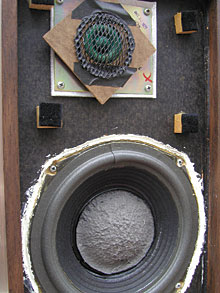
Fulton Musical Industries Model 80 & "J-Modular" loudspeakers

In the last issue we published a rather enthusiastic "Quickie" report on a small, $190/pair speaker system from a new company—the FMI Model 80. It was virtually devoid of low end, even as a stereo pair (pairing effectively doubles bass output), and slightly rough as well as a shade soft at the high end, but it had a quality of "aliveness" to it that almost defied belief. Was it a breakthrough in design? A new transducing principle? No, it was neither. In fact, the Model 80 looks like any one of those hundreds of little bookshelf systems that clutter, the pages of Stereo Review's "Hi-Fi Directory" in tedious profusion.

Canon S-35 loudspeaker

Yes, it's the same Canon—the Japanese photography, photocopier, and laser-printer giant whose logo for so many years adorned the rear wings of Williams Formula 1 racing cars. Canon's venture into the unknown waters of audio was instigated by the head of the UK-based research center, Hiro Negishi. I have been seeing Negishi-san, one of the world's leading minds in optical technology, at Audio Engineering Society conventions since the early '80s, so I was only half-surprised to see Canon launch first one loudspeaker, then a full range (footnote 1).

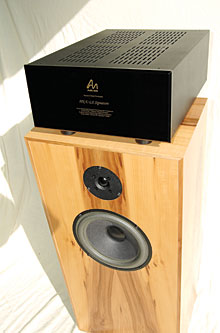
Audio Note AN-E Lexus Signature loudspeaker

Given Audio Note's early dominance of the low-power scene, you'd expect any loudspeaker from them to be a high-efficiency design, and you'd be right. What you wouldn't expect is how they go about doing it, since none of the 20-odd models in their speaker line appears to be much more than a plain-Jane two-way box, with nary a horn or whizzer in sight.

The Smaller Advent loudspeaker

One day last year, my friend Larry and I were talking about our college-fraternity days and loudspeakers. Those were four of the best years of my life. Strong friendships were formed, and ever since, we've kept in touch with most of our fraternity's brothers-in-heart. Ours was not a jock house, nor was it the last bastion of rampant male sexuality—it was, after all, an MIT frat house. But it was full of music lovers who fell neatly into three camps: the California School owned JBL Decades, the New England School had Smaller Advents, and the Renegades boasted bootlegged Bose 901s (footnote 1).

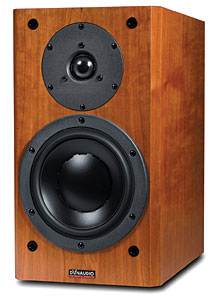
Dynaudio Focus 140 loudspeaker

Perhaps there is no subject more vigorously debated among audiophiles than the primacy of the loudspeaker. Many 'philes believe there is no more important element in a hi-fi system—after all, they reason, it doesn't matter how good the components ahead of the speakers are; if the transducers can't reproduce the signal, you can't hear it. On the other hand, the source adherents maintain, speakers can't reproduce information that hasn't been retrieved from the recording. Loudspeakers can limit the amount of information you hear, but they can't increase it. This is one of those irresolvable paradoxes similar to the question of which came first, the roast chicken or the omelet.

Monitor Audio Studio 10 loudspeaker

As much as I'm tempted by the impressive sweep and scale with which some of the large, full-range loudspeakers endow music, for some reason I find myself more at home with more compact examples of the breed. This is not through lack of familiarity with large speakers, a pair of B&W">http://www.stereophile.com/floorloudspeakers/506">B&W 801s occupying pride of place in our living room (which also serves as my wife's listening room). Yet I find myself hankering after that ultimate soundstage precision that only minimonitors seem capable of producing: the loudspeakers totally disappearing, vocal and instrumental images hanging in space, truly solid—the prefix "stereo-" is derived from the Greek word stereos, which means solid—so that a rectangular, totally transparent window into the concert hall opens at the rear of your room. In addition, the necessarily limited low-frequency extension offered by small speakers makes it much easier to get the optimum integration with the room acoustics below 100Hz.

PSB Alpha loudspeaker

As I said during the 1991 Stereophile writers' conference (Vol.14">http://www.stereophile.com/interviews/109">Vol.14 No.12): "There's immense satisfaction in finding that next Audible Illusions or Vandersteen or Rotel." My oh my, am I satisfied! But before you start writing checks, hold onto those pens for a few moments. The PSB Alphas are not ProAc, Hales, Quad, or even Vandersteen killers. Goodness, what do you expect for $200?

Advertisement
Advertisement
Advertisement