Phono Preamp Reviews

Sort By:  Post Date TitlePublish Date

Listening #73

I was walking through the woods one day when I happened on a large, flat rock near the base of an old ash tree. Conditioned as I am from such rambles with my daughter, whose interest in wildlife echoes that of my own childhood, I bent down and lifted one end of the rock, hoping to catch a glimpse of some exotic creature or another: perhaps a delicate ring-necked snake, or a plasticky-looking red eft. The rock came loose without too much effort and teetered on its broadest edge, but before I could let it flip to one side, I recoiled in horror: There, amid the millipedes and ant larvae, was a cluster of teeny-tiny, nasty-looking old men, writhing in such a tangle that I couldn't even count them. They were bespectacled, to a one, and mostly bald—I could tell quite easily, despite the berets worn by some of them—and each pair of feet was shod in a teeny-tiny pair of off-brand Birkenstock copies, with thin, shiny black socks underneath.

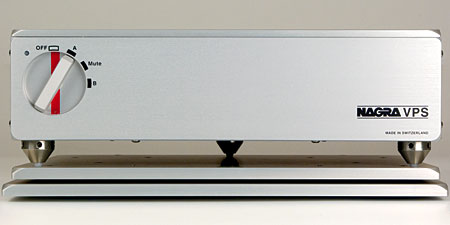
Nagra VPS phono preamplifier

Not that many years ago, it seems, every sound crew in Hollywood and around the world recorded production sound using a compact, open-reel analog tape recorder made by Nagra. The first iteration of the Swiss-made machine appeared in the early 1950s. Shortly thereafter, with the addition of an inaudible recorded tone that allowed easy syncing to picture, the Nagra recorder became the industry standard, and remained so through the 1980s. To this day, Nagra's line of audio products retains the look of those early recorders.

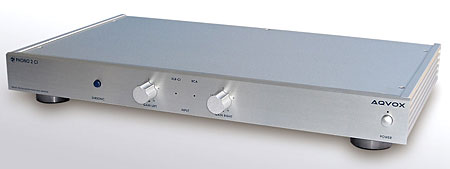
AQVOX Audio Devices Phono 2Ci phono preamplifier

The German company AQVOX Audio Devices has produced an innovative moving-coil/moving-magnet solid-state phono preamplifier, the Phono 2Ci, that's as intriguing for its technology and performance as it is for its relatively low price: $1400. The zero-feedback, op-amp–free circuit uses a compact switch-mode power supply that's built into the chassis and features conventional voltage gain for moving-magnet cartridges via its RCA jacks, and current gain for moving-coil cartridges through the balanced XLR inputs. Rear-panel switches select between RCA or XLR inputs and offer a convenient ground lift. Either the single-ended or the balanced outputs can be used with either input. Unfortunately, the tight spacing of the RCA input and output jacks, which are mounted on the circuit board, will somewhat limit your choice of cables: Pairs of thick-barreled plugs will have difficulty fitting.

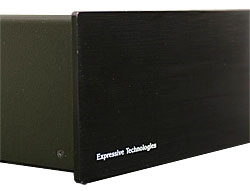
Expressive Technologies SU-1 moving-coil step-up transformer

What's this? A review of a $3000 moving-coil step-up transformer in this digital day and age? Yep. Although the market for such a product is small, the fact that the Expressive Technologies SU-1 step-up transformer enters previously uncharted state-of-the-art territory warrants these pages of editorial space. Furthermore, LP playback appears to be alive and well at the upper end of the high-end spectrum, a market segment addressed by the SU-1 (footnote 1).

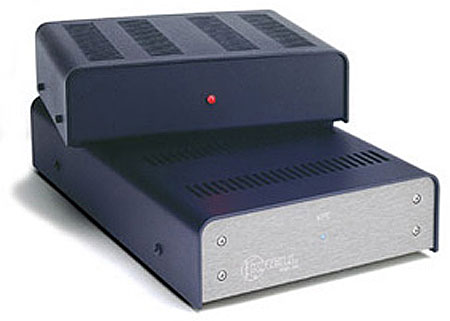
Krell KPE & KPE Reference phono preamplifiers

The Krell">http://www.stereophile.com/solidpreamps/694krc2">Krell KRC-2 can be regarded as a remote-controlled successor to Krell's successful KSL preamplifier of a few years back. The outboard Krell Phono Equalizer (KPE) is a separate box powered from the KRC-2. Priced at $850, it contains a printed circuit board very similar, in fact, to the $499 unit that can be fitted within the KRC. The KPE and KRC phono stages are well-designed universal units; if someone has the need for a stand-alone phono equalizer of Krell KRC standard, a separate power supply may be purchased for the KPE. It is also an advantage to be able to locate the KPE head amplifier in a hum-free zone near the LP turntable.

Listening #58

Is it my imagination, or has the low-power tube movement of the last 15 years gone hand in hand with a renewed interest in moving-coil step-up transformers? Trannies remain misunderstood or ignored by most of the audio press—requests for review samples continue to be met with genial shock, rather like tourism in the Budapest of the 1990s—but enthusiasm for the practice seems only to grow. That leaves me to wonder: Did the unquestioning use of active pre-preamps for so many years grow out of the same bad attitude that gave us all those awful-sounding high-power amps and low-sensitivity loudspeakers? You know the mindset: Parts are cheap. Gain is free. Do it because you can...

Simaudio Moon LP5.3 phono preamplifier

Simaudio's Moon LP5.3 MM/MC phono preamplifier ($1400) is silly good! It has single-ended RCA inputs and both single-ended and true balanced-differential outputs. It also offers a wide range of adjustments for gain (54, 60, and 66dB), resistive loading (10, 100, 470, 1k, and 47k ohms), and capacitive loading (0, 100, and 470pF), all accomplished via a series of internally mounted jumper banks. You can even choose RIAA or IEC equalization. Removing the top plate to get to the adjustments reveals boards filled with high-quality parts for the well-isolated power-supply and signal-handling circuits.

ASR Basis Exclusive phono preamplifier

"Everybody's gotta get into the act!" Jimmy Durante used to say. That's what's happening with phono preamplifiers—they just keep being built, and I keep getting them for review. Up for evaluation in next month's column are new models from Perreaux, Musical Fidelity, Graham Slee, and a Chinese one, Ming Da. You can bet there'll be more.

Advertisement
Advertisement
Advertisement