Integrated Amp Reviews

Sort By:  Post Date TitlePublish Date

DK Designs VS.1 Reference Mk.III integrated amplifier
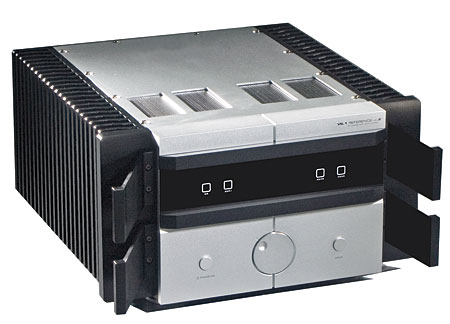
Each time I attend Stereophile's annual Home Entertainment Show, I look forward to two things. The first is the opportunity to performhttp://blog.stereophile.com/he2006/060406reina/">perform; classic and original jazz music with John">http://blog.stereophile.com/he2006/060406rayjazzed/">John Atkinson and Immedia's">http://blog.stereophile.com/he2006/060406perkins/">Immedia's Allen Perkins. The second is to seek out the most exciting new, affordable speakers to review over the following year. Both buttons were pressed for me quite admirably during HE2005 at the New York Hilton, but this time it was not an affordable speaker that most impressed me.
Outlaw Audio RR2150 stereo receiver

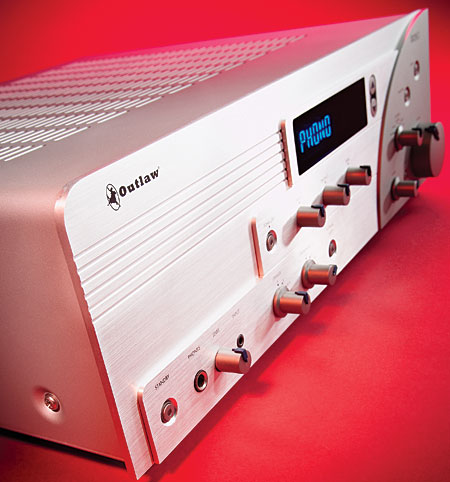
Wilson Audio Specialties' David Wilson likes to say that you should build a stereo system from the speakers down. Of course he does—he sells speakers. But that doesn't mean he's wrong. So recently, when offered an inexpensive new product for review, I decided it would be a good test of Wilson's theory. I tried driving Wilson's $45,000/pair MAXX2http://www.stereophile.com/floorloudspeakers/805wilson">MAXX2; speakers with Outlaw Audio's RR2150, a $599 stereo receiver.

PS Audio GCC-100 integrated amplifier

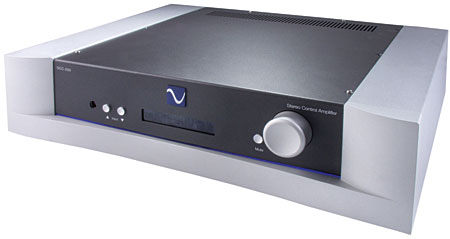
Lovers of Italian wine, travelers to Italy, and, of course, Italians, may be familiar with this story. It seems that in the year 1111, Henry V was traveling to Rome to be crowned Holy Roman Emperor. A member of his entourage, one Giovanni Defuc, was very fond of wine, and had the practice of sending ahead one of his servants to sample the wine in each place. When the servant found a wine that he particularly liked, he would write "Est!" on the door of the establishment, which was a signal to his master that the wine is (est) good. Having arrived at Montefiascone, the servant found a wine he thought so superb that he wrote on the door of the inn "Est! Est!! Est!!!"

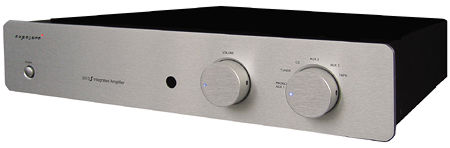
Exposure 2010S integrated amplifier

Yet another of the best systems I've ever heard at a hi-fi show was an exhibit by some former distributors for the English manufacturer Exposure Electronics, at a Chicago Consumer Electronics Show in the late 1980s. The exhibitors seemed to believe it was better to impress with a humble product than to overwhelm with a full-bore assault, because they limited their display to a single amplifier: the then-new Exposure X (as in "10") integrated, mated to a record player comprising a Linn">http://www.stereophile.com/turntables/1103linn">Linn LP12 turntable, Ekoshttp://www.stereophile.com/tonearms/395">Ekos; tonearm, and Troika cartridge, and a pair of Linn Kan loudspeakers.

Classé CAP-100 integrated amplifier

With the price of high-end audio increasingly reaching for the stratosphere, audiophiles appear to becoming much more value-conscious. This trend is reflected in the recent popularity of CD players over separate transports and processors, and particularly in the sudden resurgence in integrated amplifiers. An integrated amplifier makes a lot of sense: the buyer saves the cost of two chassis, two power cords, two owner's manuals, and an extra pair of interconnects. You also get a simpler system.

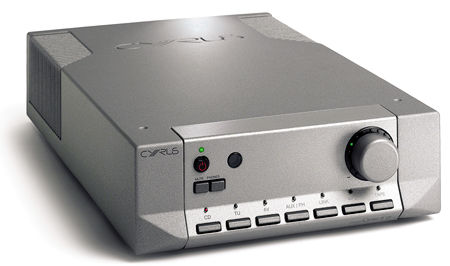
Cyrus 6vs integrated amplifier

Living with a brand-new Cyrus amp was a pleasantly nostalgic thing to do, even from the start: It arrived in a clean and downright attractive carton that seemed designed specifically to contain a brand-new Cyrus amplifier. Think of it! And I haven't even mentioned the nice owner's manual or the balance control or the headphone jack. As I said: the good old days.

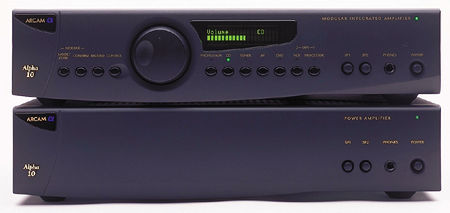
Arcam Alpha 10 integrated amplifier & Alpha 10P power amplifier

Consider the lowly spork, that modern marvel of versatility: half spoon, half fork. In theory, you should be able to eat just about anything short of a flank steak with it. But the sad fact is, whether you're eating soup or salad, you might as well try to shovel it in using a tongue depressor. The damn thing's so versatile, it almost doesn't work at all. There's a lot to be said for specialization.

Prima Luna Prologue One integrated amplifier

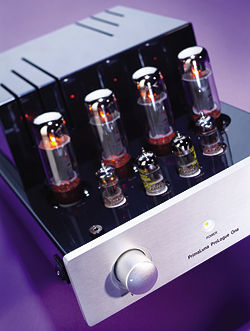
My first reaction to the Prima Luna Prologue One was based solely on looks: For $1095, I might not have been disappointed had it sounded no better than a Bose Wave Radio. Its casework straddles the breach between vintage and modern in a way that little else does, at any price. The dark gray-blue finish, hand-rubbed to a tactile gloss, wouldn't look out of place on an Alfa GTV (the new one, which resembles a drop of oil). And for the first time in my experience, a high-end audio manufacturer has figured out a way to make a protective tube cage easy to remove and replace: with banana plugs and sockets. Why couldn't one of the high-price American brands have figured that out?

Advertisement
Advertisement
Advertisement