Floor Loudspeaker Reviews

Sort By:  Post Date TitlePublish Date

Paradigm Reference Studio/100 v.2 loudspeaker

It may come as a surprise to relative newcomers to the field of audio, but some loudspeaker manufacturers are manufacturers in only a limited sense. They buy drivers, off-the-shelf or custom-built, from companies like VIFA, SEAS, Focal, etc.; cabinets from a woodworking shop; and crossovers from an electronics subcontractor. While the system design will have taken place in-house, actual manufacturing is restricted to assembling the components, perhaps tweaking the crossover, and final QC. Even some highly successful loudspeaker manufacturers use this approach, which can work well as long as the suppliers do their jobs properly.

Dynaudio Evidence Master loudspeaker

I can't resist reading about a company's flagship loudspeaker—the price-no-object product that embodies the most advanced ideas from a company's research and design department. Flagship loudspeakers tend to be large, heavy, and complex, and are designed to perform best in large rooms; often, each part of each driver is hand-built to the highest level of quality, with precisely tight tolerances. The cost? Don't ask. Some two-channel, audio-only flagships cost more than a BMW M5 sports sedan or a Porsche 911.

Revel Performa F30 loudspeaker

I visited the Revel room on the last day of the January 1999 CES, expecting another dynamic demo of their Ultima line. Instead, I found a pair of floorstanding Performa F30s connected to a rack full of the best Mark Levinson electronics. Deeply impressed by the dynamics and clarity of this first model in the new Performa line, I called Revel's Kevin Voecks as soon as I got back to New York City, but was told that another Stereophile reviewer had already got first dibs on the F30. Would I be interested in one of the other Revels? Well, yes, sure, but...

Infinity Prelude MTS loudspeaker

Sometimes you have to wonder why big corporations gobble up small speaker companies. Most such firms are built by individualist entrepreneurs chasing an elusive dream—an up-close and personal thing that is the antithesis of the corporate mentality. That's why speaker companies are so often named after the founder.

Vienna Acoustics Mahler loudspeaker

How can you tell an audiophile from a normal person? Well, given a list of names like "Haydn, Mozart, Bach, Beethoven, and Mahler," the normal person might respond, "Composers." The audiophile's response is likely to be "Loudspeakers from Vienna Acoustics." Anyway, that's my association when I see these names, which may tell you something about my state of normalcy.

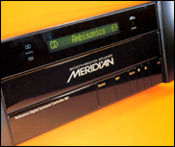
Meridian Digital Theatre surround-sound music system

I am biased: On very little evidence, I remain convinced that, in the near future, high-quality music reproduction will be multichannel. While most multichannel demos are still egregiously and aggressively ping-pong, I have attended a few successful demonstrations of discrete multichannel reproduction that have impressed me so deeply that I hunger to have all the music I love transported to me (and me to it) in this way.

Thiel CS7.2 loudspeaker

When I describe the Thiel CS7.2 to friends, the word that gets the biggest reaction is "simple." Veteran audiophiles protest, noting the big Thiel's multiple drivers, complex cabinet, and elaborate, zillion-element crossover. Nonaudiophiles just glance at the 5'-tall speaker, smile sympathetically at Bonnie, and roll their eyes.

ProAc Response 3.8 loudspeaker

If you've read Stereophile regularly over the past decade, you know that ProAc Audio's Stewart Tyler has a winning formula for designing loudspeakers. In review after review, this magazine's writers have celebrated the sonic profile he has created for ProAc speakers: a spacious soundstage with a big, coherent image; a clean, grain-free midrange; extended highs that don't intrude on the music; and tight, tuneful bass response.

NHT 2.9 loudspeaker

Hard to believe it's been more than six years since NHT launched its flagship 3.3 loudspeaker (footnote 1). At the time, the floorstanding 3.3 was a revolutionary product for the company, whose product line until then had been aimed squarely at the customer who wanted good sound, but wanted it in a small, affordable package. While the 3.3 didn't change NHT's dedication to its roots, it did signal to audiophiles that the manufacturer could play ball with the big boys.

Advertisement
Advertisement
Advertisement