Floor Loudspeaker Reviews

Sort By:  Post Date TitlePublish Date

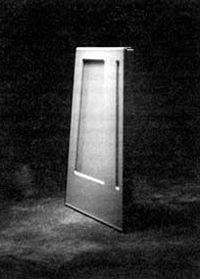
Sound-Lab A-3 loudspeaker

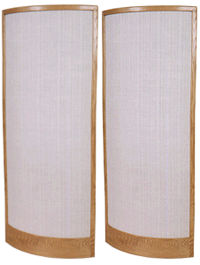
The Sound-Lab electrostatic loudspeakers are legendary. Many serious audiophiles have heard of them, and rumors of their existence abound in audio circles. But, like gnomes, UFOs, and poltergeists, Sound-Lab loudspeakers are sufficiently hard to find that it is sometimes difficult to prove to skeptics that they exist at all. Well, I can now report that they do. As proof of this contention, I can point to the two which are actually occupying solid, tangible space in my listening room at this very moment. I have even taken a photo of them, which will be published along with this report if they leave any sort of an image on the film emulsion. (Many such apparitions do not!)

Apogee Stage & Mini-Grand loudspeakers

As Laura Atkinson shuffled into my listening room one evening, she spied the Stage loudspeakers tucked away in the corner. "Hey, Dick, those look like Apogees, but they're kind of small." Rising to the occasion, I responded with: "Honey, I shrunk the Apogees." At roughly 3' tall by 2' wide, the Stage is far from intimidating; it even feels more compact and is certainly much cuter looking than the old Quad ESL. Yet Junior's resemblance to the rest of the Apogee family is unmistakable. The canted baffle, the vertical tweeter/midrange along the inside edge of the baffle, and the pleated aluminum-foil woofer clearly bear the imprint of the larger Caliper and Duetta models. It's almost as though Apogee started shrinking the Duetta until the price tag shrank below two kilobucks.

Energy Veritas v2.8 loudspeaker

If Canada has emerged as a hotbed of loudspeaker production in the past few years, the folks at Audio Products International must be positively sizzling. Of their three lines—Mirage, Energy, and Sound Dynamics—Mirage is perhaps the best known in the US, with Energy running a distant second. Mirage, at least in their flagship M series, features rather esoteric bipolar designs, while Energy sticks to the more conservative, forward-radiating approach. Stereophile has had extensive exposure to the various Mirages (a review of one of the M-series babies, the M-7si, is scheduled for a future issue); our exposure to Energy has been virtually nil, save for the odd Hi-Fi Show and CES. And thereby hangs a tale.

Thiel CS3.6 loudspeaker

Choosing a loudspeaker can be difficult. Although it is easy to be seduced by a certain model's special qualities, that exceptional performance in one area is often at the expense of other important characteristics. Go with high-quality minimonitors for their spectacular soundstaging, but give up bass, dynamics, and the feeling of power that only a large, full-range system can provide. If you choose an electrostatic for its delicious midrange transparency, you may have to forgo dynamics, impact, and the ability to play loudly. Pick a full-range dynamic system for its bass and dynamics, but lose that edge of palpability and realism heard from ribbon transducers.

Gradient Revolution loudspeaker

A.C. Wente of Bell Telephone Labs was apparently the first person to get the bright idea (in the 1930s) of measuring sound transmission in a small room. A loudspeaker at one point reproducing pure tones of constant power, and a microphone at another point measuring sound-pressure levels, gave him the means to assess the room's impact on sound quality. The measured frequency response was so ragged that I'm positive the venturesome Dr. Wente was duly shocked.

Magnepan Magneplanar MGIIIA loudspeaker

I must confess to a certain sentimental affection for Magnepan products. An early version of the Tympani did more to rekindle my interest in audio than any other speaker I can think of. In a world which seemed doomed to finding out just how small and dull it could make acoustic suspension boxes, the Magnepans reminded me that speakers could produce a large open soundstage, real dynamics, and musical life.

Vandersteen Audio 3A loudspeaker

High-end-audio manufacturers are both more and less adventurous than their more mainstream contemporaries. While mainstream-audio manufacturers will almost invariably change their models every year, the changes are more often than not cosmetic—at least in between successive models. High-end manufacturers, on the other hand, will keep the same model in the line for several years, but make cosmetically invisible refinements along the way.

Vandersteen Audio 2Ce loudspeaker

Eighty thousand pairs. According to Vandersteen Audio, that's the number of Vandersteen 2s of various generations which have been sold since the loudspeaker—and company—first saw the light of day in 1977. The 2 has been continually refined along the way—a new driver here, a new crossover change there, heavy-duty stands—more changes, in fact, than the occasional changes in model designation would indicate. The 2's main calling card has always been a high perceived value for money. If anything, this calling card has only been enhanced over the years as its price remained remarkably stable while the cost of high-end audio in general was perceived—rightly or wrongly—as being on a dizzying upward spiral.

Advertisement
Advertisement
Advertisement