Floor Loudspeaker Reviews

Sort By:  Post Date TitlePublish Date

Carver Amazing Loudspeaker (Platinum Edition)

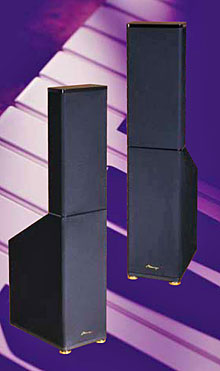
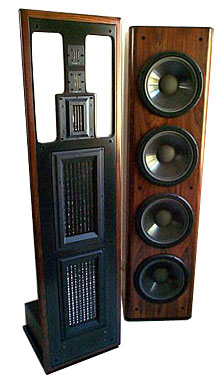
Even to a nontechnical observer, someone without a deep grasp of the germane technical issues, the Amazing Loudspeaker should indeed prove a source of amazement. First of all, there's no box. Don't mistake the back grille for an enclosure—if you pass your hand along the Amazing's behind, you'll realize that the grille is merely a cosmetic cover; you can actually stroke the woofer magnets if you're so inclined. Yet without an enclosure or electronic trickery, this speaker boasts excellent dynamic headroom and true flat bass extension almost to 20Hz. Just think of the woodworking costs inherent in trying to coax such low-end performance from a conventional box speaker. The savings in carpentry have been put toward one heavy-duty ribbon design. The Amazing begins to sound like an incredible bargain at its modest (by high-end standards) asking price. What's the catch? Fundamentally, the answer lies in superior engineering. And, as Bob Carver will readily admit, good engineering isn't inherently any more costly than bad engineering.

KEF iQ9 loudspeaker

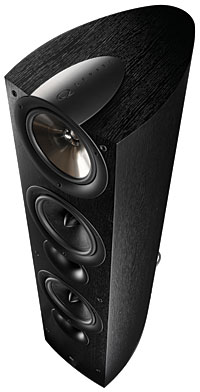
The penultimate stop on Bob Reina's British Invasion Tour of Affordable Loudspeakers (footnote 1) brings us to the doors of KEF. Although KEF is a large and well-established British firm, I've noticed that their product lines have not been as visible in the US as those of, say, B&W, Wharfedale, or Mission. In fact, the last time I heard a KEF speaker, it was the company's then-flagship design, at a Consumer Electronics Show nearly 20 years ago! Before that, when I lived in London, KEFs were ubiquitous, down to the older, entry-level designs tacked to the walls of the ethnic restaurants I frequented. My strongest KEF memory is a cumulative one: Every KEF speaker I've ever heard, regardless of price, venue, or setup, has always produced good, convincing sound.

Genesis Advanced Technologies 5.2 loudspeaker

Genesis Advanced Technologies was formed in 1991 to manufacture loudspeakers designed by industry veteran Arnie Nudell, who was responsible, with Cary Christie, for some of high-end audio's highest-performing models when both were at Infinity Systems. The company was acquired a few years back by Gary Leonard Koh and some of his friends, but Nudell remains with the company as Chief Scientist and the company has offices and a production facility in Seattle.

Penaudio Serenade loudspeaker

Audiophiles sure don't have it easy. We put in a hard day sweating to hear those diminishing-return differences, and when we're finally ready to pontificate, no one at the party will obligingly ask us what we think. They've made that mistake before, you see, then spent the next 45 minutes frantically looking around the room for someone to rescue them.

Magnepan Tympani I loudspeaker

The Magnep1anar Tympani I that is the subject of this report is already an obsolete model, having been superseded by the Tympanis IA, II, and III that were unveiled at the CE Show in Chicago this past June. Since many of our readers already own Tympani Is, and dealer stocks of them are being sold at a substantial price reduction, the report should still be of interest. We will publish follow-up reports on the newer models as soon as they become available for testing.

Infinity IRS Beta loudspeaker

In 1966, two avid audiophile/music lovers—a nuclear physicist named Arnold Nudell and an airline pilot named Cary Christie—labored over weekends and evenings for 18 months in Nudell's garage to put together the world's first hybrid electrostatic/dynamic loudspeaker system. It cost them $5000 for materials, launched a company (New Technology Enterprises), and helped contribute to the popular myth that all of the really important audiophile manufacturers got started in somebody's basement or garage (footnote 1). The system was marketed as the Servo-Statik I, for the princely sum of $1795. (At the time, the most expensive loudspeaker listed in Stereo Review's "Stereo/Hi-Fi Directory" was JBL's "Metregon," at $1230.)

B&W 802D loudspeaker

Back in the 1970s, I used to hang out at an audio store on Northern Boulevard's Miracle Mile. After business hours—and sometimes during them—a group of us audiophiles would put every new product through the wringer. One of the most anticipated was the original B&W 801, which appeared in 1979. The 801 was simply unflappable. Fed enough power, a pair of them played louder and cleaner than anything we had ever heard, including the mammoth, multimodule Fultons that were the pride of that shop. But—and this was a big but—the 801 lacked immediacy and engagement, and I soon fell back to preferring an earlier B&W model, the DM6, which seemed more coherent and to offer the music out to the listener. The 801 was more objective and detached, but boy, could it knock you over with the right source material.

Green Mountain Audio Diamante loudspeaker

I live in a house that has a pyramid-shaped roof, so I guess you could say that I have a thing for pyramids (footnote 1). That's probably why I was immediately drawn to the Green Mountain Audio Diamante. I'm also attracted to floorstanding speakers with small footprints, since my listening/video room is only 13' by 16'. My Holy Grail of loudspeakers is a small speaker that's flat between 20Hz and 20kHz, can do 110dB sound-pressure–levels without straining, and costs less than $1000/pair.

Audio Physic Caldera III loudspeaker

More, I think, than any other link in the audio chain, loudspeaker designs tend to reflect the personal preferences, opinions, and philosophies of their creators—think Henry Kloss, Paul Klipsch, Rudy Bozak, David">http://www.stereophile.com/interviews/478">David Wilson, Jon Dahlquist, Arnie Nudell, and Amar Bose (just kidding). Consider, if you remember, where Ken">http://www.stereophile.com/interviews/232">Ken Kantor took Acoustic Research when he took over AR's design reins. Might as well have called AR NHT, for all that the new designs followed the old.

Advertisement
Advertisement