Kinematics
When Franz Reuleaux created the "language of invention," he more or less invented the future we live in.


When Franz Reuleaux created the "language of invention," he more or less invented the future we live in.
Not bloody likely, says Michael Dirda. A scant 12 years after his death, you're unlikely to find even his most lauded novel, <I>Lucky Jim</I> in bookstores, libraries, or on friends' bookshelves.
Audiophiles get a lot of ribbing at times for all kinds of reasons. Has anybody ever made fun of you for being an audiophile?
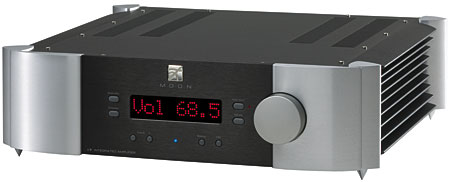
I was the member of the family on whom the others could depend for technical assistance: mending eyeglass frames, fixing the radio, replacing the lightbulb in the oven, getting the car to idle smoothly. No job too big or too small. House calls a specialty.
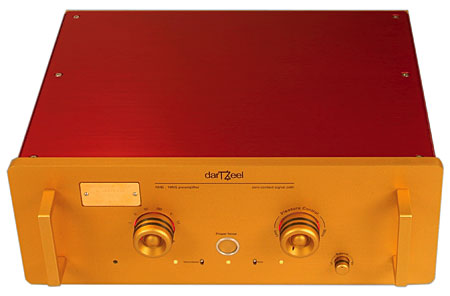
With the introduction of the NHB-108 stereo amplifier, Swiss-based darTZeel quickly established a reputation for pristine, hand-built quality, fanciful industrial design, and elegant circuitry—all accompanied by a healthy jolt of sticker shock. (See John Marks' coverage in his September 2003 "<A HREF="http://www.stereophile.com/932">Fifth Element</A>" column, followed by Wes Phillips' <A HREF="http://www.stereophile.com/solidpoweramps/405dartzeel">full review</A> in April 2005 .) The 100Wpc (into 8 ohms) NHB-108 costs more than $18,000. A lot of change for not a lot of power, but the reviews were unanimous in praising the amp's exceptional sound quality.
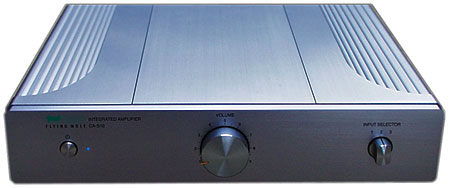
The naming of audio companies is a tricky business. Ideally, the name should be distinctive, so that people will remember it, and descriptive of the products. However, given the proliferation of audio manufacturers, it's getting more and more difficult to come up with a name that fulfills these criteria, and some names are similar enough to lead to confusion. In one of my show-report blog entries from the 2007 Consumer Electronics Show, instead of correctly listing a company name as Divergent Technologies, I called it Definitive Technologies, which is the name of an another audio company—and was rightly chastised for it in a comment by a reader. I'll bet that no such confusion will occur in the case of Flying Mole Electronics. (As far as I know, there is no Flying Groundhog Electronics.)
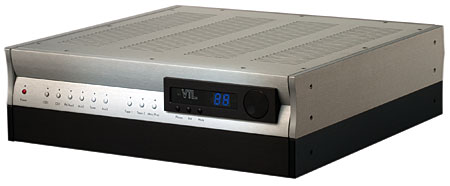
I've long admired Vacuum Tube Logic's line of amplifiers and preamplifiers. Owners <A HREF="http://www.stereophile.com/interviews/153">Luke Manley</A> and his wife <A HREF="http://www.stereophile.com/interviews/607vtl">Bea Lam</A> routinely appear at the Consumer Electronics and Home Entertainment shows with luxurious, microprocessor-controlled tube gear, soothing new music, good-sounding rooms, and a friendly, unhurried manner. Their show setups are dialed in so well that I often find myself taking refuge there, sitting and listening for hours with other <I>Stereophile</I> writers.
Now that more and more music lovers are turning to the Internet to purchase CDs, DVDs, and downloadable files#151;see WP's <A HREF="http://www.stereophile.com/news/062507itunes3/">story on iTunes</A> this week—Naxos isn't taking any chances. The world's largest classical music label, whose US branch, Naxos of America, also claims to be the #1 independent distributor of classical music in the US, has recently set up multiple websites to lure music lovers into the fold.
We received a e-mail recently from long-time reader Sharon Churchill, which linked to an <A HREF="http://www.newscientist.com/blog/invention/2007/06/sticky-sweet-spot.ht…; in the <I>New Scientist Invention</I> blog concerning a recent Sony patent application for a system that will automatically recalibrate its response to put the sweet spot where the listener is, wherever that might be.
According to market research company NPD Group, in the first quarter of 2007, Apple's iTunes Store has overtaken Amazon.com and Target to become the US's third largest music retailer with 9.8% of all music sales. Apple counts 12 track sales as equivalent to one CD sale, meaning that the company is responsible for nearly 21 million of the quarter's 212 million CD sales.