John Atkinson

Ayre Acoustics QA-9 USB A/D converter
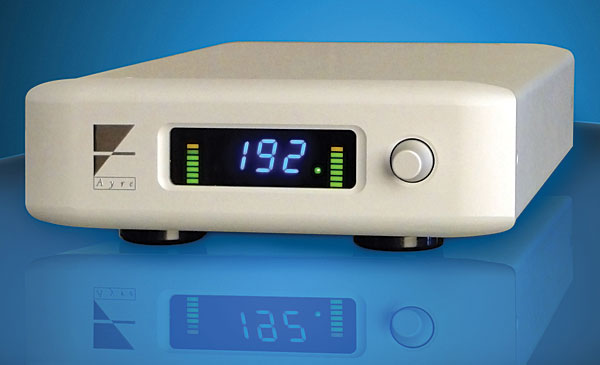
Since its founding in 1993, Colorado-based Ayre Acoustics has made its name with amplifiers and preamplifiers based on truly balanced, solid-state circuitry that didn't use the ubiquitous panacea of loop negative feedback to produce linear behavior. Their first digital product was the D-1x DVD player, reviewed for Stereophile by Paul Bolin in February 2003, which offered unusually good video performance. The D-1x was followed by the C-5xe and DX-5 universal players, respectively reviewed by Wes Phillips (July 2005) and Michael Fremer (December 2010). But the most intriguing digital product to come from Ayre was the QB-9 digital processor. Reviewed by WP in October 2009, the QB-9 has just one input, USB, and uses Gordon Rankin's proprietary Streamlength code to give asynchronous operation, which in theory offers the best jitter suppression. "The QB-9 isn't a computer peripheral," said Ayre's marketing manager at that time, Steve Silberman. "It makes computers real high-end music sources"—a statement with which WP agreed.
Continue Reading »
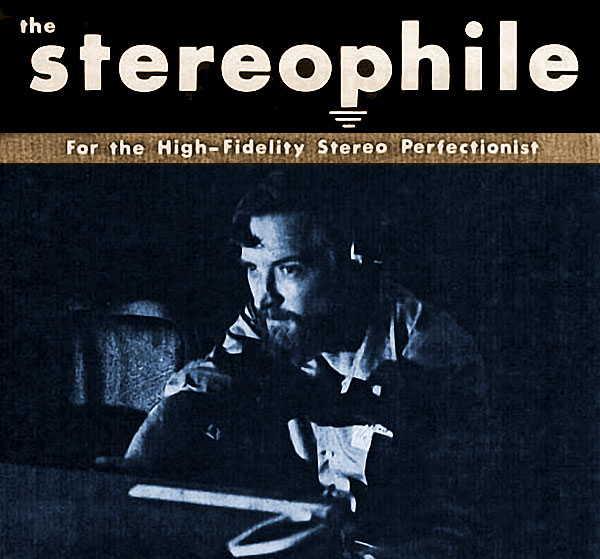
50 Years of Stereophile!

Fifty years ago this month, Vol.1 No.1, Issue No.1 of The Stereophile, published, edited, and mostly written by J. Gordon Holt out of Wallingford, Pennsylvania, hit the newsstands. Gordon had worked for two major audio magazines, High Fidelity and HiFi/Stereo Review (later renamed Stereo Review), and had been disgusted by those magazines' pandering to advertisers. Not only was The Stereophile going to tell it like it was, it was going to judge audio components by listening to them—a heretical idea in those days of meters and measurements. "Dammit," said Gordon, who died in 2009, "if nobody else will report what an audio component sounds like, I'll do it myself!"
Continue Reading »

The 2012 Rocky Mountain Audio Fest:That's a Wrap

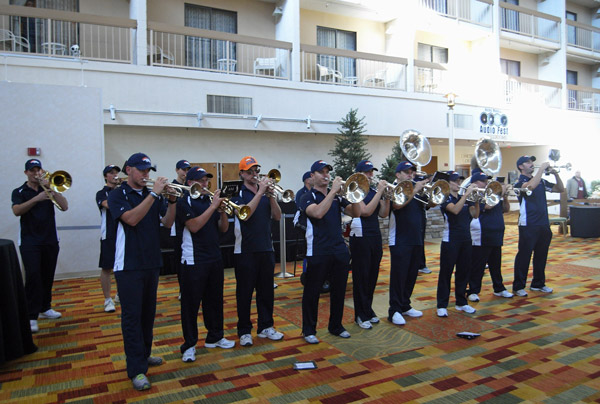
With a fanfare at 4pm, Sunday October 14, in the Denver Tech Center Marriott's Atrium, the Denver Broncos Half-Time Band, courtesy of Kimber Kable's Ray Kimber, brought the Show to a close. According to Show organizer Marjorie Baumert, "We had about 150 more exhibitors (according to the badges), about 3600 attendee days (approximately 100 more than last year). We had 1295 attendees pre-register and that was an all-time record (last year was 1100). . .
Continue Reading »

Sony Shines

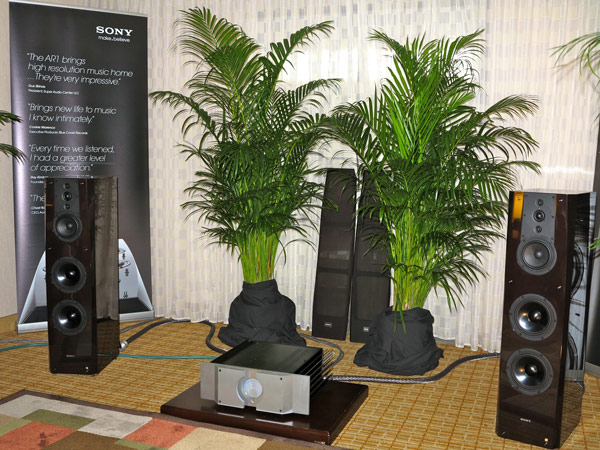
One of the final rooms I visited at the 2012 RMAF was Sony’s. An as-yet-to-be-named floor-standing speaker was being demmed with Pass Labs amplification, Kimber Kables, and a Mytek DSD-capable DAC, taking data over USB from a laptop. The speaker has much in common with the superb SS-AR2 that I reviewed in October, but is shorter and, as can be seen from Jason Serinus’ photo, has an intriguing array of two supertweeters above and below the tweeter.
Continue Reading »

Esoteric & Cabasse

The active L’Ocean speaker from French manufacturer Cabasse is similar in concept to the huge La Sphère that Michael Fremer reviewed in June 2008, but is smaller, cheaper—$159,000/system, compared to $205,000—and its external digital crossover can now handle 24-bit datastreams up to 96kHz. L’Ocean was demonstrated at RMAF with Esoteric digital components—Cabasse is now distributed in the US by Esoteric—and Johnny Cash’s version of the The Beatles’ “In My Life” sounded palpably real. And in a Show dominated by black boxes, the Cabasse’s White Pearl finish was very camera-friendly.
Continue Reading »

Gob-smacked by DEQX

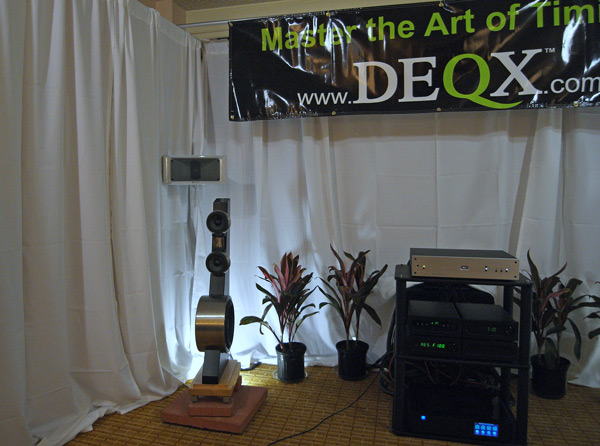
When I entered the DEQX room and experienced a neutral, almost full-range sound, I assumed I was listening to the Gallo Reference speakers. But no—it was the $80 pair of RadioShack PA horns in the room corners that were playing, corrected in the digital domain with the latest DEQX DSP processor, the DEQX Mate. This is an analog in-and-out (XLR and RCA), two-channel processor that goes between the preamp and power amplifier. Bypassing the DEQX Mate resulted in the squawky balance I would have expected from the horns, with no lows or highs. Switching the DEQX Mate back in-circuit gave a sound that was evenly balanced, with good HF extension and enough upper bass to sound convincing. Color me gob-smacked!
Continue Reading »

Sonus Faber’s New Venere

Styled to resemble Sonus Faber’s cost-no-object “The Sonus Faber” flagship design, the new Sonus Faber Venere range of speakers made its debut at RMAF. Costing $2498/pair, ie, around less than 2% of the big speaker’s price, the Venere 2.5 was demmed with an Audio Research DSI200 class-D integrated amplifier ($5995), a Wadia Model 121 decoding computer ($1299), a Pro Ject Xtension turntable with Sumiko Blackbird cartridge ($3699) a Pro Ject Phono Box ($999), and Pro Ject’s new Stream Box ($1999). The LP of Jeff Buckley’s classic album Grace was reproduced with appropriate impact and a color-free tonal balance. Even considering the relatively affordable price of the system, this was still one of the better-sounding rooms I heard at RMAF.
Continue Reading »

Thiel’s New CS2.7

Thiel’s long-awaited trickle-down speaker from 2008’s ground-breaking CS3.7, the CS2.7 ($9900/pair), made its North American debut in one of the Denver Audio Designs rooms. It combines the coaxial HF/MF unit that the late Jim Thiel developed for the ‘3.7 with a proprietary 8” woofer, reinforced with a passive radiator to give claimed bass extension to below 35Hz. Frequency response is specified as 35Hz–20kHz ±2.5dB, and crossover filters, of course, are all first-order. (No impedance spec was given; Thiel speakers have always been current-hungry.) The CS2.7s were demmed with Aragon Iridium 400W monoblocks ($7998/pair), an Aragon Sound Stage digital preamp ($4499), an Arcam CD37 SACD/CD player ($2299), an Arcam FMJ D33 D/A processor, and Straight Wire Expressivo interconnects and speaker cables, and Straight Wire Blue Thunder AC cords. The sound of Ryan Adams’ “Dirty Rain” had extended lows, grain-free highs, and superbly stable, well-defined stereo imaging.
Continue Reading »

Hegel’s H300

Anders Ertzeid, VP of Sales and Marketing for Hegel, introduces the Norwegian company’s new H300 integrated amplifier ($5500). This amp includes a 32-bit DAC, 5 digital inputs and 5 analog inputs, and uses a high-precision clock circuit said to eliminate jitter.
Continue Reading »

Legacy Launches Aeris

Legacy's Bill Dudleston stands by the new Aeris speaker ($16,900/pair), which combines an AMT tweeter/supertweeter module (see below) with a dipole midrange unit and upper woofer—these have corrugated surrounds for maximum inearity—and two sealed-box subwoofers operating below 220Hz and driven by an internal 500W ICE-power class-D amp. With an AVM amplifier and CD player,the sound of Tchaikovsky's Italian Caprice was forceful and clean, though the big bass drum thwacks clipped the amplifier at the level I had chosen for the orchestral sound in the large room Legacy was using.
Continue Reading »
Advertisement
Advertisement
Advertisement