Michael Trei

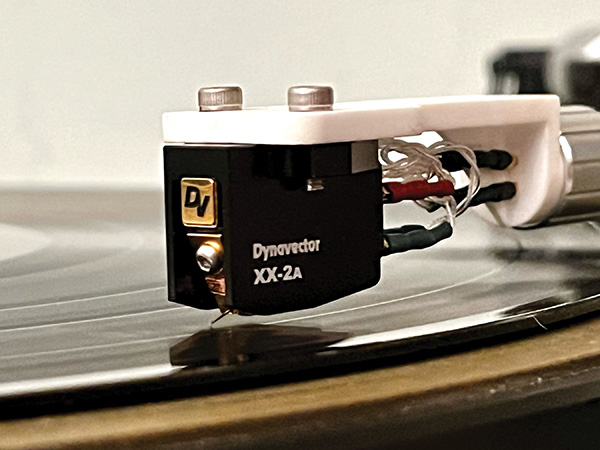
Spin Doctor #16: Sutherland Dos Locos Phono Preamp, Dynavector XX-2A Phono Cartridge

Ron Sutherland makes a strong case for being crowned the king of all phono preamps, though I expect he would blush at any such suggestion. In 1979, with degrees in physics and electronic engineering (where his final project involved designing and building a digital logic–controlled preamp), he teamed up with Gayle Sanders to found electrostatic speaker company MartinLogan. ("Martin" and "Logan" are Sanders' and Sutherland's middle names, respectively.) But after a few years, he found the increasingly corporate mindset at M-L a bit stifling, so he decided to go his own way. Ron wanted to build gear he thought was cool and fun while not being directed solely by its commercial potential. He joined up with his brother to start Sutherland Engineering, creating hi-fi equipment that piqued his own interest and hopefully that of a bunch of customers.

At first, Sutherland made a wide range of components, including preamps, power amps, and DACs, but gradually he focused more and more on phono preamps. Today that's the only thing he makes...

Continue Reading »

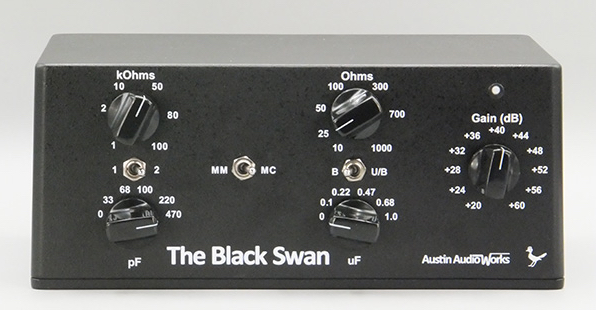
Spin Doctor #15: Austin AudioWorks Black Swan phono preamplifier

Forty years ago, as I was starting out on my audio journey, I railed against the flashy mainstream audio gear of the day. To me less was more, and I tried to convince my friends that my small, austere British-made audio rig, including what my friends jokingly called my Lynn Swanndek turntable (after the Steelers wide receiver), really did sound much better than their big silvery Japanese stacks loaded up with shiny knobs, switches, and meters. Audio was all about the sound after all, and I wasn't interested in some dazzling visual display that had nothing to do with what I was hearing. I gravitated toward gear that wasn't flashy or fancy looking, feeling that meant that the effort and expense to create it went where it counted most, to the parts that made it sound great.
Continue Reading »

The Spin Doctor at High End Munich 2024

Last month, I talked a bit about some of the new gear being exhibited at AXPONA, America's big hi-fi show, held near Chicago. Well, every year, as soon as that show is over, it's time to get ready for the Big Kahuna of audio shows, High End Munich.

Admittedly, I have never attended the big shows in Shanghai, Hong Kong, or Warsaw, but it would be hard to imagine either one outdoing Munich. The Warsaw show calls itself the second biggest show in Europe, deferring, presumably, to the Munich show. Munich is so big that it even has a sideshow, HiFi Deluxe, just down the road. HiFi Deluxe caters to exhibitors who got shut out of the big show, which despite its hugeness is oversubscribed. It can all become a bit overwhelming.

The main Stereophile crew covering the Munich show—Ken Micallef and Jason Victor Serinus—did all the heavy-duty legwork, posting highlights here. I toured the halls to see what was new, collecting the best, most Spin Doctor–ish things for this report. Here's a smattering.

Continue Reading »

Spin Doctor #14: Lyra Atlas λ Lambda phono cartridge and fixing footfall problems

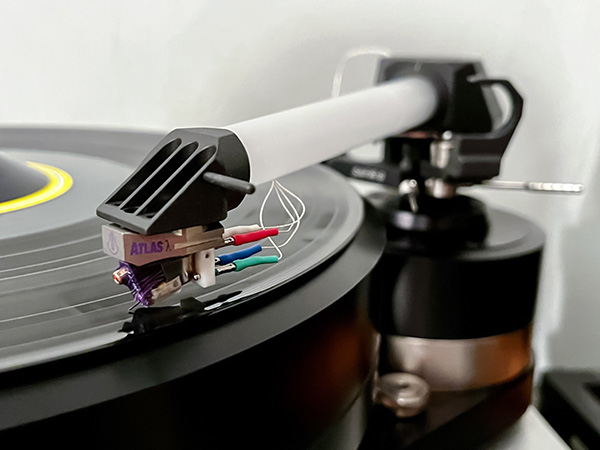
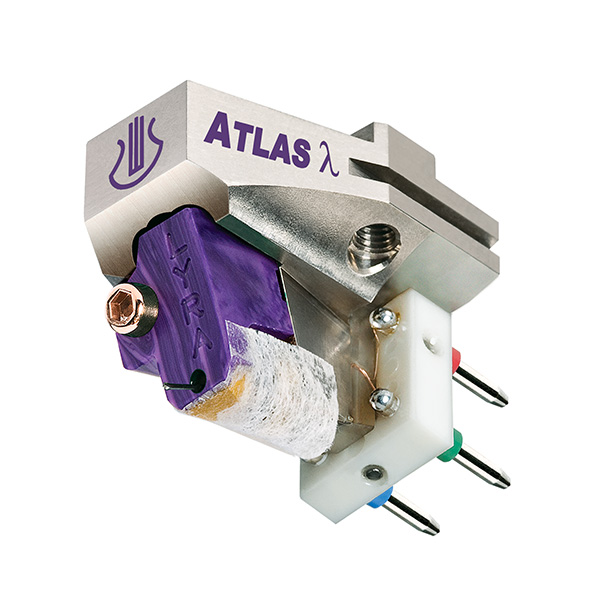
It has been more than a decade since 2012, when Lyra launched the original Atlas moving coil cartridge as the company's flagship, but in the intervening years, there have been a few updates. First, in 2016, Lyra introduced what they call the SL versions of the Atlas and also the Etna. These cartridges were designed to take advantage of a new crop of transimpedance phono preamps like the CH Precision P1 and the Sutherland Phono Loco, which boast exceptionally low noise levels but work best with cartridges that have very low impedance. Cutting the number of turns on each of the cartridge's two coils in half reduces the moving mass and inertia, allowing the stylus/cantilever assembly to respond more accurately to the tiny groove modulations. This results in improved tracking at the cost of a lower output level, which, thankfully, transimpedance phono preamps are well-equipped to handle.

Then in 2020, both Atlas and Etna versions were updated to new λ Lambda versions, with a redesigned suspension and damper system that Lyra says delivers enhancements in clarity and resolution.

Continue Reading »

The Spin Doctor at AXPONA 2024

These days, there's a hi-fi show taking place somewhere on the planet pretty much every weekend, but for me, spring is show season. First, in April, comes AXPONA, which is held near Chicago. AXPONA is the largest North American high-end audio show, making it pretty much impossible for one person to see everything during the three-day event. Even with my focus on record-playing gear, I found myself skipping some rooms, telling myself that I could catch them a month later at High End Munich. Munich is even bigger than AXPONA, so we'll have to see how that plays out.

With that in mind, here are a few things that caught my eye at AXPONA 2024.

Continue Reading »

Spin Doctor #13: Acoustic Signature Verona NEO turntable, TA-5000 NEO, TA-7000 NEO tonearms, Ultra Carbon TC-40 record weight

I sometimes joke about how audio designers create products that resemble themselves, not just in how they look, but also in the design approach used, and especially the way they sound. So, we have tall, cool, pragmatic Scandinavians making gear like the lean, elegant Børresen loudspeakers, while the Italians build luscious curvy equipment endowed with natural wood and leather, like Sonus Faber speakers and Unison Research amplifiers. Continuing this blatant stereotyping, we have Acoustic Signature founder Gunther Frohnhöfer, a stout German known for creating precision-built turntables that are as solid-looking as he is.

When I visited the Acoustic Signature factory in 2023, I watched as they hewed massive slabs of aluminum into beautiful, heavyweight turntables. This approach is the opposite of the lightweight-but-rigid philosophy embraced by Rega, and while the resulting performance has different strengths, I would argue that it is at least equally valid. As with Rega, Acoustic Signature products have a purposeful simplicity, in a way that would allow a nonaudiophile to instantly recognize what their function is.

Continue Reading »

Spin Doctor #12: EMM Labs DS-EQ1, The Wand 14-4 Turntable, M•A Inner Sleeves

"I think both moving coil and moving magnet cartridges are terrible." That's what legendary Canadian audio designer Ed Meitner told me when I asked about the pioneering transimpedance current drive phono stage he created for his Meitner PA6 preamp some 40 years ago.

Meitner has been designing innovative hi-fi gear for the pro and consumer audio markets for more than 50 years, but for most of the last 30, he has been best known for his work with high-resolution digital audio and DSD recording. Despite this focus on digital—and despite that comment about the two leading phono cartridge technologies—deep in his heart, Ed still loves analog and has fond memories of the Kenwood optical cartridges from the 1970s, which I discussed in last month's Spin Doctor column. So when Ed read that a company in Japan called DS Audio was bringing back an improved version of the optical cartridge using modern materials, he contacted designer Tetsuaki Aoyagi to learn more.

Continue Reading »

Spin Doctor #11: Alternative Phono Cartridge Technologies and the DS Audio DS-W3 optical cartridge system

Over the last 50 years, I must have installed well over 1000 phono cartridges, but I still remember the very first one: a Goldring G850 I put into the family Garrard Autoslim turntable when I was 11 years old. In 1973, the G850 was the least expensive moving magnet cartridge Goldring made. The change from the flipover-stylus ceramic cartridge that came with the Garrard wasn't an attempt to satisfy a youthful audiophile itch but, rather, a result of my first encounter with a system compatibility problem.

A few months earlier, I had convinced my nonaudiophile dad to upgrade the family stereo. We went from our ancient Monacor SMX-50 tube receiver to a pretty weird but less ancient Sony all-in-one cassette system called the TC-133CS. I failed to understand that the new Sony's magnetic phono input was incompatible with our old ceramic cartridge. Once I figured that out, I tried to convince my dad that what we really needed was a Shure M75ED. After all, that cartridge came from the same company that made the legendary V-15 Type III, widely regarded as the best cartridge in the world at the time. My dad, however, had different plans. Guided by his home-product purchasing bible, Consumer Reports, he decided we should go instead with the less-costly Goldring.

Continue Reading »

Spin Doctor #10: Tone Controls, Vinyl EQ Curves, and the Mola Mola Lupe

Twice in the last month I have been at someone's house, servicing their turntable, when they asked whether they should be considering a new phono preamp that offers additional playback equalization curves besides the standard RIAA. My usual reaction is to thumb through their record collection, where, more often than not, I find that they don't own a single record that was cut using a curve other than RIAA.

Phono playback EQ is one of those audiophile topics that stokes some people's passions, with plenty of disagreements about how important it is. I have seen grown men get into heated discussions about the history of record EQ curves, but in truth, the subject is only likely to matter if you listen to a lot of 78s or original mono LPs pressed between the late 1940s and the mid-1950s.

Continue Reading »

Spin Doctor #9: Soviet-era Hi-Fi & 2 Aidas phono cartridges

In 1985, I visited what was then known as Soviet Estonia with my family. My paternal grandparents, Mimi and Pop, had emigrated to the US from this small Baltic country in 1929. Fifty-six years later, after more than a decade of rejection, the family was granted permission by the Soviet authorities to visit our ancestral homeland, and the whole family, including Mimi, made the trek. (Pop died in 1962.)

Once we were there, we were more or less free to move around in the capital city Tallinn, but leaving the city was strictly forbidden, except as part of a planned group excursion with our KGB minders—er, "Intourist guides."

Continue Reading »
Advertisement
Advertisement
Advertisement