Jason Victor Serinus
Echole, Absolare, and Bybee
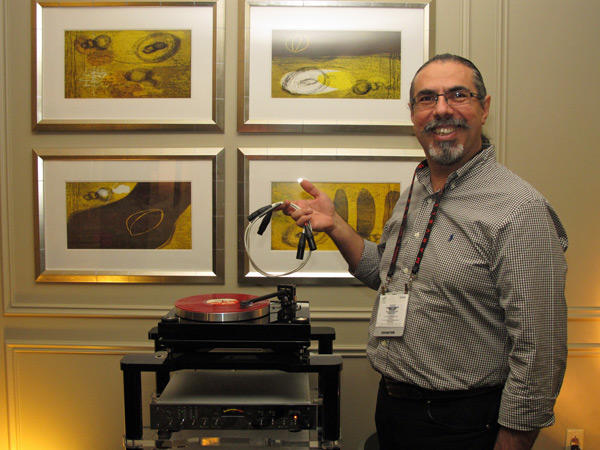
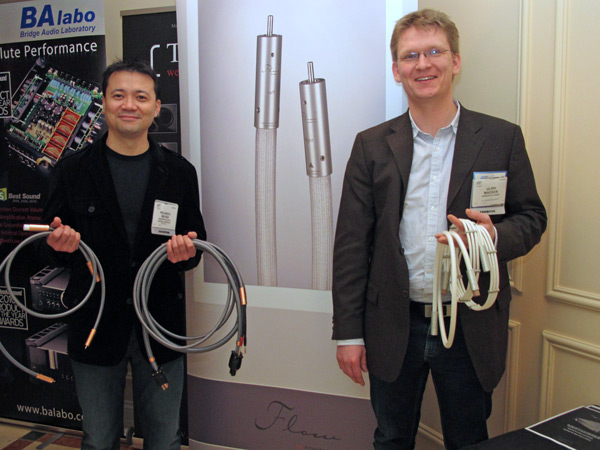
Kücükaslan founded Echole four years ago in New Hampshire. On display at T.H.E. Show was the complete line of Obsession Signature: speaker cable ($11,000/6ft pair), interconnects ($7500/3ft pair), and power cords ($6850/6ft).
Parts for Echole’s two cable lines, Echole Obsession and Echole Obsession Signature, are manufactured in both the US and Turkey. The wire, which is manufactured in Japan, consists of a proprietary ratio of silver, gold, and palladium. (The Obsession line has less gold and palladium that the Obsession Signature).
Stein Music’s Intriguing Accessories
They’ve also impressed me greatly. A set of four Stein Harmonizers has been residing in my reference system in Oakland for several months, bringing me much pleasure. To these ears, when set up correctly, they have a far from subtle effect on three-dimensionality, transparency, and realism. They take me one step closer to the real thing, making what comes out of my speakers sound less like hi-fi and more like music.
I was delighted to spend some time at T.H.E. Show with the Harmonizers’ designer, Holger Stein of Germany. Stein was showing the newest version of the Harmonizers, which were five years in the making.
The latest Harmonizers have a three-position switch on the rear. Those positions are (1) on with light, (2) on without light to preserve battery life for up to two years, and (3) off, to save energy when the system is not playing. Besides that, they function identically to their predecessor (which I have).
So how does the Stein Harmonizer work? Best to quote directly from Stein. Since, for him, English is a second language, I’ve given him an assist in the editing department:
Wireworld’s New USB Audio Cables
Both cables use a new technology, called DNA Helix, that Salz originally developed for use in Wireworld’s premiere PS and SS HDMI cables. DNA Helix utilizes twice as many signal conductors as conventional USB cable designs.
When Salz was first developing the DNA Helix design, he began to measure the transmission speed of cables. By designing a more efficient cable, he found he was able to increase transmission speed by 20%.
“I always start with the direct connection as my reference,” he explains. “What I heard from cables at the start of my work was really disappointing. This new design allows me to get substantially closer to the purity of the direct connection.”
Audioquest’s Diamond USB
A key feature of the Diamond USB, which is held in the photo by Audioquest’s Andrew Kissinger, is the Audioquest DBS (dielectric bias system). Invented and patented by Richard Vandersteen, with the cable version co-patented by Vandersteen and Audioquest’s Bill Low, the DBS creates an electrostatic field that saturates and polarizes the molecules of the insulation to minimize energy storage in the dielectric. The result is claimed to be much greater dynamic range, lower background noise, and reduced phase distortion.
Steve Silberman, VP of Marketing, explained that all insulators have capacitance. Energy from the conductor enters the insulation and needs to discharge. The DBS’ electrostatic field lowers the discharge, which in turn lowers the amount of phase distortion and makes for a cleaner signal.
In a very short demo, Silberman compared music through a stock USB cable that came with his printer to music through the Diamond. Using the new Arcam R asynchronous USB DAC, Arcam AVR 600 receiver, AQ Niagra interconnects ($1600/1m pair), AQ Redwood speaker cables ($2300/3ft pair), and Vandersteen 2Ce 30th anniversary edition speakers, the difference in transparency and color was striking.
Critical Mass Systems Stands
The newest Critical Mass product is Maxxum ($5650 per shelf), a precision component-support system. The shelf and rack architecture operate together to mitigate vibration in the floor, the rack, the shelf, and the component at the same time.
“We do more than isolate,” the sleep-deprived designer offered by way of explanation. “We give energy in the air a pathway out of the component so that components are not saturated with vibration from the loudspeakers.”
Lest you think Critical Mass Systems only manufactures high-priced products, prices start at $195 for a set of four MXK spikes, and $195 for a basic shelf. “Even though we’re very expensive, we start very low,” says Lavrencik.
At CES 2011, Critical Mass Systems products were used in the Lamm, Hansen/Tenor, and BAT rooms. In the photo, Lavrencik kneels near his Maxxum amplifier/component stands ($5650/each) and the Lamm ML3 Signature monoblocks ($139,290/pair) being used to drive Wilson Alexandria II speakers.
Audio-Technica Noise-Canceling Headphones
I’m glad that John Atkinson suggested I spend no more than a half-day at the LVCC. That’s how long it took to navigate through tens of thousands of people (or so it seemed) in the South and Central Halls to reach the displays of Audio-Technica, Sennheiser, and Monster.
First stop was Audio-Technica, where I encountered former audiophile critic turned publicist Frank Doris. Together we examined three new over-ear “Audiophile headphones” and one set of in-ear noise-canceling headphones.
I sampled the most expensive of the audiophile bunch, the Audio-Technica ATH-W1000x Grandioso ($699.95) that Tyll Hertsens writes about elsewhere in this report. I also briefly checked out their new in-ear QuietPoint active noise-canceling (ANC) ATH-ANC23 headphones ($99.95). Complete with an in-line volume control, the phones will first reach the market in February 2011. I found them a pleasure to use. Unfortunately, Unfortunately, all that was available to audition were MP3s of highly compressed, noisy pop and rock.
Monster Cable’s New Cans
Due in spring 2011 will be Monster’s Miles Davis Trumpets in-ear speakers (not yet priced). Featuring drivers in the front instead of the back of the buds, which allows them to be very, very small, these headphones look and feel very special.
Ted Sindzinski, holding the new ‘phones in the photo, believes these are one of the company’s best-sounding headphones. “They’ve been manufactured for a nice, warm, full, rich sound,” he assured me. Note the cute little silver trumpet on the cables. If you ask me, they’ve got Stephen Mejias’s name written all over them.
Sennheiser’s New Audiophile Headphones
I auditioned the HD 598, whose beige soft velour pads contrast elegantly with their black body. The salesperson who showed me around made a big deal of the packaging. Far more important were the frequency range, 15Hz28kHz, and the sound. Although the rather bombastic source material was supposedly MP3, the headphones delivered impressively smooth bass and a far more natural-sounding presentation than I would have expected.
Audience’s Latest Power Conditioner
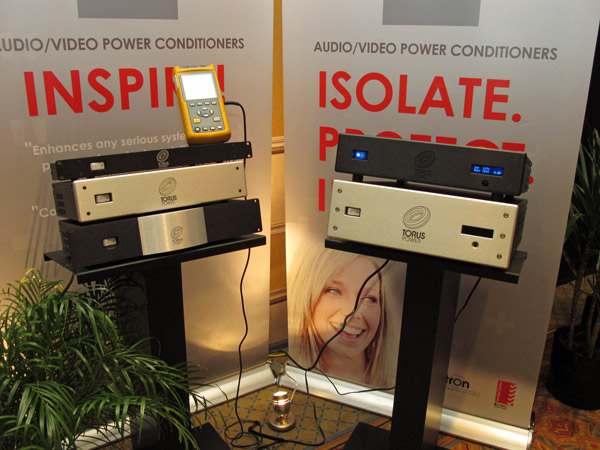
The 6-outlet version of the Adept Response aR6-TS was in use in the room. A 12-outlet version is also available ($8600 or $10,150, depending upon powerChord choice).
What’s new about the unit is the “S” in aR6-TS. “T” stands for the Teflon version of power conditioner, and “S” for its new Audience Teflon aura-TO capacitors. John McDonald says the new capacitors are significantly more resolute and transparent.