Budget Component Reviews

Sort By: Post DateTitle Publish Date

Acoustic Energy Aegis One loudspeaker
In this issue's "Letters" column, you will find comments from readers who are bothered by what they perceive to be this magazine's emphasis on reviewing very expensive technology. Yes, we do cover a lot of cutting-edge technology, and it is, of necessity, expensive. But our experience has been that that technology invariably trickles down to products that real people can actually afford.
PSB Alpha A/V loudspeaker

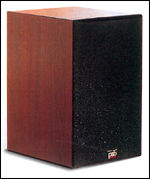
The original PSB Alpha was reviewed for Stereophile by Jack English in July 1992 (Vol.15 No.7). A modest-looking two-way priced at just $199/pair, it combined a reflex-loaded 6.5" woofer using a plastic-doped paper cone with a 0.5" plastic-dome tweeter. JE summed up the Alpha by saying it "is simply one of the best buys in audio, providing a musically satisfying sound...a sensational audio bargain." It went on to become one of the best-selling audiophile speakers ever, with over 50,000 pairs sold.


PS Audio P300 Power Plant

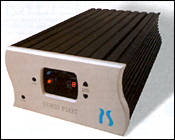
Although advertising copywriters would have us believe otherwise, there is not a lot of true innovation in audio. Most audio products are based on well-established principles, perhaps refined in detail and execution. Of course, some products do take novel approaches, but they tend to be too off-the-wall to be taken seriously, or simply don't do the job as well as more conventional products. What's really exciting is to encounter a product that is audaciously original in concept, yet makes so much sense that you wonder why no one even thought of it before (footnote 1).


Yamaha @PET RP-U100 personal receiver

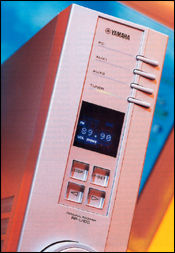
Convergence is a widely used buzzword in today's consumer-electronics industry. However, other than using my PC's soundcard in the office to play back MP3-encoded music and plugging the Mac in my listening room into my reference system in order to experience Riven with the highest possible sound quality, I've kept a low profile in this area.


Rotel RB-991 power amplifier

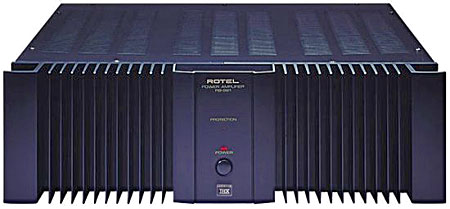
As a reviewer who has focused on seeking out high-quality audiophile gear for cost-constrained readers, I'm embarrassed to say that the flagship RB-991 stereo amplifier is the first Rotel product I've had in my house. (To be fair to myself, this 38-year-old family-owned company did not develop a large US market presence until this last decade.)


MSB Technology Link D/A converter

Recently, we've seen the digital "horsepower" race accelerate with the arrival of digital sources and devices with 24-bit and 96kHz sampling capability. Much of this has been spurred by the 24/96 labels emblazoned on the newer DVD players—and, within the purer confines of the audio community, by high-end DACs with this same ability. Indeed, it's possible that the dCS Elgar DAC, near and dear to John Atkinson's heart and a perennial Class A selection in Stereophile's "Recommended Components," performs so well with standard 16-bit/44.1kHz sources because its wider digital bandwidth permits greater linearity within the more restricted range of regular CDs.


Entech Number Cruncher 203.2 & 205.2 D/A converters

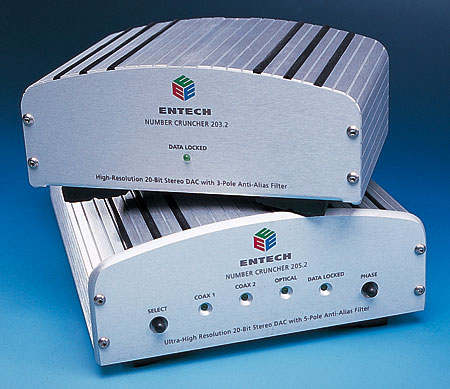
"They're cuuuute!" Not a very professional reaction, but what can I say? When the Monster Cable folks pulled out their new Entech Number Crunchers during a recent visit to Santa Fe, I couldn't help myself. I was edging John Atkinson and Wes Phillips out of the way, using my long arms to reach over...gotta get one! There would be time later for the critical evaluation and cool, detached objectivity—first, I had to get one. The Entechs are the Beanie Babies of the audio world


KEF RDM Two loudspeaker

Stereophile is, in one sense, like a family—us younguns have to make do sometimes because the house is straining at the seams. When I first arrived in Santa Fe, for instance, I was told not to come to the office for a few days—the good news, John Atkinson informed me, was that I had a desk; the bad news was that nobody had a clue where to put it. The dilemma was solved in Solomon-like fashion by shoehorning my desk into the "listening room," which was already serving double-duty as audition space and speaker-measurement lab. If manufacturers visited, we'd sweep up all the acoustic damping from the floor and stash it in JA's office; and if JA needed to take measurements, I would be asked to work at home. It was a manifestly fair solution: inconvenient for everyone involved.


Paradigm Reference Studio/20 loudspeaker

The least expensive model in Paradigm's Reference series, the Studio/20 loudspeaker is a rear-ported two-way dynamic bookshelf/satellite design, superficially identical to the powered Active/20 that JA">http://www.stereophile.com//loudspeakerreviews/597/">JA reviewed last November. It features Paradigm's 25mm PAL pure-aluminum dome tweeter in a die-cast heatsink chassis, and a 170mm MLP mica-polymer cone in an AVS die-cast heatsink chassis with a 38mm voice coil. The crossover is third-order, quasi-Butterworth, said to be "phase-coherent." It features high-power ceramic resistors, film capacitors in all signal paths, and both air-core and steel-core inductors.


Advertisement
Advertisement
Advertisement