
As We See It

Sort By: Post DateTitle Publish Date

Measurements, Maps & Precision
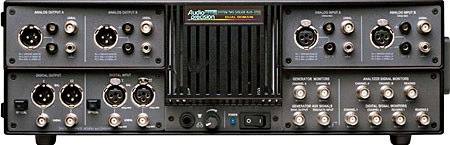
As I wrote in this space last month, test-equipment manufacturer Audio Precision has loaned Stereophile a sample of their top-of-the-line SYS2722 system, which has both significantly greater resolution and greater bandwidth than the Audio Precision System One Dual Domain we have been using since 1989. The reviews you can read in this issue include the first measurements I have performed with this impressive piece of gear, though there are still a number of graphs I produced using our System One. In fact, with the equipment I tested using the SYS2722, I performed duplicate sets of measurements using both the System One and the Miller Audio Research QC Suite in order to get a handle on how close the three systems agreed. (They did on the tests where the SYS2722's improved resolution was not a factor.)

Anniversaries, Appreciations, Aleatorics, & an Apology

It was the strangest feeling: to be part of something yet without any understanding of how what I was doing fit into the whole. Back in the early 1980s, I had graduated from playing miscellaneous instruments in an early-music ensemble to devoting myself to the recorder (the end-blown fipple flute, not the audio archiving machine). My teacher, Nancy Winkelmann, had introduced me to various ensembles, and one Saturday afternoon, an ad hoc group of us was working with a composer of so-called "aleatoric" music; literally, music by chance.

45 Years of Stereophile

It was 45 years ago this month that the first issue of Stereophile, just 20 pages in length, went in the mail. It had been founded by one J. Gordon Holt. Gordon had been technical editor of High Fidelity magazine in the 1950s, and was tired of being asked to pander to the demands of advertisers. "I watched, first with incredulity and then with growing disgust, how the purchase of a year's advertising contract could virtually insure a manufacturer against publication of an unfavorable report," he said in a 1974 article looking back at those dark times. And if a company didn't buy advertising, they didn't get reviewed at all. The Stereophile, as it was then called, was Gordon's answer to audiophiles' need for an honest, reliable source of information. "Okay, if no one else will publish a magazine that calls the shots as it sees them, I'll do it myself," he later wrote.

The Past Is Prologue

"Why didn't they choose a color set?" I had been reminiscing about the early days of TV and how my parents bought a black-and-white set so we could watch the Coronation of Queen Elizabeth II in 1953. My daughter Emily's question had me stumped. It is difficult to explain to someone born 10 years after the launch of CD—someone who, for example, has never seen, let alone used, a typewriter, and who enjoys a comparatively infinite set of choices among mature 21st-century technologies—that it was not always thus.

What it is we do when we do this thing we do

Back on April 13, Stereophile assistant editor Stephen Mejias posted the following thought on his "Elements of Our Enthusiasm" blog: "Is it possible to listen to music and listen to the hi-fi? Or are they two entirely different activities, incomparable and incompatible? Right now, for me, they seem to have nothing in common, whatsoever."

Life, Love, and The Big Ahh

A fellow member of the Bay Area Audiophile Society recently forwarded to me a link to Wikipedia's entry for audiophile. It's a horror. Even before the page defines the word, it begins with a large question mark, circled in green, and the warning, "This article or section may contain original research or unverified claims. Please help Wikipedia by adding references."

Audiophiles Perfect What The Mass Market Selects

As I write this in the first quarter of 2007, CD sales are off over 22% compared to this time last year. The music industry as we know it, based on sales of some kind of physical medium, is over. While CDs and even LPs will remain available—they're so easy and cheap to make—they've become irrelevant to the mass market and to the future of audiophile recordings. The major labels have also become irrelevant (not to mention highly irritating).


Advertisement
Advertisement
Advertisement