CD Player/Transport Reviews

Sort By: Post DateTitle Publish Date

YBA CD 1 Blue Laser CD player
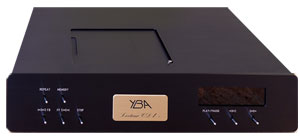
ybacd101.jpgI'm about to out YYves-Bernard André as one of the great unknown tweakers of high-end audio. (My own predilection for stepping into uncharted tweakwaters is well known.) Yves-Bernard, his wife and partner Ariane Moran, and importer/distributor Daniel Jacques of Audio Plus Services seemed perfectly sanguine about letting the cat out of the bag. And why not? In a singular way, the YBA audio solution encompasses both the supertweak and the more-casual-about-equipment music lover.


The YBA CD 1 Blue Laser (or Lecteur CD 1, as it's known at home in France) breaks new ground. It is very French in that it's individualistic in the extreme, and perfectly embodies current thinking chez YBA regarding music playback in the home. Its design dates back to 1991, a point Yves-Bernard takes pains to point out in the manual.
Mark Levinson No.37 CD transport & No.36S D/A converter

We are now well past the era in which every review of digital playback equipment had to begin with an apology for the medium. CD replay performance may, in fact, now be bumping up against a glass ceiling. But that doesn't discourage high-end audio manufacturers from trying to advance the art, and tempt audiophiles (at least those among us who are not hopeless digiphobes) out of our minds.


Mark Levinson No.31.5 Reference CD transport

If there is a component category that causes the "objectivists" in the audio community to splutter uncontrollably over their cups of herbal tea, it is the high-end CD transport. For in their "bits is bits" world, all a transport is required to do is recover the digital data from a disc—much like a grown-up cousin of your computer's $25 floppy-disk drive. The thought of paying up to $10,000 for something so humble—and, in their eyes, unnecessary—typifies what these blinkered folks regard as the insanity of the High End.


California Audio Labs Icon Mk.II Power Boss CD player

I have always been a dyed-in-the-wool vinyl fan, committed to the superiority of analog over current 44kHz/16-bit CD technology. Nevertheless, I have been surprised at how greatly the sound of CD has improved over the past 10 years. By 1994, digital had gotten much closer to analog than I had ever expected, which was a good thing, as 1994 also saw the disappearance of the LP as a medium for obtaining new releases of mainstream recordings. But over the last two years, I've noticed some interesting phenomena: More turntables, tonearms, and cartridges started to become available, at least in the high-end arena. Audiophiles and, to a lesser extent, segments of the general music-loving public, began clamoring for new vinyl releases. Specialty labels, such as Classic Records and Acoustic Sounds, started to reissue premium vinyl releases of classical, jazz, and pop classics at reasonable prices. And major labels again began to offer vinyl versions of major pop releases.


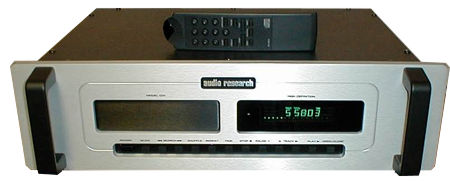
Audio Research CD-1 CD player

Walking through the circus that was WCES '95 was like undergoing total neural-synaptic overload. I felt hard-pressed to just keep my head above water separating good sound from bad. Trying to piece together a coherent picture of the show, I jotted down the components in the best systems that I'd heard, and a few items popped up with astonishing regularity. One of these was Audio Research's single-chassis CD player, the CD-1.


Sumo Axiom CD transport & Theorem II D/A processor

Making digital audio sound good appears to be a much more difficult job than its developers first realized. When digital audio was in its infancy, there was a tendency to think that digital either worked perfectly, or didn't work at all. This belief led the engineering community to devise ill-considered and flawed standards that affect the musical quality of digitally reproduced music today.

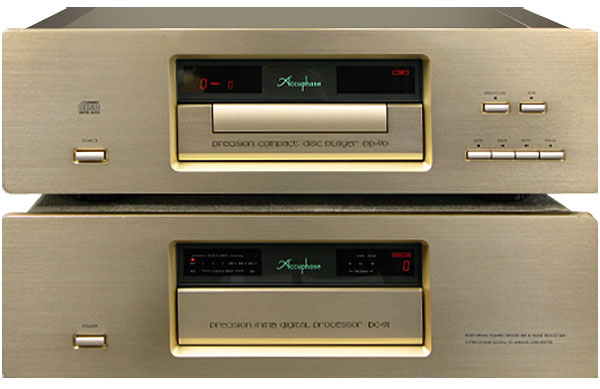
Accuphase DP-90 CD transport & DC-91 D/A processor

In 1995, as the compact disc enters its second decade of commercial reality, it's fair to say that the associated hardware has come of age, exorcising at last the digital gremlins of time-base jitter and quantization noise. Digital-processor maturation is particularly evident in the design of the all-critical D/A processor. The simplistic digital circuitry of yesterday has given way to considerable design sophistication that deals directly with jitter and low-level nonlinearities.
Advertisement
Advertisement
Advertisement