Stand Loudspeaker Reviews

Sort By: Post DateTitle Publish Date

Pawel/Ensemble PA-1 & Reference loudspeakers

Ten seconds to ignition. Relax, buckle in, and welcome to Stereophile's Good Times time machine. Flux capacitors fully energized. Ignition. Not to worry, that slight tingling sensation is perfectly normal. Roll back your calendar to...June 28, 1933. We're at the Eighth Annual convention of the Institute of Radio Engineers in Chicago. Harry Olsen is on the podium, describing a new wide-range cone loudspeaker for high-fidelity sound reproduction.
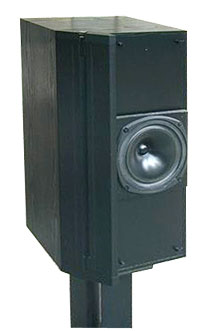
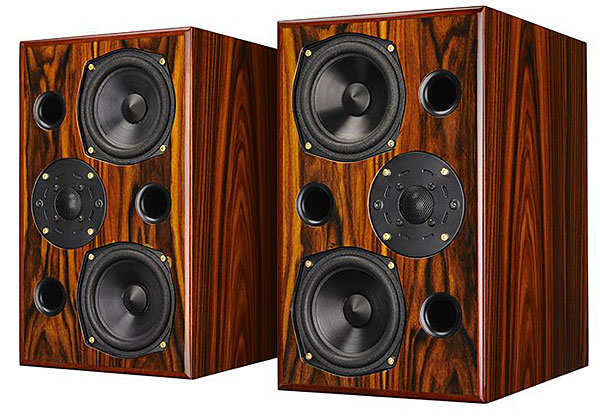
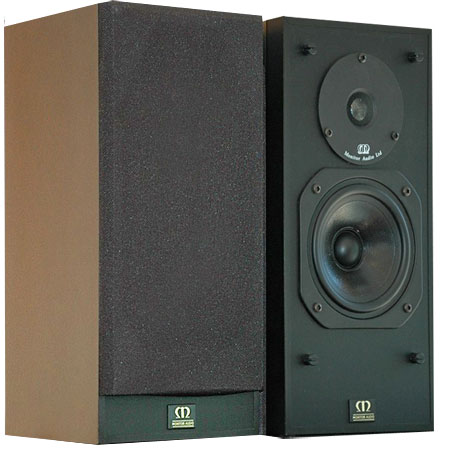
Quiet, please, Mr. Olsen is about to describe the disadvantages of multiple–drive-unit systems. "The radiating surfaces must be separated by a finite distance, with the result that this system will exhibit peculiar directional characteristics in the overlap region where the sound radiation issues from both sources. To reduce this effect to a minimum, the overlap region must be confined to a very small range which requires an elaborate electric filter system for allocating the frequency bands of the units. The greater space required for the two loudspeakers is another important factor. The cost of two separate field structures and vibrating systems will be considerably greater than that of a single unit."

Celestion 3000 loudspeaker

Some reviews seem ill-fated from the get-go: samples break; systems go wrong; test equipment gives anomalous measurements; and at times the reviewer starts to doubt his or her ears when it seems impossible to get the component being reviewed to sound anywhere as good as reported by other writers. Such was the case with this review of the Celestion 3000. When Celestion's Barry Fox visited Santa Fe three days before Christmas 1989 with early samples of the speaker, we were dismayed to find that the ribbon of one of the pair was crinkled and immobile, apparently due to the extruded-aluminum magnet frame warping in transit. Fortunately, Barry had brought a spare tweeter with him, to show how it worked, so we replaced the broken one in order to do some listening.


Cambridge SoundWorks Ambiance loudspeaker

According to the conventional wisdom, companies selling consumer products fall into two categories: those whose sales are "marketing-led" and those whose sales are "product-led." Marketing-led companies tend to sell mature products into a mature market where there are no real differences between competing products—soap powder, mass-market beer, or cigarettes, for example—whereas product-led companies tend to sell new technologies, such as personal computers and high-end hi-fi components. In the audio separates market, conventional wisdom would have a hard time categorizing any individual company: no matter which you choose, it would be simplistic to say that it is either product- or marketing-led. No matter how good the product, without good marketing the manufacturer stands little chance of success; a poor product superbly marketed may make a company successful overnight, but that success will have hit the end stops by the following night.


Acoustic Energy AE2 loudspeaker

In the September 1988 issue of Stereophile, I wrote a rave review about the first speaker, the AE1, from what was to me a totally unknown English company, Acoustic Energy. Though tiny, and possessing an intrinsically limited low-frequency response, the $1500/pair AE1 was one of the most musical loudspeakers I have ever used, throwing a deep, beautifully defined soundstage, and possessed of a clean treble and a sweet, if rather forward-balanced, midband.

Paradigm Control Monitor loudspeaker

If speakers were cars, the Infinity IRS Beta and B&W 801 Matrix would represent the luxury end of the mass market, with perhaps the Celestion SL700, Quad ESL-63, and MartinLogan Sequel II analogous to rather hairy, temperamental sports cars—the Porsche 911, for example. But most people don't buy Porsches, or even Lincoln Town Cars; they buy Hyundai Excels and Ford Escorts. In the same way, when the car is garaged for the night, they don't sit down in front of IRS Betas; in all likelihood they listen to their records with a compact two-way design. If competently designed, a small two-way can give a great deal of musical satisfaction, and, to take a current hobbyhorse of mine out for a trot, if a designer can't produce an at least competent two-way loudspeaker, he or she has no business trying to design larger, more ambitious models—there's nowhere to hide your lack of talent if all you have to play with is a tweeter, a woofer, a rectangular enclosure, and a handful of crossover components.

Rogers LS7t loudspeaker

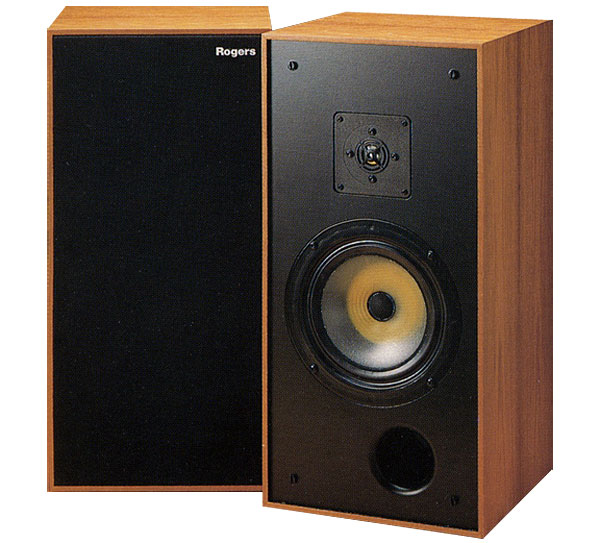
The English loudspeaker manufacturer Rogers [no connection with the contemporary US company Rogers High Fidelity] has had an illustrious history since being founded in 1947 by veteran designer Jim Rogers. Absorbed by the Swisstone company in 1976, it has since gone from strength to strength, the main creative work now being done by the respected English engineer Richard Ross. Noteworthy for keeping the miniature BBC LS3/5a design in continuous production for nearly 15 years, Rogers also makes a range of polypropylene-cone woofers and midrange units which are used in other models in its range.

Amrita AMRIT-MiniMonitor loudspeaker

"Amrita" is Sanskrit for "nectar," and indeed, the Amrita owner's manual states that they are confident their speakers "will provide Nectar For Your Ears." Although this Iowa-based manufacturer offers a large range of loudspeakers, I decided that Stereophile should review their small AMRIT-MiniMonitor ($875/pair) after Martin Colloms mentioned in his report from the 1987 SCES in Vol.10 No.5 that it sounded "pleasantly balanced on both rock and classical material." We received a pair for review in the summer of 1988, but it turned out that only one was working, the other having a very restricted low-frequency response below 100Hz. After repeated requests for replacements, Amrita's John Andre personally delivered a pair to Santa Fe in the Spring of 1989. This time, both worked out of the box!

Celestion 3 loudspeaker

666celestian3.250.jpg"Why does John Atkinson devote so much of his time to loudspeakers selling for under a [sic] $1000?" wrote a correspondent to The Audiophile Network bulletin board in August, there being a clear implication in this question that "more expensive" always equates with "better" when it comes to loudspeakers. While it is true that the best-sounding, most neutral loudspeakers possessing the most extended low-frequency responses are always expensive, in my experience this most definitely does not mean that there is an automatic correlation between price and performance. I have heard many, many expensive loudspeakers whose higher prices merely buy grosser sets of tonal aberrations. For those on modest budgets, provided they have good turntables or CD players, a good pair of under-$1000 loudspeakers, coupled with good amplification, will always give a more musical sound than twice-the-price speakers driven by indifferent amplification and a compromised front end.


End of discussion.

Advertisement
Advertisement
Advertisement