Stand Loudspeaker Reviews

Sort By: Post DateTitle Publish Date

Harbeth BBC LS5/12A loudspeaker

In the ice-cream world, chocolate is the universal end of the line. Vanilla experiments that taste great but look foul, maple syrup flavors that are more maple than syrup, tutti-frutti that's too tutti—all are recycled as chocolate flavor, their visual sins permanently hidden from view. In the world of wood, the equivalent of chocolate ice cream is the ubiquitous "black ash" veneer. The original color and character of the wood are irrelevant: it all ends up stained black.


Spica TC-60 loudspeaker

As far as I can tell, Santa Fe–based speaker engineer John">http://www.stereophile.com/interviews/694">John Bau had designed but four commercial loudspeakers before the TC-60 was launched at the 1994 Winter CES: in order of appearance, they were the Spica SC50i (1980), the TC-50http://www.stereophile.com/standloudspeakers/446">TC-50; (1983), the Angelushttp://www.stereophile.com/floorloudspeakers/693">Angelus; (1987), and the SC-30 (1989). None were expensive, and all garnered much praise, both in Stereophile's pages and elsewhere.


Dunlavy Audio Labs SC-I loudspeaker

The SC-I ($995/pair) is the smallest model in the "Signature Collection" to come from Dunlavy Audio Labs, the company founded by John">http://www.stereophile.com/interviews/163">John Dunlavy after he left Duntech. The largest model in this series used to be the $4995/pair SC-IV that Robert Deutsch so enthusiastically reviewed last April, and that this month was voted Stereophile's 1994 "Product of the Year." There is now also a huge SC-VIhttp://www.stereophile.com/floorloudspeakers/162">SC-VI; available.


Audio Physic Step loudspeaker

Immedia introduced the German Audio Physic speakers at the 1994 Winter CES. As I mentioned in my Show report (Vol.17 No.4), I felt the price:performance ratios of the three models displayed was an indirect one: the least-expensive—the Step—sounded best. Since I'm always looking for products that offer great bang for the buck, I arranged to receive a pair of review samples.

Sonus Faber Minuetto loudspeaker

I know, I know—"NOT ANOTHER $%#$ SONUS $%#$# FABER REVIEW IN $%#$# Stereophile!!" In just the past two years or so alone we've spilled a pretty fat bottle of ink on this Italian speaker line: Martin Colloms reviewed the $12,500/pair Extrema (Vol.15 No.6) and $9000/pair Guarneri Homage (Vol.17 No.7); Jack English covered the $4500/pair Electa Amator (Vol.15 No.10); and Larry Greenhill wrote about the $1800/pair Minima FM2 (Vol.16 No.4). That's a lotta jizzatoni, so let me tell you right off the bat that when I called Italy a few months ago, speakers were the last thing on my mind.


I wanted shoes.

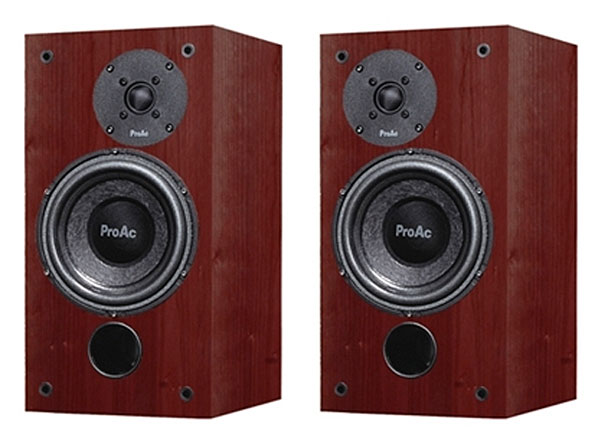
ProAc Studio 100 loudspeaker

Of all the speakers I've heard through the years, the $3000 ProAc Response 2 (footnote 1) is definitely one of my all-time faves. One of the few high-end speakers at any price that sounds equally at home pumping out Prong as it does Puccini, the Response 2 blew me away with its incredible musicality and just plain "rightness." The Response 2 doesn't call strict attention to any one area of technical achievement, like so many Audiophile-Approved jobs, but just makes music so naturally and unforcedly that I hesitate, even considering its remarkable performance, to call it an "audiophile" loudspeaker. Yah, I dig the Response 2! So last year when ProAc introduced the Studio 100, a new affordable version of the Response 2, I got excited.

ProAc Response 1S loudspeaker

994ProAcR1S.jpgHere's the deal: If you're the kind of listener who must listen to your stereo at levels that change the barometric pressure of your listening room, or if you can't enjoy reggae concerts because they don't have enough bass, then the ProAc Response 1S (revised) is definitely not the speaker for you. Read no further. Move on. Scoot.


Anybody left? Good. Now we can talk about a very special little speaker. In a way, I didn't even want to review the 1S. I mentioned to John Atkinson that I'd heard them at my buddy Ruben's house and enjoyed them immensely, but I'd been using a pair of $13,000 speakers to review an exotic amplifier and had, sad to say, become quite spoiled: bass down to 28Hz, 93dB sensitivity, and some of the most accurate soundstaging I'd ever heard—we're talking about some serious suffering for my art, here.


So when the ProAcs arrived at my house, I thought it unfair: unfair to me (I was gonna miss them big dogs), and unfair to the Response 1S. After all, does anyone remember who played after the Beatles on the Ed Sullivan Show?

B&W John Bowers Silver Signature loudspeaker

In recent years, computer modeling, finite-element analysis, and laser interferometry have brought about a huge increase in our knowledge about what makes the moving-coil loudspeaker drive-unit work. Nevertheless, it has remained fundamentally unchanged since it was invented by Rice and Kellogg more than 60 years ago. That doesn't mean that it hasn't been refined considerably; in this review I examine the performance of a design whose drive-unit technology has been taken to the limit of what is currently possible, the B&W Silver Signature.

Velodyne DF-661 loudspeaker

Silicon Valley–based Velodyne was founded in 1983 to develop a range of subwoofers that used servo-control to reduce non-linear distortion to vanishingly small levels. They succeeded in this goal to the extent that Velodyne is now perhaps the best-known subwoofer company in the US, currently employing 65 people. At the 1994 Winter CES, Velodyne launched the subject of this review: the DF-661 ($1800–$2600/pair), their first full-range loudspeaker (the "DF" stands for "Distortion-Free").


The three-way DF-661 was designed from the ground up to continue the Velodyne tradition of ultra-low distortion. "We had developed the technology and resources to attack distortion elsewhere in the audio chain," wrote company President David Hall, "and started with the premise that, by definition...distortion in loudspeakers is wrong." (His italics.) "We went to the laboratory for a solution, with the living room as the ultimate goal." Velodyne calls this attention to technological detail "The Silicon Valley approach to sound."

Advertisement
Advertisement
Advertisement