Floor Loudspeaker Reviews

Sort By: Post DateTitle Publish Date

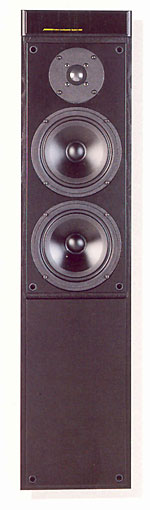
Meridian D600 digital active loudspeaker

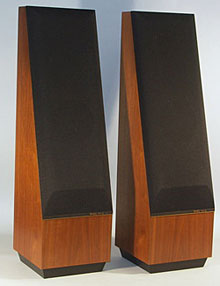
In audiophile circles, it is the "Stuart"—electronics designer Bob Stuart of the Boothroyd-Stuart collaboration—who has received most recognition. The contribution of industrial designer and stylist Allen Boothroyd has gone relatively unremarked. Yet as I unpacked Meridian's D600 "Digital Active" loudspeaker, I was struck by Boothroyd's ability to make the humdrum—a rectangular box loudspeaker—seem more than just that. The man has one hell of an eye for proportion. From the first Orpheus loudspeaker of 1975, through the Celestion SL6 and 'SL600http://www.stereophile.com/standloudspeakers/744">SL600; (where AB did the industrial and package design), to this latest Meridian loudspeaker design, his brainchildren look "right," to the extent of making competing designs appear at minimum over-square and clumsy, if not downright ugly.


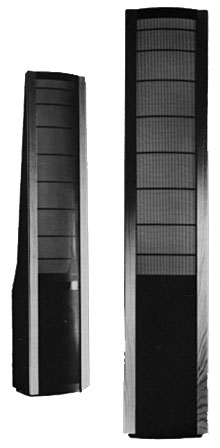
MartinLogan Sequel II loudspeaker

Loudspeaker designers are dreamers. Something takes hold of a man—the fact that loudspeaker designers are all men must be significant—and he wrestles with recalcitrant wood, arcane drive-units, and sundry coils, capacitors, and cables, to produce something which will be individual in its sound quality yet inherently more true to the original sound. An impossible task. Yet if there were to be an aristocratic subset of those dreamers, it would be those who have taken upon themselves the burden of producing electrostatic loudspeakers. For these farsighted engineers, there is no standing on the shoulders of others, there is no recourse to tried and tested combinations of other manufacturers' drive-units. Every aspect of the design, no matter how apparently insignificant, has to be created afresh from first principles. For a new electrostatic design to produce a sound at all represents a great triumph for its progenitor, let alone having it sound musical. And to produce an electrostatic loudspeaker that is also possessed of great visual beauty is indeed a bonus.


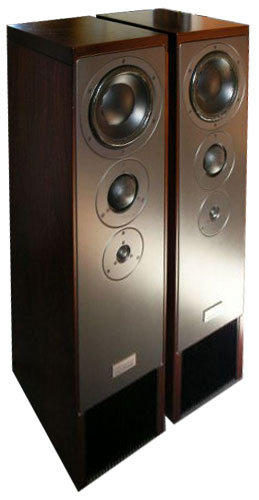
Pioneer Elite TZ-9 loudspeaker

Although, historically, Asian high-performance loudspeakers have not had much impact in the US (with the possible exception of the Yamaha NS1000), it is obvious from recent events that that situation might change. Some Japanese manufacturers are determinedly attempting in 1989 to scale the high-end heights. Onkyo, for example, launched an entire range under the Precise brandname, designed by that most idiosyncratic of talented Californian engineers, Keith Johnson, while Yamaha has licensed the Swedish ACE-Bass technology to produce loudspeakers that extend amazingly low in the bass for their size. But it is Pioneer, already well-ensconced in the US pro market with their TAD (Technical Audio Devices) drive-units and monitors, who have made perhaps the biggest techno-splash with their "Elite-TZ" speakers. These feature both high-tech drive-units and a novel (if not entirely new) method of minimizing enclosure vibrations.


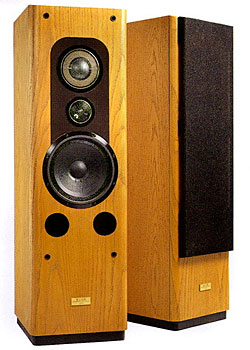
The TZ-9 is the top of Pioneer's new line, and costs a cool $4000/pair, placing it firmly in the high-end category. But for that outlay, the TZ-9 owner acquires a largish and quite handsome speaker, finished in a rather orange-colored oak veneer and standing some 4' high. Both tweeter and midrange units feature domes fabricated from an amorphous form of carbon termed by Pioneer "Ceramic Graphite," which is said to have 10 times the bending stiffness and two times the internal loss or self-damping of an equivalent titanium dome. The practical result should be accurate pistonic motion in each unit's passband, with a better-damped HF resonance than a metal dome. In practice, these Ceramic Graphite diaphragms can be quite brittle. Despite the presence of protective wire grilles over the mid- and high-frequency units, the first pair of TZ-9s we received had had the midrange domes shattered, due to inadequate early packaging.

Dynaudio Accent 3 powered loudspeaker

When it comes to loudspeaker drivers, Dynaudio has earned an enviable reputation for quality and reliability. To use an automotive analogy, they are the Mercedes Benz of the driver universe. If you're a speaker builder, the odds are that you have already experimented with these drivers. And even if you're not a speaker builder, it's quite possible that your speakers use Dynaudio drivers. After all, some of the finest speaker systems in the world do. A case in point is the Duntech Sovereign, which single-handedly embodies almost the entire Dynaudio catalog.


Vortex Screen loudspeaker

One of the joys of reviewing audio reproduction equipment is discovering a little-known product that provides an extraordinary level of performance and musical satisfaction at an affordable price. These components, sometimes made in a garage, reflect the designer's single-minded zeal for musical accuracy, not the sometime corporate mentality of meeting a price point or catering to the latest fad.

Delaware Acoustics DELAC S10 loudspeaker

666skinny.promo250.jpgOne of the joys of reviewing loudspeakers is that there are always intriguing aspects of any particular design. The problems involved in producing a speaker that has an even tonal balance, well-controlled directivity, good bass extension, and a smooth integration of the outputs from often widely disparate drive-units have what appears to be an infinite number of solutions. The result is often a speaker so different from the norm that it just cries out to be auditioned.

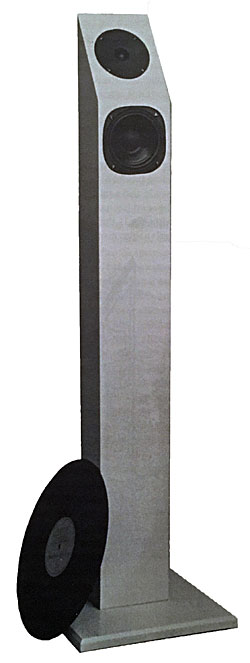
Such was the case with the Delaware Acoustics DELAC S10, which costs $629/pair. Only sold factory-direct, this would therefore have been low on Stereophile's priority list for review if it weren't for two things: first, the fact that the S10 was designed by one Ralph Gonzalez, a name that should be familiar to readers of Speaker Builder magazine for having written a very useful speaker design and analysis program; second, as implied in the first paragraph, the S10 is one of the weirdest speakers I have ever laid ears on.

Thiel CS3.5 loudspeaker

Frankly it's a bit nutty for me to be doing this review. First, as Publisher of this esteemed journal, my primary duties involve financial and personnel management, as well as a good bit of public relations; I don't need and am not required to perform the exacting tedium of product reviews. Second, Jim">http://www.stereophile.com/interviews/221">Jim Thiel and Kathy Gornik of Thiel are friends of mine. So what, you ask? Well, if this were going to be a uniformly positive review, I would therefore be ruled out as the reviewer; if it's to be wholly or partially negative, it will surely put a strain on one of my best audio friendships.


Thiel CS1.2 loudspeaker

Thiel Audio, headed up by Jim">http://www.stereophile.com/interviews/221">Jim Thiel (President and chief designer) and Kathy Gornik (Marketing Director), sets itself apart from other speaker manufacturers not only by making what I feel to be almost uniformly excellent products, but also by serving as a kind of hallmark for the good dealer: Although not all good dealers sell Thiel, just about every Thiel dealer is a good one. This comes about because, in spite of just about uniformly positive reviews and excellent customer relations, Thiel (primarily in the person of Ms. Gornik) has insisted on limited distribution through retailers they know will give their product a good demonstration. There are a few other such companies performing this hallmark function, though only Mark Levinson Audio Systems readily comes to mind. Most other successful companies prefer as wide a geographical distribution as possible, in spite of the occasional necessary compromises in dealer quality.


Advertisement
Advertisement
Advertisement