Floor Loudspeaker Reviews

Sort By: Post DateTitle Publish Date

KEF Reference Series 103/4 loudspeaker
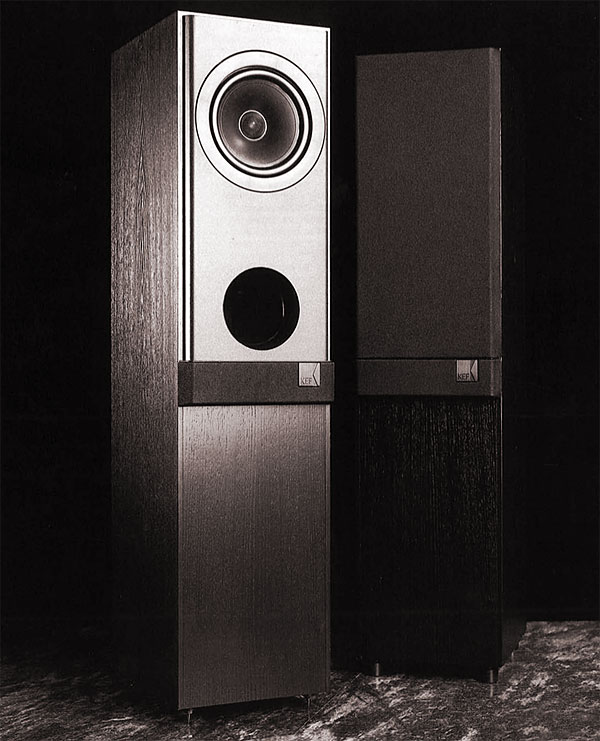
By now most readers will be familiar with the relatively new tuned-cavity method of low-frequency loading. Such designs have popped up all over the place of late, especially in those little satellite/woofer systems, but KEF can rightly lay claim to generating the design's theoretical basis, as JA described in his review of the KEF R107/2 loudspeaker in Vol.14 No.5 (May 1991). Essentially, the technique consists of loading the rear of a woofer in a conventional fashion—usually a sealed box—but also loading the front of the driver into another enclosure, ducted to the outside. Basically, the design acts as a bandpass filter with its response centered on the port-tuning frequency. The rolloff is smooth and rapid on either side of this frequency, providing a natural low-pass characteristic but thereby virtually mandating a three-way system. If properly designed, this configuration offers a number of theoretical advantages. The radiating element is actually the air in the port, which is low in mass. Low distortion is possible, as is relatively high sensitivity.
Paradigm Studio Monitor loudspeaker

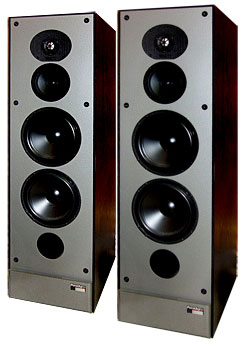
692.parapromo.jpgParadigm is not a new name to US audiophiles, but the Canadian loudspeaker company hopes to increase awareness of its products with their Monitor series, all members of which incorporate a similar design philosophy and drive-units. Heavy and apparently massively constructed, the top-of-the-line Paradigm Studio Monitors ($1899/pair) are the first commercial loudspeakers to pass my way with provision for tri-wiring: three sets of terminals on the back of the enclosures provide direct links to the crossover segments feeding each separate driver (or drivers, in the case of the low end).
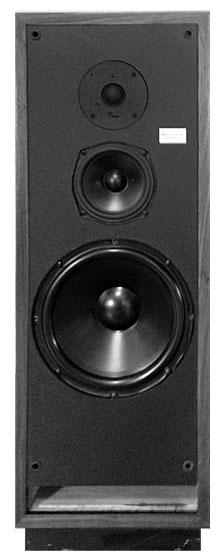

Those crossovers use quasi-Butterworth filters, but there is, by design, little attempt to correct for driver aberrations in the crossover, a technique which Paradigm does not believe produces the best results. The wood-veneered cabinet is solidly constructed, making use of a combination of high-density composite hardboard and MDF—a technique claimed to reduce uncontrolled resonances. MDF cross-bracing is provided, and four heavy-duty spikes are furnished per speaker. (I used Tonecones in my listening for the simple reason that three spikes are self-leveling, four are not.)

Fried R/4 loudspeaker

If anyone can be said to be the guru of the transmission line, that would have to be Irving M. "Bud" Fried. He has been promoting the design for years now, first with the made-in-England IMF designs, later with the designs of Fried Products, made right here in the US of A. He has long been convinced of the basic superiority of the design, and still uses it in his top-of-the-line systems. But true transmission lines are invariably big, heavy, hard to build, and, for all of those reasons, expensive. Essentially, they involve a long, convoluted, heavily damped tunnel behind the bass driver which channels the back wave to the outside world. The length and cross-sectional area of the tunnel are of some importance, although the technical basis for the transmission line, as applied to a loudspeaker enclosure, has never been firmly nailed down. Certainly there is no mathematical model for the transmission line as complete as that developed over the past two decades for the sealed or ported box (footnote 1).
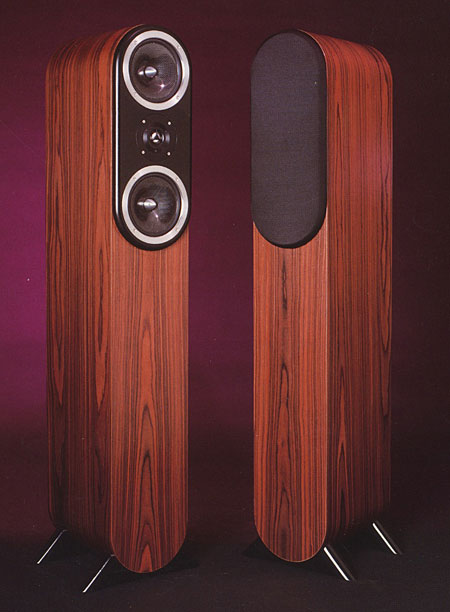

But Bud Fried has clung to the transmission line, for all of its complexities. In order to bring at least some of its touted advantages to a lower price point, he had to come up with a variation which would work in a smaller enclosure. That variation was the "line tunnel," which, according to Fried, originated in an early-1970s Ferrograph (a British company specializing in tape recorders) monitor which was later adapted by IMF. Basically it consists of a short (compared with a transmission line) duct from the inside to the outside of the heavily damped enclosure. The duct is designed with approximately the same cross-sectional area as the loudspeaker cone.

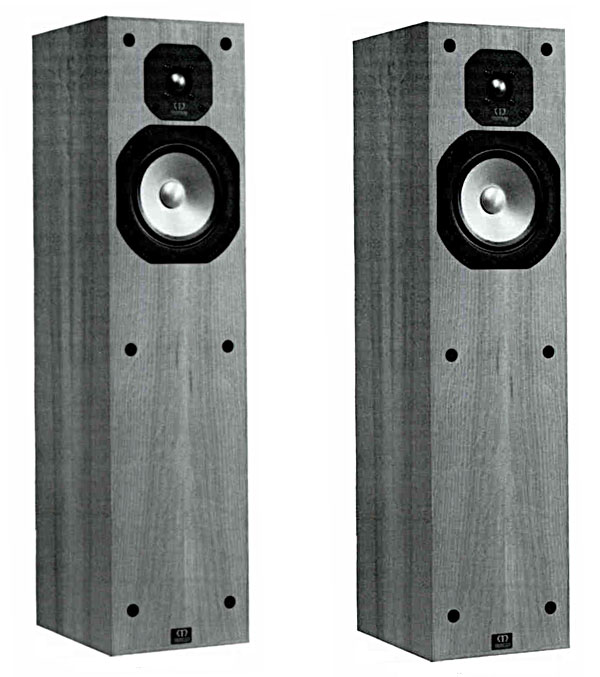
Monitor Audio Studio 20 loudspeaker

A review of the Monitor Audio Studio 20 loudspeaker is a study in contrasts. Compared with most other loudspeakers in the $4500/pair range, this 6.5" two-way from England is a mere pup. Perhaps this observation was sparked by the fact that I'd just finished reviewing the similarly priced Snell Type B, a huge, six-driver, four-way system. The two loudspeakers couldn't be more different, both in physical characteristics and sound.

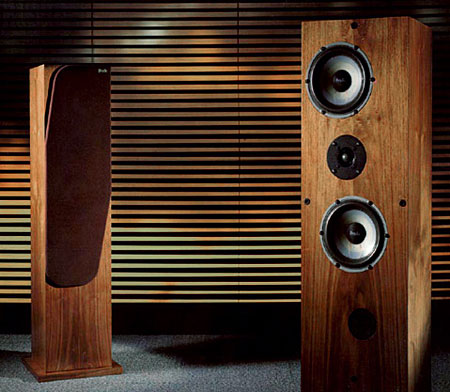
Snell Type B loudspeaker

The Snell Type B is the culmination of three years' research and development effort by designer Kevin Voecks. Along the way, various iterations of the B have been shown at Consumer Electronics Shows. Like other Snell models, the facilities of Canada's National Research Council were used extensively during the B's development, both their anechoic chamber and their double-blind listening techniques.

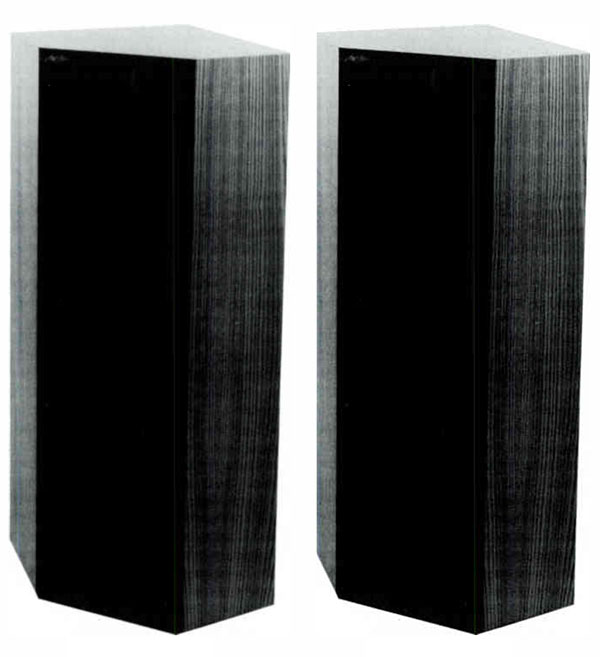
Magnepan MG2.6/R loudspeaker

91maggie26rAsk anyone in the street what they think of when they hear the word "loudspeaker" and odds are they'll describe a wooden box with moving-coil drivers sitting in its front. But ask a Stereophile reader and it's quite possible that he or she'll describe a large, flat panel reminiscent of a room divider: in our 1989 reader survey, the most widely represented brand of loudspeaker was Magnepan, with a significant lead over Infinity and Vandersteen, the second and third most common speaker brands. This represents considerable commercial success in a generally conservative marketplace for a company whose products are so different from the norm.
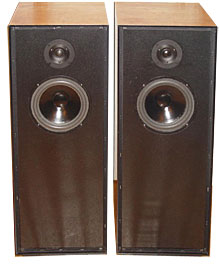
Snell Type E/III loudspeaker

One question posed by John Atkinson at the July 1991 Stereophile Writers">http://www.stereophile.com/features/109">Writers Conference had to do with the ease of reviewing: Is it harder to write a bad review of an expensive product than a good review? I find it hardest to write a good review of an inexpensive product. If I admire a less expensive loudspeaker, for example, it may become a recommended component, and can displace a more expensive speaker (that received mixed comments) from our twice-yearly rankings. This can be a big responsibility; even a conditional rave of a low-cost product means that JA may assign another Stereophile reviewer to do an immediate follow-up report. The Snell Type E/III loudspeaker may be a good case in point.


Advertisement
Advertisement
Advertisement