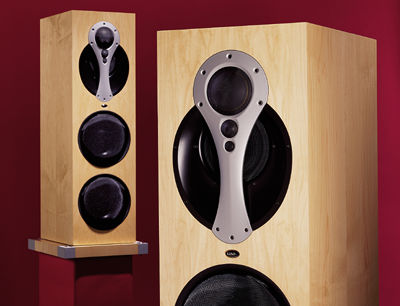
Floor Loudspeaker Reviews

Sort By: Post DateTitle Publish Date

Thiel CS1.6 loudspeaker

In the past year, Stereophile has reviewed a number of cost-no-object flagship loudspeakers. B&W's">http://www.stereophile.com//loudspeakerreviews/600/">B&W's Signature 800, MartinLogan's">http://www.stereophile.com//loudspeakerreviews/390/">MartinLogan's Prodigy, Burmester's">http://www.stereophile.com//loudspeakerreviews/601/">Burmester's B-99, Snell's">http://www.stereophile.com//loudspeakerreviews/556/">Snell's XA Reference Tower, Krell's">http://www.stereophile.com//loudspeakerreviews/382/">Krell's LAT-1, Linn's">http://www.stereophile.com//loudspeakerreviews/555/">Linn's Komri, Dynaudio's">http://www.stereophile.com//loudspeakerreviews/501/">Dynaudio's Evidence Temptation, Sony's">http://www.stereophile.com//loudspeakerreviews/391/">Sony's ES SS-M9ED, and Rockport's">http://www.stereophile.com//loudspeakerreviews/644/">Rockport's Antares have all passed through the review mill. Manufacturers like to submit their flagships for review for a number of reasons, not the least of which is the pride they take in showing what their engineers can do when given a blank check. However, while all these models do indeed provide great (if different) sound for the tens of thousands of dollars they demand from their owners, they are out of reach of the majority of audiophiles. It is important, therefore, for reviewers to spend time with real-world designs; when I heard the $1990/pair CS1.6 from Kentucky's Thiel at the 2002 CES last January, I requested a pair for review.
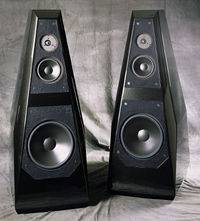
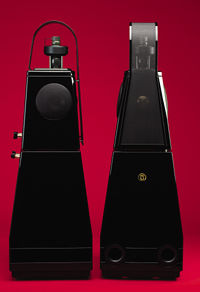
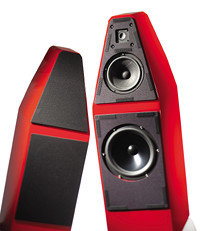
Athena Technologies AS-F2 loudspeaker

I have always had an affection for speakers designed and manufactured by the Canadian conglomerate Audio Products International Corp. (API), which markets speaker designs under the names Mirage, Energy, Sound Dynamics, and Athena. In fact, it was 20 years ago that API created the first budget speaker that caught my attention, the Mirage 350. At the time, the 350 was the only speaker I'd heard that cost less than $300/pair. It sounded open, musical, and detailed without seeming bass-shy. (A larger successor, the 460, was for many years my reference home-theater speaker.) Although I've been impressed with many other API designs I've heard over the years at friends' houses, press events, and hi-fi shows, it had been more than a decade since I'd formally reviewed an API product.


Rockport Technologies Antares loudspeaker

Antares is a giant red star in the constellation Scorpio. According to Rockport Technologies' Andy Payor, the $41,500/pair Antares loudspeaker is the "ultimate" reasonably sized, full-range loudspeaker, and is built to a standard "unequaled in the industry." Rockport's $73,750 System">http://www.stereophile.com//analogsourcereviews/258/">System III Sirius turntable came with equally boastful claims that turned out to be anything but hyperbole. Has Rockport done it again with the Antares?


MBL 111B loudspeaker

It was almost five years ago that I first spent some serious auditioning time with an omnidirectional two-piece speaker from German manufacturer MBL: the four-way MBL 111. When I reviewed the 111 in the April 1998 Stereophile, I had been extremely impressed with the speaker's stereo imaging, which was superbly stable and well-defined, with images that floated completely free of the speaker positions. The tonal balance was also excellent, with a rich midrange, superbly clean highs, and extended lows. "This Radialstrahler is one of the best tweeters I have experienced," I wrote. In fact, the 111 was let down only by bass frequencies that tended to lag behind the music slightly.

Wilson Audio Specialties Sophia loudspeaker

Of the small number of times I have been totally swept away by listening to recorded music, a significant proportion have involved loudspeakers from Wilson Audio Specialties. It was my experience of their X-1/Grand SLAMM in the listening rooms of reviewer Martin Colloms, then-retailer Peter McGrath, designer Dan D'Agostino of Krell, and manufacturer Madrigal Audio Labs, that led me to name it my "Editor's Choice" for 1995 and join my vote with those of the Stereophile scribes to make it the magazine's "Loudspeaker of the Year." I wrote in my">http://www.stereophile.com//asweseeit/470/">my December 2001 "As We See It" about how a cross-country road trip had begun with a listen to the Cantus">http://www.stereophile.com//features/465/">Cantus CD on the Wilson WAMMs in their">http://www.stereophile.com//interviews/478/">their designer's Utah listening room. And, as I wrote in my">http://www.stereophile.com//asweseeit/557/">my April column, auditioning Peter McGrath's 24-bit Nagra-Dhttp://www.stereophile.com//digitalsourcereviews/461/">Nagra-D; master tapes on Wilson MAXXes in the Halcro room was, for me, the highlight of the 2002 CES.


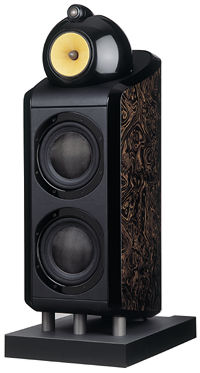
B&W Signature 800 loudspeaker

I once got a fortune cookie that read, "Ask and ye shall receive. This includes trouble." A few years back, shopping for speakers, I inquired about reviewing the B&W Nautilus 802, but it was too soon after Wes Phillips had reviewed the Nautilus">http://www.stereophile.com//loudspeakerreviews/207/">Nautilus 801 for Stereophile. So, other auditioning and reviewing (and buying) other speakers, I asked again, and again was met with deferral. Recently, out of the blue, B&W offered the Nautilus 802—then, in the next breath, asked if I'd rather have the Signature 800s.


Odeon La Traviata loudspeaker

Interest in super-efficient, horn-loaded, compression-driver loudspeakers has grown in the past few years, fueled in part by a renewed fascination among many hobbyists with low-powered, single-ended triode tube amplifiers. But staring down the maws of two Tubby the Tubas is not every audiophile's idea of a good time—even when the resulting sound is spectacularly fast, coherent, and extended.


Advertisement
Advertisement
Advertisement