

Hegel Music Systems HD2, HD10, and HD20 DACs
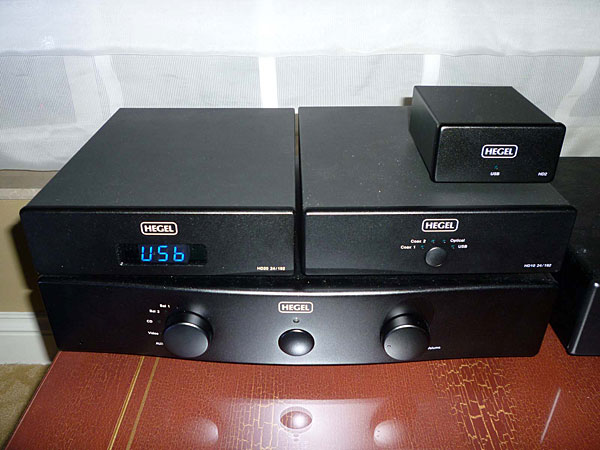
Hegel Music Systems was on hand to show off their ever-expanding range of DACs. The smallest sitting at the top right is the $350 HD2 USB "music streamer" that can handle 24bit/96kHz USB data and output it either as analog audio or digital data over SPDIF.
Under the HD2 is the $1,200 HD10 which offers USB, coax and optical digital inputs as well as both balanced and unbalanced outputs. To the left of the HD10 is the newest DAC from Hegel, the HD20, which in addition to the inputs and 24/192 conversion found on the HD10, offers remote control and display for $2,000.
Hey Mac, you got the time?
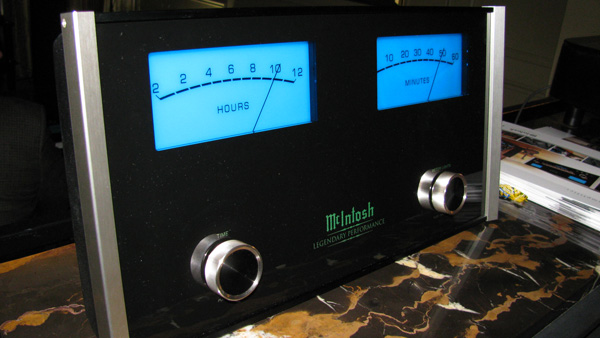
I was simply delighted by this clock’s slight cheekiness and subtle beauty. Seeing it also served as a reminder of how iconic the McIntosh faceplate has become in American audio. No price determined for this timepiece.
HIFI-Tuning Supreme Fuses

The latest in a growing line of fuses from HIFI-Tuning, enjoyed by Bob Deutsch and Michael Fremer, is the Supreme. Robert Stein of The Cable Company explained that the Supreme fuses are made of 99% silver impregnated with 1% gold, combining the smoothness of HIFI-Tuning’s gold fuses with the openness and resolution of their silver fuses. Prices range from $50$75, so you can tweak away!
HRT iStreamer
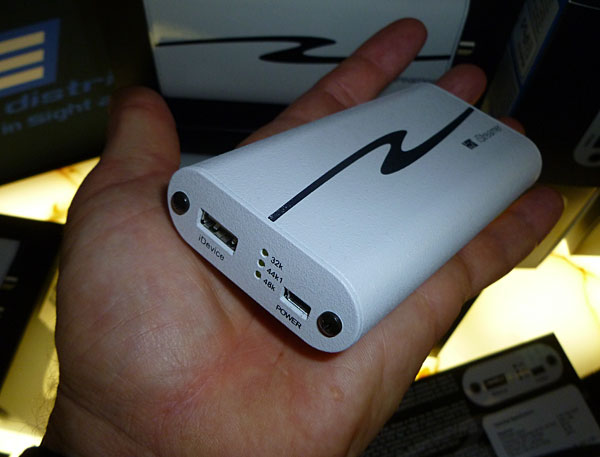
HRT's latest DAC, the $199 iStreamer, sports a connector to take the digital signal directly from your iPod/iPhone/iPad device and convert it to analog. Power supply is included and the DAC will handle 32, 44, or 48kHz data rates at 16 bits.
Simple and to the point, this may be the perfect starter product for the budding audiophile.
Is that a headphone amplifier?
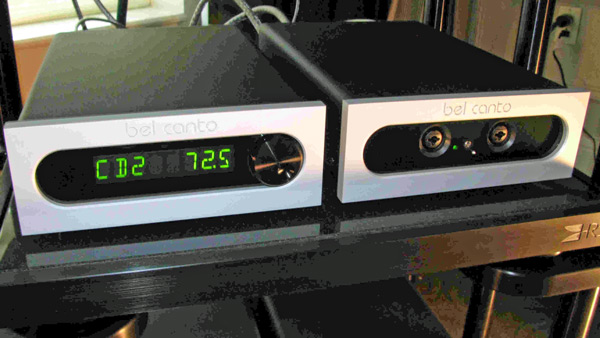
Also on display was Bel Canto’s new headphone amplifier (shown right), a product so new it doesn’t yet have a proper model number or name. Bel Canto’s John Stronczer let me take a listen to the amp through a pair of in-ear headphones. The sound was lovely, but I couldn’t really get the cans to stay in my ears (I must have very large ear canals).
When I checked out the back of the headphone amp I noticed that it was in the signal path of the room’s big rig. The DAC3.5VBS’s outputs went into the headphone amp and the outputs of the headphone amp went to the rig’s amplifiers. I asked John, “What gives?” He told me that he has been experimenting with using the new headphone amplifier as a unity gain buffer, taking advantage of the headphone amp’s ultra-low output impedance. John said that he hears improvements in the system using this configuration and that Bel Canto is exploring new applications for this technique. No price has yet been set for this headphone amplifier.
Jeff Joseph with the Perspective
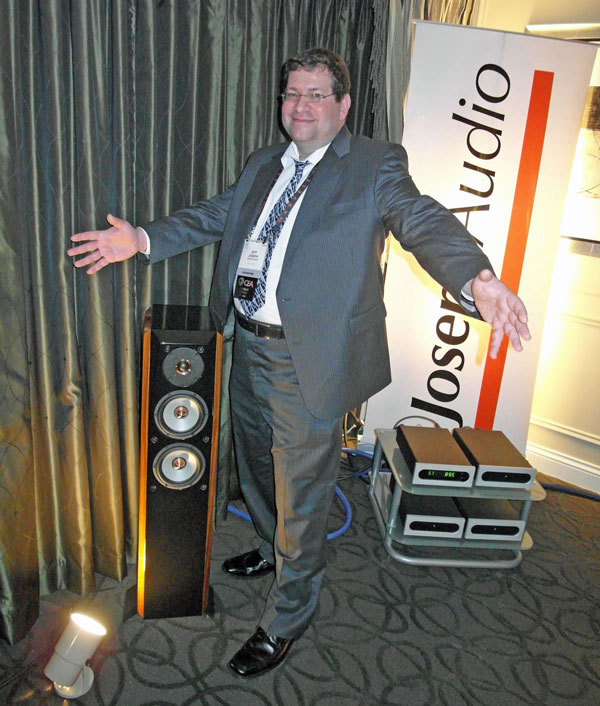
In defining what is the maximum cost of “mid-priced” speaker, which was my assignment at the Show, I had tentatively settled on $10,000/pair. Jeff Joseph Audio’s Perspective, still undergoing tweaking, at a projected price of $11, 800/pair, exceeds that self-imposed maximum, but the speaker sounded so good, and Jeff Joseph was so obliging in hamming it up, that I just had to include it in my blog and take Jeff’s picture. JA, you can write up a sub-$10k speaker in return.
Joseph Sahyoun’s Earthquake speakers
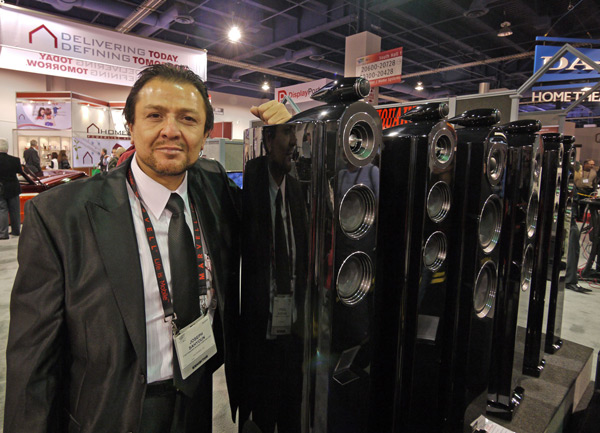
Veteran CES-goers often refer to the Las Vegas Convention Center (LVCC) as “the Zoo”a term that I don’t think applies very well. In the zoos that I’m familiar with, the animals are not crowded closely together (as people are during CES), and they’re not there because of choicewhich people are, even though they may grumble about it. I normally spend about half-a-day at the LVCCI refuse to call it “the Zoo”which gives me a chance to catch up on what’s happening in mass-market consumer electronics. And it sometimes allows me to discover the occasional product that could easily have been exhibited in the hallowed halls of high-performance audio in the Venetian.
Case in point: the Titan Series Telesto ($7999/pair) and Tigro ($9500/pair) floor-standing loudspeakers from Earthquake, a company that until now has specialized in subwoofers. According to Earthquake President and designer of these speakers, Joseph Sahyoun, these are speakers that he actually designed several years ago, but could not build them because he was not able to get overseas the kind of molded cabinet construction that he felt was essential to get the results he wanted. The cabinets of these speakers are now made in the USA, and the drivers are also made in-house. The speakers were on passive display, so I can’t comment on the sound, but the design certainly looks like a serious effort, with a lot of attention to detail.
KEF's Q-Series
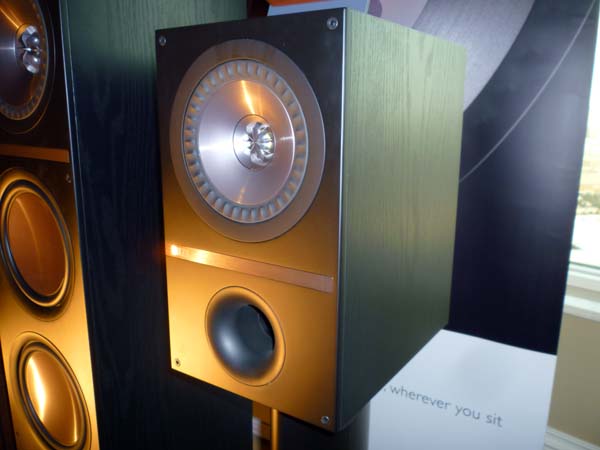
KEF’s Q300 ($600/pair) is a 2-way, bass-reflex design with a 6.5” Uni-Q driver and 1” vented-aluminum tweeter utilizing KEF’s tangerine waveguide, said to reduce the acoustic resonances created by normal direct-radiating tweeters, improving the coupling between the tweeter dome and air. The speaker that was actually playing in the room, however, was the larger Q900 floorstander ($1600/pair), a 2.5-way, bass-reflex design with an 8” Uni-Q driver and 1.5” vented-aluminum tweeter and tangerine waveguide. Partnered with an inexpensive Denon player and Integra receiver, the sound was marked by quick, extended highs and controlled lows.
Kimber Select KS 6000 Series Speaker Cable
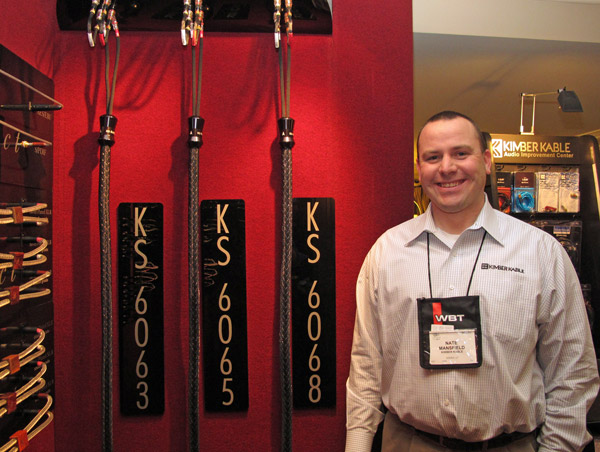
Nate Mansfield, Sales Manager of Kimber Kable, happily showed off the company’s newest products, the complete line of Kimber Select KS 6000 series speaker cables ($4400$18,800/8ft pair, depending upon level and wiring). Introduced in prototype form at CES 2010, the KS series has been shipping for the last six months, and is available in either all-copper, copper-silver hybrid, or full silver configurations. Designed by Ray Kimber, the cable also features a new multi-layer braid that combines stranded and solid core conductors in the same cable. The Kimber Select KS 6000 series represents a technological evolution of the old Black Pearl 88, a highly regarded all solid-core cable which Kimber manufactured in the early 1990s.
Kiso Acoustic HB-1
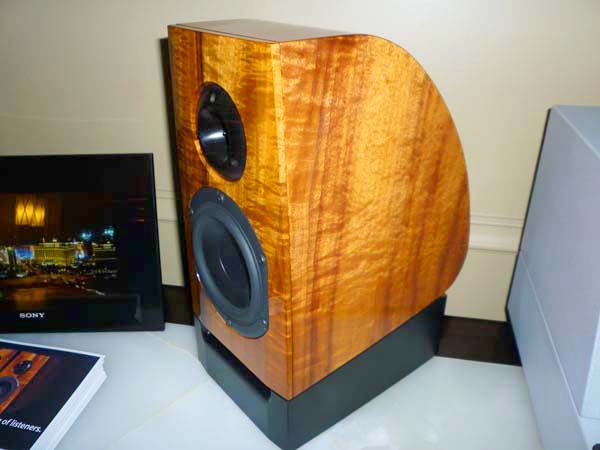
I was sort of shocked to see the Kiso Acoustic HB-1. While I’d never heard of Kiso Acoustics, the speaker looked so darn familiar. The HB-1 is nearly identical in size and shape and design philosophy to the Onkyo D-TK10, a collaboration between Onkyo and guitar-maker Takamine, which I discussed back in late 2006...