

Salon Son et Image #25 Starts Friday

The magic numbers, for Salon Son et Image, are 25, 100, and 10,000. Canada's first and largest high-end audio show, whose 25th-anniversary show arrives March 2325 (press day March 22) in downtown Montreal's Hilton Bonaventure, expects to set a new attendance record as up to 10,000 visitors explore 100 exhibit rooms.
Salon Son et Image put on hold (and now reborn!)

In an announcement made yesterday on their corporate website, UK-based Chester Groupwhich, in recent years, has sponsored consumer-audio shows in Vancouver, Brooklyn, and Brighton, UK, among other localesrevealed that they are "deferring" this year's Salon Son et Image, which had been scheduled to take place March 18 through 20 at the Bonaventure Hotel in Montreal.
Sam on the Show
You know the trouble with show reports? You read them after the show. So let me give you a brief report on Home Entertainment 2001 before the Show.
Sam Phillips, Recording Pioneer, Dead at 80
Sam Phillips, the Memphis recording engineer who was acclaimed by many as one of rock and roll's inventors, died of respiratory failure July 30. He was 80.
San Francisco Airport Audio Museum
Tipped off by Stereophile reader David Goodwin, I recently visited the San Francisco Airport Museum's beautifully thought-out and executed exhibit The">http://www.sfoarts.org/exhibits/f2/f2-current.html">The History of Audio: The Engineering of Sound. Installed to coincide with the 121st convention of the Audio Engineering Society, held at San Francisco's Moscone Center October 5–8, the exhibit runs through May 2007 in the North Connect Gallery of the airport's Terminal 3 (footnote 1).
San Francisco Conservatory of Music Hosts Giant LP Sale
Music lovers within driving distance of San Francisco and those planning a visit for later this month should set aside Sunday, February 28, for a feast of black vinyl. That's the day the San">http://www.sfcm.edu/">San Francisco Conservatory of Music holds its Giant LP Sale.
San Francisco Dealer Event Thursday
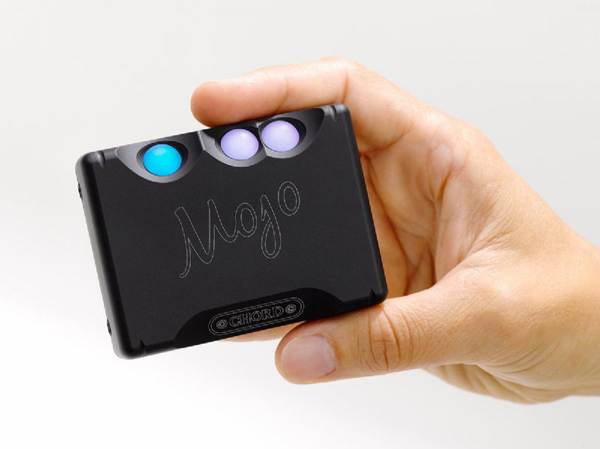
San Francisco's AudioVisionSF (1628 California Street) is hosting "From Digital to Analog" on Thursday December 3, 811pm. The event will feature Robert Watts (Chief Digital Designer for Chord Electronics, whose Mojo portable D/A headphone amplifier is pictured above) and Jeff Dorgay (Editor of TONEAudio magazine). Shown and demonstrated will be the latest in turntables, cartridges, tube amplifiers, cables, and electrostatic loudspeakers, as well as DACs, streamers, and servers.
San Francisco Mahler Symphony Premiers as Download
In a surprising move, the San Francisco Symphony has announced plans to release the next installment in its ongoing Mahler series, the beloved Symphony 5, in download format before issuing the recording on hybrid SACD/CD. The Fifth will first become available on iTunes on September 12, and in hard format three weeks later. Such an unprecedented release schedule, from one of the few symphony orchestras in the world to regularly record in the high-resolution SACD format, can be seen as part of a near-universal recognition among record labels of the importance of online sales.
San Francisco Symphony's Mahler Coming on Vinyl

"We did this for audiophiles, really," says the San Francisco Symphony's general manager, John Kieser. "Our distributors around the world have been telling us that it would be terrific if our Mahler series were available as a complete set on vinyl. This is a major endeavor, in that we're talking about 22 LPs."
Sandy Berlin
Sanford "Sandy" Berlin died on March 11 at his home in Santa Monica, California. He was 80 and had suffered from cancer. Born in 1927, he would have been 81 on April 10. During a long and highly successful career in audio management, Berlin held top positions at companies ranging from Harman/Kardon and JBL to Madrigal and Revel. He entered the industry in the 1960s, after brokering Harman/Kardon, then owned by General Instruments, back to its founder, Sidney Harman, who subsequently hired him and put him in charge of H/K. When Harman's firm, then called Jervis Corporation, acquired JBL in 1969, Berlin moved to Los Angeles to reshape it. He later set up German and French distribution units for Harman-group products and, after negotiating Harman's purchase of Tannoy, moved to England to serve as Tannoy's chairman. When Harman set out to create a new speaker brand, Bolivar, Berlin took the reins of that Tennessee-based operation (which ultimately proved unsuccessful).