

Music in the Round #24
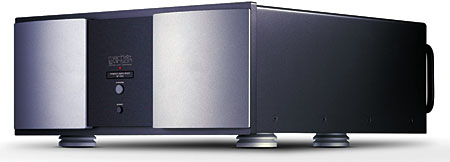
Good things come in threes, they say. Well, three-channel power amps suit me just fine. My main component rack is at the back of the room, so I split power duties between a two-channel amp under the rack to drive my rear-channel B&W 804S speakers and, way at the front, either three monoblocks or a three-channel amp for the front three B&W">http://www.stereophile.com/floorloudspeakers/1205bw">B&W 802Ds. I do this to ensure that the timbre of the front three channels is consistent. The outstanding performance of the Simaudio">http://www.stereophile.com/solidpoweramps/306sim">Simaudio Moon W-8 dual-mono power amp (Stereophile, March 2006) almost tempted me to go with a stereo amp and a monoblock, but voicing and balancing a multichannel system with equanimity makes me want as much simplicity as possible. I guess manufacturers and users see it the same way; many new three-channel amps are coming on the market.
Music in the Round #38
We all recognize that the Super">http://www.stereophile.com/features/374">Super Audio Compact Disc, despite being an almost ideal format for high-resolution audio, has not replaced the "Red Book" CD. However, Sam Tellig's comments in the June and July issues of Stereophile, and Steve Guttenberg's "As">http://www.stereophile.com/asweseeit/whatever_happened_to_51-channel_mu… We See It" in July, unleashed e-mails urging me to champion multichannel sound (don't I do this already?) and smite the unbelievers (not a chance).
Music in the Round #40
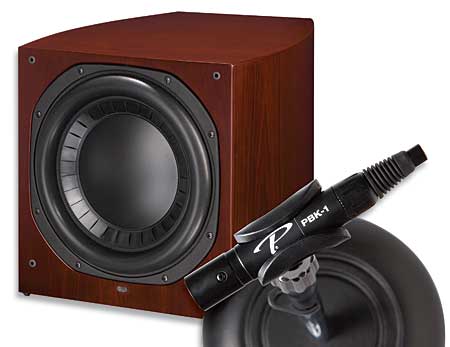
It seems only yesterday, but it's been 10 years since I began using the original Paradigm">http://www.stereophile.com/subwoofers/955">Paradigm Reference Servo-15 subwoofer in my system. It was good then, and it still is, although a lot around it has changed. At first, I hooked it up via Paradigm's X-35 crossover, then via a Technics SH-AC500D surround processor, and finally to the subwoofer/LFE outputs of the various preamplifier-processors and A/V receivers I've used. Y'see, the Servo-15 is just a powered sub. It has an amp and a level control, but no crossover, no channel mixing, and no phase control. Just plug in the signal and it plays it. Along came in-room response correction from Audyssey, Anthem, Velodyne, etc., and the Servo-15 became an even better sub. For music, it entirely satisfies my needs.
Music in the Round #76
In my last column, in the November 2015 issue, I talked about Marantz's AV8802A preamplifier-processor and two accessories: UpTone Audio's USB Regen, and a DIY battery supply for my DAC. This month's column is all about accessories, and for me that's unusual. Some items, like interconnects and speaker cables, are usually considered accessories because they're not fundamental components (eg, source, amplifier, speaker), even though they're essential to getting any sound at all.
Music in the Round #80
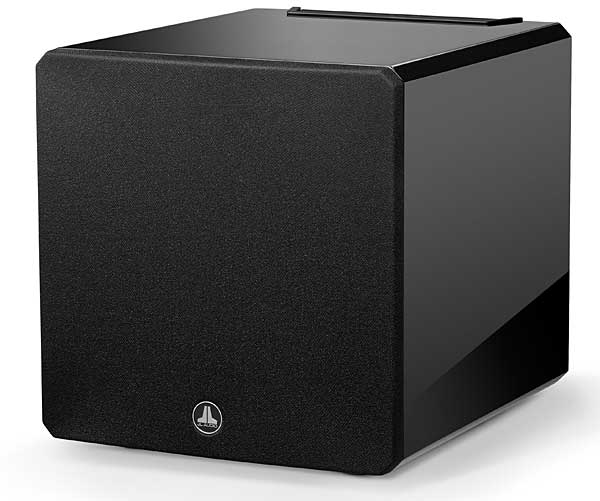
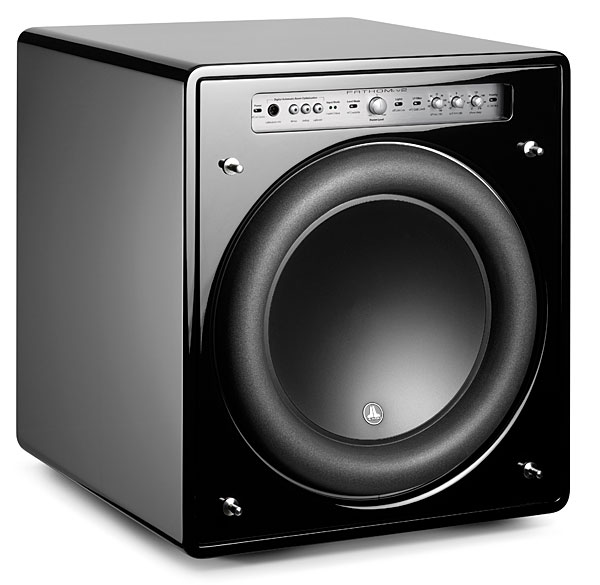
In January, I reviewed JL Audio's Fathom f113v2 subwoofer (footnote 1), which features, among other improvements over the original Fathom f113, a better multiband equalizer. The significance of this relates to the great influence exerted by room dimensions and acoustics on a loudspeaker's performance.
The matter of room acoustics itself relates to the Schroeder frequency: a transition point, usually between 200 and 300Hz above which a room will exhibit a high density of reflections that are analyzed statistically, and below which that room will display a limited number of discrete modal reflections. (Thus, it should not to be confused with the number of times that Beethoven's music appears in Charles Schulz's comic strip "Peanuts.")
Nelson-Reed 1204 subwoofer
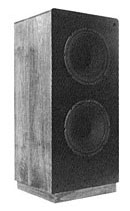 I was so impressed by the Nelson-Reed 8-04/B loudspeaker's low-end range that I seriously doubted the add-on subwoofers could add enough of significance to be cost-effective.
I was wrong.
Two of the subwoofers were provided, along with the necessary electronic crossover unit. Each 1204 unit contains four 12" woofers in a very solid sealed enclosure, with two facing to the front and two facing the rear. The electronic crossover has three controls, besides the AC power switch: a hardwire (footnote 1) bypass switch, a stereo/mono switch, and a subwoofer level control. In the stereo mode, the low frequencies are kept separate, left from right; in mono mode, they are blended together for feeding to a single subwoofer. I will not resurrect the question of whether or not it is important to maintain stereo separation into the LF range, except to echo N-R's observation that there is no LF separation on analog discs to begin with; the lows are mixed together, to limit vertical excursions of the cutting stylus that could cause it to rise above the disc surface or, worse, dig into the aluminum base of the master disc.
I was so impressed by the Nelson-Reed 8-04/B loudspeaker's low-end range that I seriously doubted the add-on subwoofers could add enough of significance to be cost-effective.
I was wrong.
Two of the subwoofers were provided, along with the necessary electronic crossover unit. Each 1204 unit contains four 12" woofers in a very solid sealed enclosure, with two facing to the front and two facing the rear. The electronic crossover has three controls, besides the AC power switch: a hardwire (footnote 1) bypass switch, a stereo/mono switch, and a subwoofer level control. In the stereo mode, the low frequencies are kept separate, left from right; in mono mode, they are blended together for feeding to a single subwoofer. I will not resurrect the question of whether or not it is important to maintain stereo separation into the LF range, except to echo N-R's observation that there is no LF separation on analog discs to begin with; the lows are mixed together, to limit vertical excursions of the cutting stylus that could cause it to rise above the disc surface or, worse, dig into the aluminum base of the master disc.
NHT SuperZero loudspeaker & SW2 subwoofer
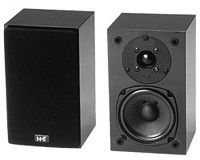
What makes someone a good hi-fi reviewer? A fine critical sensibility? A good technical background? Ears? Eyes? Nose? Throat? So many different people are reviewing audio gear these days that it's downright impossible to characterize a good reviewer. But I do know that Beavis and Butt-head would make killer hi-fi reviewers!
Paradigm Reference Servo-15 powered subwoofer
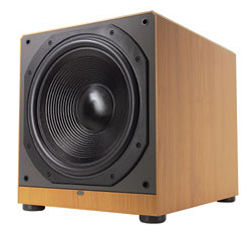
Émile Durkheim (1858-1917) once wrote, "The less limited one feels, the more intolerable all limitation appears" (footnote 1). Although directed at the paradoxical observation that suicide rates are higher in newly prosperous countries than in those mired in poverty, his comment applies equally well to subwoofers.
REL Acoustics Studio II powered subwoofer
From The Audio Catechism:
Q: What is a subwoofer?
A: A large, ugly device that must be placed in the most inconvenient location in the listening room—for instance, in front of the only door.
Q: What is the purpose of the subwoofer?
A: To produce prodigious amounts of low-frequency sound and to glorify its owner, who can rest safe in the knowledge that his is the biggest.
Q: What is a subwoofer?
A: A large, ugly device that must be placed in the most inconvenient location in the listening room—for instance, in front of the only door.
Q: What is the purpose of the subwoofer?
A: To produce prodigious amounts of low-frequency sound and to glorify its owner, who can rest safe in the knowledge that his is the biggest.
REL No.31 powered subwoofer
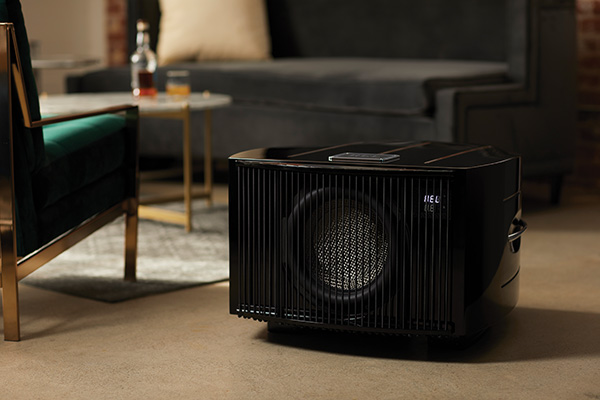
I have a love-hate relationship with subwoofers. They tend to bring out my tweaky alter ego. Perhaps one of these sorry personae lives within you too: the perennially neurotic Mr. Hyde to your more obliging Dr. Jekyll. Hyde is the tense, never-satisfied fault-sniffer who zeroes in on sonic details that are perhaps slightly off, even when other people in the room are enjoying themselves.
With subwoofers, he's at his worst. Did you hear that?, he'll exclaim when he worries that a low bass note received too much emphasis. He nags and niggles that perhaps the integration between the main speakers and the subwoofer leaves a crater somewhere in the low-frequency band. He harps, not always believably, that he can hear where the subwoofer is, even though deep bass is supposed to be impossible to localize. Most of all, he barely lasts a song without getting twitchy about the sub's gain setting, imagining that he has to dial in exactly the right amount of deep-bass presence with each track.