

SOTA Vanguard II CD player
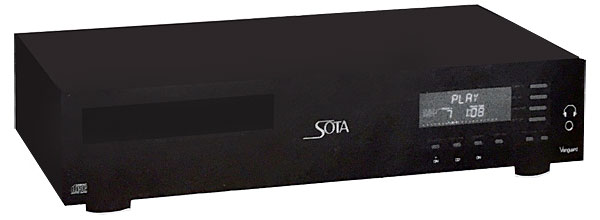
The Greek myth of Odysseus has always been a favorite of mine. For an audiophile looking for a CD transcription system under $2500, it seems to be an especially appropriate metaphor. Almost all the units I've heard since CD's inception fall into one of two camps: the Sirens or the Rocks.
For those of you not up on your Greek mythology, the Sirens were the archetypal seductresses whose sweet songs lured sailors to drive their ships upon the rocks. Siren CD players are those that soften and sweeten the sound. Their primary purpose is to seduce, to give a false sense of comfort to their victims; their fidelity to the truth is secondary to their desire to elicit a positive emotional reaction.
Sumo Axiom CD transport & Theorem II D/A processor
Making digital audio sound good appears to be a much more difficult job than its developers first realized. When digital audio was in its infancy, there was a tendency to think that digital either worked perfectly, or didn't work at all. This belief led the engineering community to devise ill-considered and flawed standards that affect the musical quality of digitally reproduced music today.
Tandberg 3015A CD player
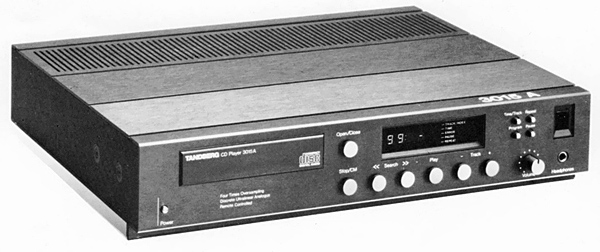
Tandberg of Norway has a rather ambiguous corporate image among audio perfectionists. Long considered to make some of the best tape-recording equipment around, the firm has never been seen as a leader in electronics, despite some boldand reportedly good-soundingforays into the realm of $2000 preamps and $3500 power amplifiers. Perhaps this is why, when Tandberg started making CD players, high-enders were uncertain how to respond.
The Mod Squad Prism CD player
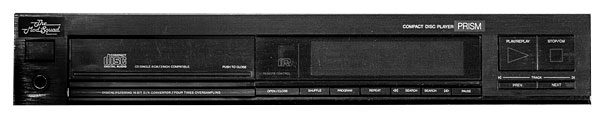
While it can't exactly be said that the folks from The Mod Squad invented the game of audiophile modifications of existing, current-production hardware, they certainly have grown to be one of the major leaguers. Their mods have a reputation for being well-thought-out, nearly always offering improvements over the originals. And while they weren't the originators of the concept, any company which brought the world Tiptoes (probably their most famous product) will probably have a niche in the 21st-Century Museum of High-End Audio.
The Mod Squad Prism II CD player
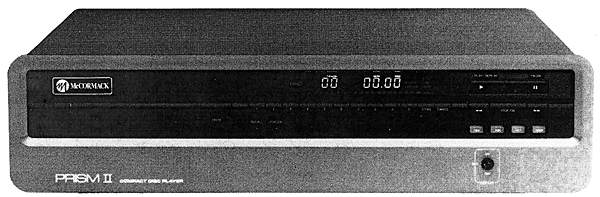
Like its Prism I predecessor, which I reviewed in May 1988, the Mod Squad Prism II is based on a Philips player: the same 16-bit, 4x-oversampling converter, the same general control layout. But The Mod Squad does their own extensive remanufacture, both on the internal circuitry and on the cosmeticsthe latter involving a handsomely sculptured case and metal front trim-panel surrounding Philips's command center.
Theta Data Basic CD transport
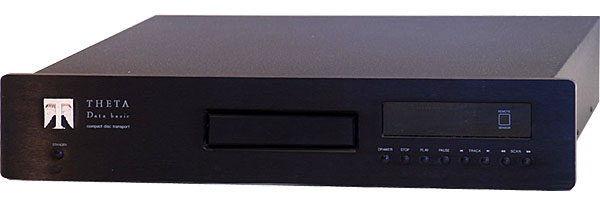 It seems to me that it should be possible to make a perfectly jitter-free CD transport without resorting to elaborate, expensive mechanical structures. This idealized transport would ignore all mechanical considerations of disc playbackvibration damping and isolation, for exampleand simply put a jitter-free electrical driver at the transport output. If such a circuit could be made, it wouldn't care about how bad the signal recovered from the disc was (provided the recovered data were error-free). The circuit would just output a perfect, jitter-free S/PDIF signal. The result would be the sound quality of the $8500 Mark Levinson No.31 Reference CD transport in $200 machines. Such a scheme would provide an electrical solution to what has been considered largely a mechanical problem.
But back in the real world there's no doubt that attention to mechanical aspects of transport design affects sound quality. Examples abound: listening to Nakamichi's 1000 CD transport with its Acoustic Isolation door open and closed; playing the Mark Levinson No.31 with the top open; and putting any transport on isolation platforms or feet are only a few of the dozens of experiences I have had that suggest that mechanical design is of utmost importance.
It seems to me that it should be possible to make a perfectly jitter-free CD transport without resorting to elaborate, expensive mechanical structures. This idealized transport would ignore all mechanical considerations of disc playbackvibration damping and isolation, for exampleand simply put a jitter-free electrical driver at the transport output. If such a circuit could be made, it wouldn't care about how bad the signal recovered from the disc was (provided the recovered data were error-free). The circuit would just output a perfect, jitter-free S/PDIF signal. The result would be the sound quality of the $8500 Mark Levinson No.31 Reference CD transport in $200 machines. Such a scheme would provide an electrical solution to what has been considered largely a mechanical problem.
But back in the real world there's no doubt that attention to mechanical aspects of transport design affects sound quality. Examples abound: listening to Nakamichi's 1000 CD transport with its Acoustic Isolation door open and closed; playing the Mark Levinson No.31 with the top open; and putting any transport on isolation platforms or feet are only a few of the dozens of experiences I have had that suggest that mechanical design is of utmost importance.
Theta Data universal disc transport
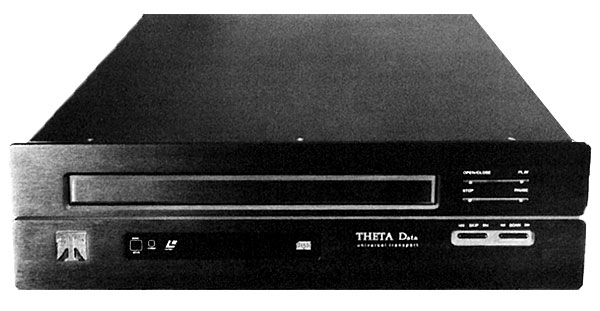
"In the fields of observation, chance favors only the mind that is prepared."
When Louis Pasteur uttered these words more than a hundred years ago, he must have speculated that they would apply equally well to future circumstances as to the events of his day. What he couldn't anticipate, however, was the technology to which his insight now seems so appropriate.
Theta Jade CD transport
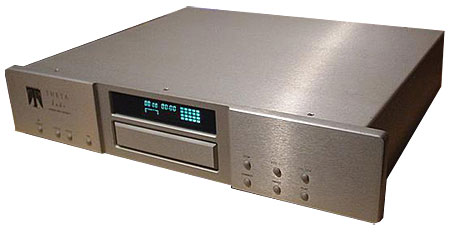
Many pundits in our industry say that CD is under threat from Super">http://www.stereophile.com/asweseeit/164">Super Audio CD, DVD-Audiohttp://www.stereophile.com/asweseeit/270">DVD-Audio;, and dual-layer CD/DVD technologies. Conflicting stories abound, and even though I'm supposed to be well-informed, I've found some of them hard to sort out! For example, Michael Fremer, concluding a fine review of the $7500 Bow Technologies ZZ-Eight integrated CD player in August, compared its notable 16-bit/44.1kHz achievement with a DVD-based disc originally mastered at 24/96kHz and replayed on an inexpensive DVD player. He found the Bow wanting in some respects. What is the world coming to?
Vincent Audio C-60 CD player

Should an audio component accurately reproduce the signal it's fed, or should it evoke the sound and feel of live music? Accuracy or musicality? This question has been at the heart of high-end audio since its inception. Back then, the question often took the form of the tubes-vs-transistors debate. Proponents of solid-state pointed to the far superior measured performance of transistor designs, and claim that they thus more accurately reproduced the input signal. Tube lovers steadfastly maintained that their gear sounded better, more naturalmore like music. Since then, both camps have eliminated the obvious colorations of their respective technologies, and the levels of performance of today's best tubed and solid-state gear have converged. At the same time, the circuits themselves have blurred into hybrids of various sorts, different mixes of devices and circuits.
Wadia 27ix & Wadia 270 transport
History teaches us that the full flowering of any social phenomenon takes place after the seeds of its destruction have been sown. That tourist magnet, London's Buckingham Palace, for example, was built decades after the English Revolution and the Restoration had redefined the role of the British monarchy as being merely titular, and made the elected Parliament the real seat of power.