

Sonographe SD-22 CD player
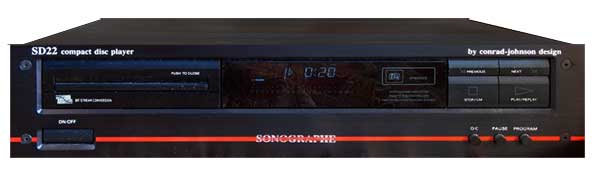
While many of the "modded Philips" firms simply replace the plastic "Philips" or "Magnavox" logo with their own after completing all their internal circuit mojo, for the Sonographe SD-22 ($895), Conrad-Johnson goes quite a bit further by wrapping the stock plastic flimsy-luxe box with their own heavy metal skin, making for a much stronger and nonresonant chassis. Unlike many of the modkateers, C-J doesn't replace the fairly flimsy stock RCA jack assembly of the Philips machine; in my experience, this is one of the first things to go bad on such a unit, as the contact integrity is usually poor and gets worse. Replacing the RCA assembly with high-quality gold RCAs would've raised the price of the SD-22 another $50100, but I think the long-term reliability might be worth it. The SD-22 has no digital-out jacks, only analog outputs.
Sony CDP-101 Compact Disc Player
Our long-awaited laser-audio disc player (usually called the CD, for "Compact Disc") finally arrived, along with a real bonanza of software: two discs—a Polygram classical sampler of material from Decca, Deutsche Grammophon and Philips, and a Japanese CBS recording of Bruckner's 4th Symphony, with Kubelik.
Sony CDP-520ES CD player
 Publisher's Note: For the first time since I've published Stereophile, we are running two completely differentand opposed reports on the same product. Normally, we try to reach some conclusion as to why reviewers come up with opposite views on a product, and resolve the problem prior to publication. In this case, the problem lies in the differing sound systems used for review. Since some readers will have systems like SWW's, and others will have systems more like JGH's, I felt it was valuable to run both reviews.
For the record, SWW's reference system consists of Dayton Wright XG-lO speakers, BEL 1001 amplifiers, a Klyne preamp, a SOTA Star Sapphire turntable, the Well-Tempered Arm (or Sumiko Arm), and a Talisman S cartridge. The sound on analog disc is far preferable to that from CD, being much more alive and present, and with a tendency to exaggerate sibilants. The low end of the system is awesome, the high end extended, and transients are rendered with a great feeling of immediacy and quickness.
Publisher's Note: For the first time since I've published Stereophile, we are running two completely differentand opposed reports on the same product. Normally, we try to reach some conclusion as to why reviewers come up with opposite views on a product, and resolve the problem prior to publication. In this case, the problem lies in the differing sound systems used for review. Since some readers will have systems like SWW's, and others will have systems more like JGH's, I felt it was valuable to run both reviews.
For the record, SWW's reference system consists of Dayton Wright XG-lO speakers, BEL 1001 amplifiers, a Klyne preamp, a SOTA Star Sapphire turntable, the Well-Tempered Arm (or Sumiko Arm), and a Talisman S cartridge. The sound on analog disc is far preferable to that from CD, being much more alive and present, and with a tendency to exaggerate sibilants. The low end of the system is awesome, the high end extended, and transients are rendered with a great feeling of immediacy and quickness.Sony CDP-R1/DAS-R1 CD player
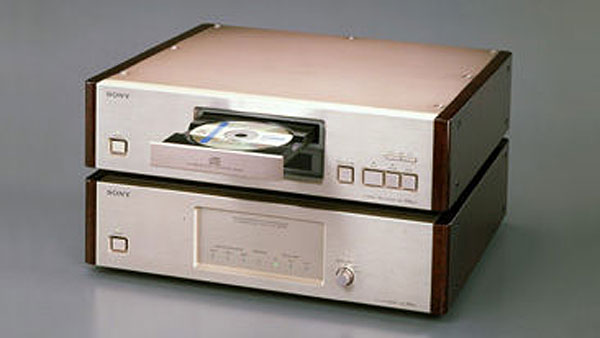
Two of the most cherished terms in the lexicon of high end are "no holds barred" and "cost no object." These are usually applied, together, to the most expensive version of something currently on the market. But is either term really appropriate for an audio product? The answer is a flat, unequivocal No. No consumer product has ever conformed to the real meaning of those terms, and it is unlikely that one ever will.
Sony CDP-X555ES CD player
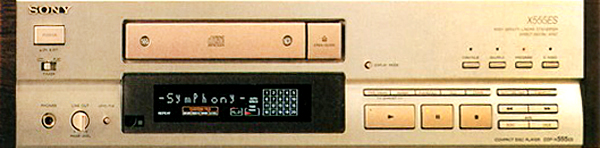
I'll give the Giant Japanese Conglomerates one thing: they build their CD players like Humvees. The Sony CDP-X555ES ($900) exudes pride in ownership; from the simulated-wood side panels to the copper-shielded chassis, the Sony is a very impressive-looking player. Typically, however, Sony chose to marry a very sophisticated digital section with what appears to be a standard mid-fi analog section featuring Texas Instruments 5532 dual op-amps, carbon composition resistors, and inexpensive electrolytic coupling caps. The 555ES has both fixed and variable outputs, and a Toslink optical output. There is no coaxial digital output.
Sony CDP-X779ES CD player
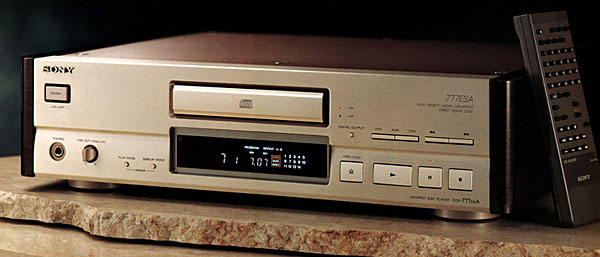
Sony's first CD player, the much-maligned CDP-1 (reviewed in Vol.5 No.10), did all the things we'd been promised from CD except deliver perfect sound. It met CD's incredible claims for frequency range and linearity, harmonic and intermodulation distortion, and signal/noise ratio, yetdespite my own initial enthusiasm for itit proved ultimately to be a disappointing-sounding player (footnote 1). Its sound was rather hard and grainy, and quite spectacularly uninvolving to listen to. But considering that it was the first of its kind, it was a good start despite its many sonic shortcomings (footnote 2).
Sony CDP-X77ES CD player
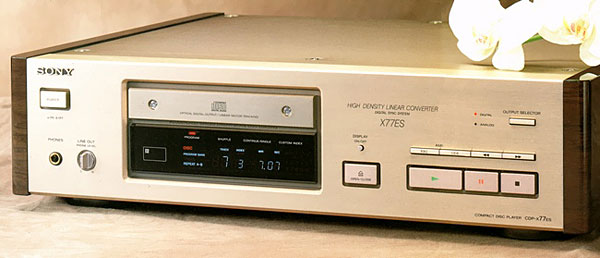
With Sony's latest flagship single-box player ($1700), we find yet another variant on 1-bit D/A technologyHigh Density Linear Converter, or HDLC. At the heart of this Pulse Length Modulation (footnote 1) D/A technique is Sony's CXD-2552 Pulse D/A converter (two per channel in complementary mode in the CDP-X77ES). This complex LSI chip incorporates a third-order noise shaper, the PLM converter, and a digital sync circuit receiving its input from the system clock.
Sony CDP-XA7ES CD player
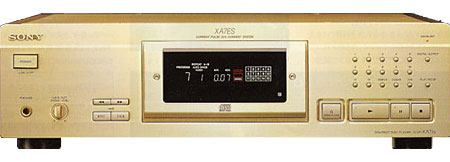
It's conventional wisdom among audiophiles: Small, high-end audio companies build high-quality products in small numbers. Products which are often expensive. But not always. Big mass-market companies build cookie-cutter products in big numbers. They're usually cheap. But not always.
Sony D-7S portable CD player
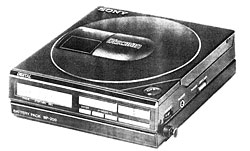 There's a race on between Sony and Matsushita, to determine who can build the smallest battery-operated CD player with the most features. Sony currently holds the lead with its second-generation D-7 ($300), about 30% smaller than the first "pocket" CD, the D-5. Most of the reduction is in height; both players have a horizontal cross-section only slightly larger than the CD itself. The illusion of smallness is further enhanced by an angled front panel with beveled edges.
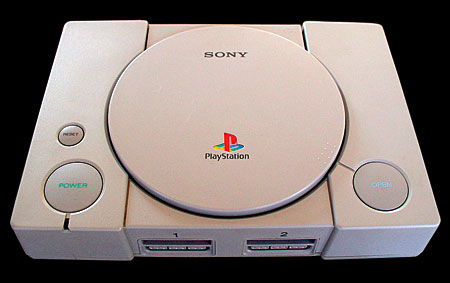
Sony PlayStation 1 CD player
My home, which overlooks a dairy farm, is easy to see from a mile away, invisible from the end of its own driveway. Elevation: 1345'. Population: 3.