

Cary Audio Design CAD-300SE LX20 monoblock power amplifier
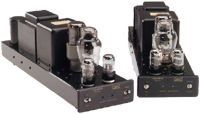
Many tube aficionados hold that amplifiers built with the venerable 300B tube hold the aces when it comes to sonic purity and beauty of harmonic line. Cary Audio Design's Dennis Had succeeded in producing what many believe is the definitive moderately sized single-ended triode (SET) amplifier: the CAD 300SE. This monoblock, powered by classic 300B Western Electric or derivative tubes, could provide 8–10Wpc, requiring the adoption of relatively moderate volume settings and/or sensitive, easy-to-drive loudspeakers. Cary also produced a lower-priced "integrated" stereo chassis, the CAD 300SEI.
Cary Audio Design CAD-572SE monoblock power amplifier
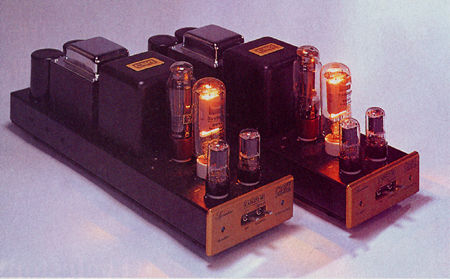
In conversation with Cary">http://www.stereophile.com/interviews/399">Cary founder Dennis Had at a recent audio convention breakfast, I learned that he had a long career in electronics, specializing in military/industrial high-power radio-frequency amplification and transmitters. However, his dream was always the re-creation of single-ended tube amplifiers, especially zero-feedback designs.
Cary Audio Design CAD-805 monoblock power amplifier
Lee de Forest filed for a US patent on his "Audion"—the first triode—on October 25, 1906, but never could explain why it worked (footnote 1). It was up to Armstrong and Langmuir, in their pioneering work, to place the hard-vacuum triode on firm scientific ground. When the US entered World War I in April 1917, the Army had to rely on French tubes. Six months later, Western Electric was mass-producing the VT-1 receiving tube and the VT-2 transmitting tube. However, it was only in the decade following World War I, as designers became conversant with the triode amplifier, that many of the crucial elements of tube amplification were nailed down. Technical issues such as coupling two gain stages and selection of optimal coupling impedance were already resolved by the mid-1920s. The triode ruled supreme until the tetrode came along in 1926, followed in 1929 by the pentode from Philips's research laboratories in Holland.
Cary Audio Design SLM-100 monoblock power amplifier
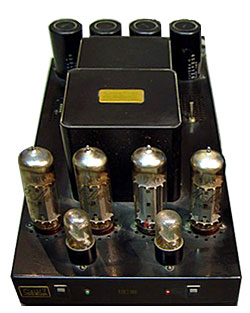
Although I'll be spending most of my time at Stereophile reviewing affordable gear, I will from time to time examine so-called "trickle-down" designs from high-end designers who have made their mark in the upper-price echelons. More and more, such designers are taking what they've learned and applying it to less-expensive products in order to broaden their customer base. Cary Audio Design, for example, of single-ended triode fame, has entered the ring with the SLM-100 pentode monoblocks.
Cary CAD-1610-SE monoblock power amplifier
At the last few audio shows, whenever I heard a pair of the big Cary CAD-1610-SEs, I fair licked my chops. The two-tiered monoblock looked positively stunning in black and polished aluminum, exotic tubes bristling from the top "floor" of its two-story edifice. The Cary always induced pelvic tilt in me—you know, when your lizard brain takes over and tube lust is in the air.
Cary CAD-280SA V12 power amplifier
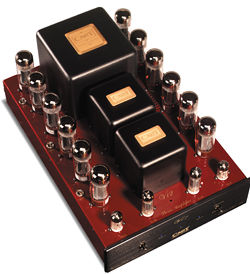
According to Cary Audio designer Dennis">http://www.stereophile.com/interviews/399">Dennis Had in this amplifier's documentation, "Countless hours were spent designing and voicing the CAD-280SA V12 stereo amplifier...It delivers high performance in a combination of class-A single-ended triode and true balanced push-pull technology."
Conrad-Johnson LP125M monoblock power amplifier
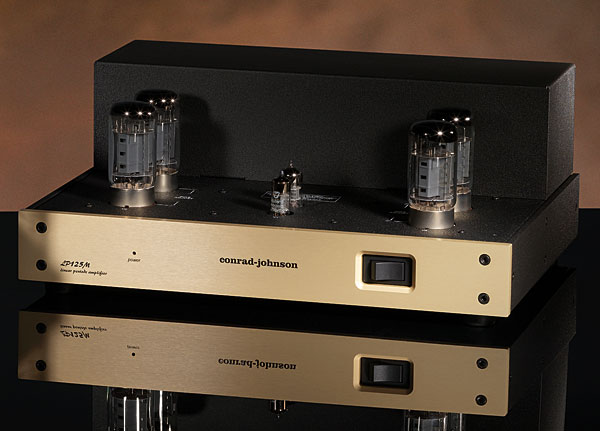
For anyone who's been around the audiophile block a few times, Conrad-Johnson Design is a brand that needs no introduction. My first acquaintance with Conrad-Johnson was before I began writing for Stereophile (more than two decades agotime sure flies fast when you're having fun!). I was in the market for a new preamp, having become convinced that my Dayton Wright SPS Mk.II was the weak link in my system, and had narrowed my choices to two similarly priced products: a solid-state model made by PS Audio (I'm not sure of the model number), and the tubed Conrad-Johnson PV-2ar. They were carried by different dealers, who allowed me to take their preamps home over the same weekend for a direct comparison. I was impressed by both preamps, and was sure that either would represent an improvement over the Dayton Wright, but in the end decided to go for the PV-2ar. I later traded it in on a dealer's demo unit of another Conrad-Johnson preamp, the PV-5. And, as it turned out, one of my first reviews for Stereophile was of Conrad-Johnson's PV-11 preamp.
Conrad-Johnson MV60 power amplifier
It's always good to tear into a good steak with Tor Sivertsen, Conrad-Johnson's main marketing man.
Conrad-Johnson Premier Eleven power amplifier
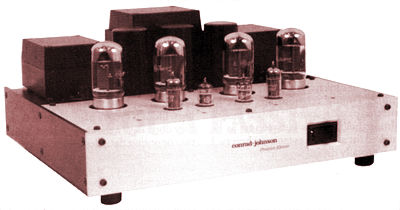
I love being seduced. I'm shocked to learn that not everyone does. The very qualities in live music that excite and intoxicate me are denigrated by many audiophiles as "colorations." It would seem they prefer the lean, chilly sound that they've dubbed "accurate." While I concede that almost all of their preferred audio components have ever-more-extended high frequencies, I'm not certain that that's the same thing as having greater accuracy. It sounds to me—to use Stravinsky's description of electronic music—"spayed for overtone removal." The overtones that I miss are those stripped from the middle ranges—the ones the clinical crowd (footnote 1) disparagingly refers to as the "warmth" region.
Conrad-Johnson Premier Five monoblock power amplifier
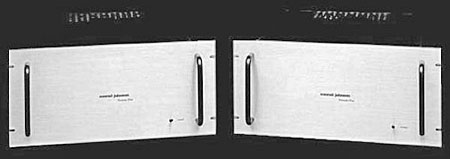
Many audiophiles who have only recently subscribed to Stereophile will be surprised to find that those clunky, heat-producing, short-lived tubes that reigned up through the mid-'60s are still Executive Monarchs in the mid-'80s. Why, for Heaven's sake? Because, despite everything, people like them.