

VTL 100W Compact monoblock power amplifier
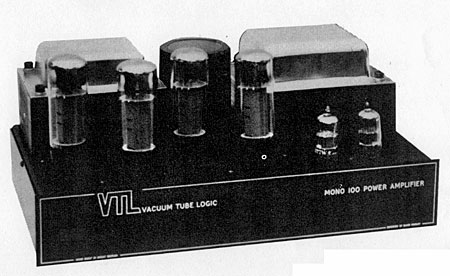
The last time I was in England, I happened to be rummaging through some boxes in my mother's garage, boxes containing photographs, my old school books, concert programs, diaries, postcardsall the bric-a-brac you collect throughout your life that you'll never have a need for and can never discard. If anything, such rubbish is perhaps the nearest thing to roots that anyone can have these days. Among the boxes was an amplifier that had been an everyday companion of mine for many years, the vintage Vox AC100 I had used to amplify my Fender bass when on the road.
VTL 225W Deluxe monoblock power amplifier
The VTL 225W DeLuxe monoblocks are very similar to the 300W monoblocks that received such an enthusiastic reception from J. Gordon Holt a year or so ago (in Vol.11 No.10) and, ultimately, most of the audiophile community. Technically, they differ only in output tubes and transformer: the 225W uses EL34s, the 300W uses 6550s. The 225Ws, at $4200/pair, cost $700 less than their more powerful brothers. The question may be raised: Why have two models so close in price and performance? According to David Manley, the 225Ws were built on special order for audiophiles who preferred the sound of EL34s to the 300Ws' 6550s. Demand was so great for the EL34 version that he decided to add it to the line. They look almost identical, the only difference being the smaller output transformer on the 225W and an additional filter capacitor on the 300W's top chassis.
VTL Compact 160 monoblock power amplifier
 When I reviewed VTL's 25W Tiny Triodes in April 1991, I found them to be incredibly fun little suckers to play with, but got frustrated with their inability to drive my Spica Angeluses to reasonable levels with most of my recordings. I loved what I was hearing, but there wasn't nearly enough of it! As it turns out, John Atkinson was listening; not just to my plea, but also to the new VTL Compact 160 monoblocks in preparation for a full review. However, while all this was going on, David Manley decided that the power-supply voltages in the 160 weren't beefy enough to exploit his new KT90 output tubes; back the amps went for a transformerectomy.
VTL MB-1250 Wotan monoblock amplifier
 Most reviewers look for a "hook" or angle of some kind when it comes time to write a review. After all, how many ways are there to get excited about audio equipment? Kathleen and I like to focus on the human side of the High End. So it was with some amusement that I watched the obstacles swirl around what I thought would be a fairly straightforward review of the Vacuum Tube Logic MB-1250 Wotan monoblock power amplifier. My thought was to return from single-ended to push-pull with a bang! I'll say...
It all began at the January 1996 WCES, where I found my shorts positively welded to the listening chair during a memorable musical blast at VTL. Luke Manley and his extreme audiophile wife Bea had a good thing going and they knew it. People were talking. "Did you hear those monster two-storey VTLs on the Alón Vs?"
Most reviewers look for a "hook" or angle of some kind when it comes time to write a review. After all, how many ways are there to get excited about audio equipment? Kathleen and I like to focus on the human side of the High End. So it was with some amusement that I watched the obstacles swirl around what I thought would be a fairly straightforward review of the Vacuum Tube Logic MB-1250 Wotan monoblock power amplifier. My thought was to return from single-ended to push-pull with a bang! I'll say...
It all began at the January 1996 WCES, where I found my shorts positively welded to the listening chair during a memorable musical blast at VTL. Luke Manley and his extreme audiophile wife Bea had a good thing going and they knew it. People were talking. "Did you hear those monster two-storey VTLs on the Alón Vs?"
VTL MB-450 Series II Signature monoblock power amplifier
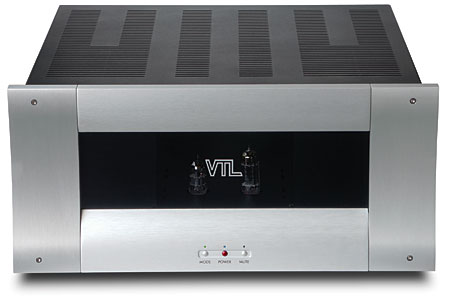
Stop me if you've heard this one: Back in the early 1990s, just after the fall of the Soviet Union, I debated professor of music engineering and magazine columnist Ken Pohlmann on a talk show on the CBS radio network. The subject was analog sound vs digital sound, but I guess when Pohlmann felt I was getting the upper hand, he felt he needed to play the tube card. Derisively, he said, "I bet you're one of those tube guys, too, aren't you?" Before I could open my mouth, he continued: "You know, the Soviet Union's military gear, including the MIG fighters, ran on tube electronics, and look what happened to them!"
VTL MB-450 Series III Signature monoblock power amplifier

The VTL MB-450 series began life in the late 1980s as the Deluxe 300, a pair of which I once owned. Over the years the basic design has been improved and modified, in the forms of the MB-450 (1996) and the MB-450 Series II (which I reviewed in January 2008). The tube complement remains the same: eight 6550s in the push-pull output stage, a 12AT7 input tube, and a 12BH7 driver. Into a 5 ohm load, the MB-450 III is claimed to produce 425W in tetrode mode or 225W in triode, from 20Hz to 20kHz.
VTL MB300 & MB450 Signature monoblock amplifiers
Not only does the venerable vacuum tube refuse to lie down and die, as everyone predicted when audio went solid-state; it continues to deliver better performance than anyone had imagined it could. Only a few years ago, we could characterize "the tube sound" as being sweet but soft at the high end, rich but loose in the midbass, deficient in deep bass, and bright and forward, usually with excellent reproduction of depth. Since then, we've seen the introduction of what might almost be called a new generation of tube amplifiers, which rival solid-state units in those areas where tubes used to have weaknesses, but have given up little of the tube's sonic strengths.
VTL MB750 monoblock power amplifier
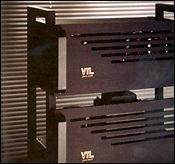
How much power do you really need? What does it do for you, anyway? Even before the single-ended renaissance, the prevailing wisdom was that you really didn't need that much power. When I had a pair of Met 7 speakers, even the "1 watt" indicator LED was hardly ever lit. Ditto for my time with a Threshold Stasis Two—all those cool power-indicator LEDs just sat there dark. Besides, everyone knows that power can be had only at tremendous cost, both monetary and in terms of other performance attributes.
VTL S-400 Reference power amplifier
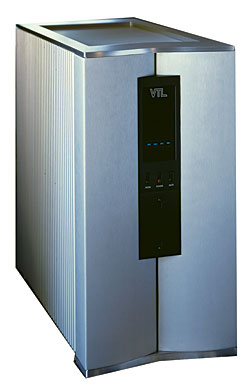
When I reviewedhttp://www.stereophile.com/tubepoweramps/152">reviewed; VTL's MB-750 monoblock amplifier in the December 1997 Stereophile (Vol.20 No.12), it was a transitional time for the company. Luke">http://www.stereophile.com/interviews/153">Luke Manley had recently taken it over, and he and his wife and partner, Bea Lam, were aggressively retooling. They introduced new business systems, including rigorous inventory and quality control; rebuilt VTL's dealer network around top-rank dealers; and systematically upgraded the products themselves to improve their consistency, reliability, manufacturability, and performance. VTL's goal, Luke explained to me at the time, was to build amplifiers that competed with the very best, and to "make the tubes invisible to the customer."
VTL Siegfried Series II Reference monoblock power amplifier
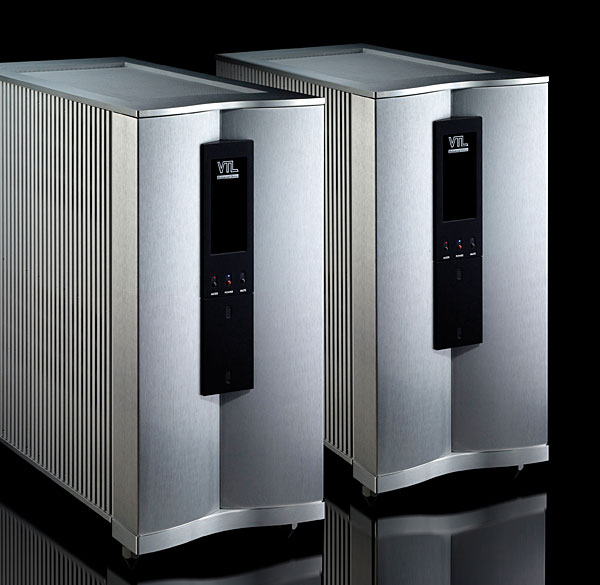
Big tube amplifiers were once scary monsters reserved for those who didn't mind heavy maintenance, careful tweaking, and the occasional explosion. Blown tubes required replacing, preferably with pricey matched pairs, then biasing with a voltmeter. Optimal sonic performance required regular bias monitoring and adjusting, and because of current surges on startup, you had to choose between leaving the heat-producing monoliths on, or turning them on and off for each listening session, thus shortening the life of the tubes.