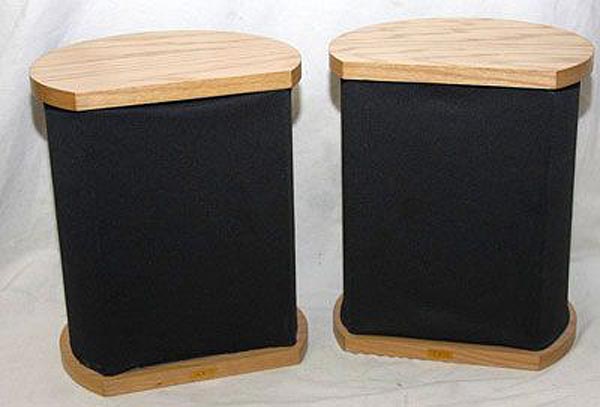
This is a speaker we've been fairly intimate with over quite a period of time. Designed by John Bau, the SC-50i started out three years ago as an inexpensive speaker system ($330/pair) not sold through dealers.
One of the factors allowing it to cost so little was the clever adaptation of cardboard tubes, normally used as forms for pouring concrete pillars, for use as speaker enclosures. They have a number of advantages, other than low cost: their circular form helps eliminate resonance of the back wave within the enclosure; the material is rigid because of its shape, and is non-resonant due to its construction.
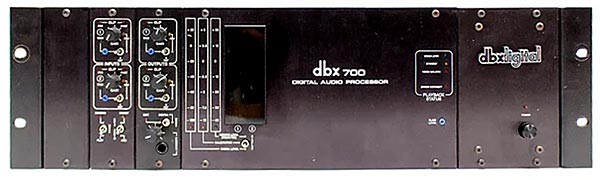
As ALF would say, "There's more than one way to cook a cat." We've been so overwhelmed with linear pulse-code modulation (PCM) recording, we forget there are other ways to pass from the analog domain to the digital.
One of these is delta modulation. The Greek delta (which in its upper-case, block-letter form, looks like an equilateral triangle) is the mathematical symbol for the difference between two quantities; accordingly, in delta modulation, we record not the absolute value of a signal sample, but the difference between successive samples.
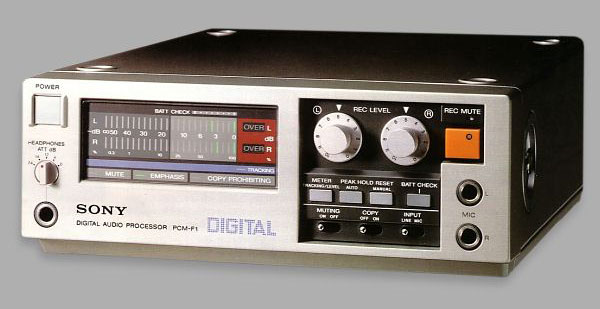
In 1978, when I reviewed Sony's first audiophile-type PCM-1 converter, I earned the undying scorn of a large segment of audiophilia by reporting that, on the basis of a rather short testing period (which did however include some live recording), I was unable to hear anything the matter with its sound. Four years later, but after substantially more testing, I am obliged to report the same thing about the PCM-l's son, the PCM-Fl.