As <A HREF="http://www.stereophile.com/news/011904roundup/index.html">promised</A> earlier in January, <A HREF="http://www.wmg.com">Warner Music Group</A> has announced a major restructuring that it hopes will put it in better shape to compete in the "challenging business environment of today's music industry." The move comes after the recent closing of WMG's $2.6 billion acquisition by Edgar Bronfman, Jr. and a group of investors.
Four short years ago, rock band Metallica angered part of its fan base by <A HREF="http://www.stereophile.com/news/10746/index.html">going after</A> downloaders who used the online file-trading service Napster. At that time, the band provided Napster with the screen names of 335,000 users reputed to be pirating Metallica's music, and demanded they be removed from the service. The group was also the <A HREF="http://www.stereophile.com/news/10725/">first to sue</A> the fledgling company.
One of my mentors, John Crabbe—my predecessor as editor of the English magazine <I>Hi-Fi News</I>—used to insist that a magazine's soul is its "Letters" column. If a magazine was able to publish a lively collection of readers' letters, said John, it would enjoy a lengthy life. Conversely, if its letters column was dull or nonexistent, then no matter how much advertising it had or how many readers it could boast, it was just a matter of time before it had the lid shut on it. In the 28 years since John told me this, I have not found an exception. The kicker, of course, is that there's no easy way of ensuring that a magazine has lively letters to publish.
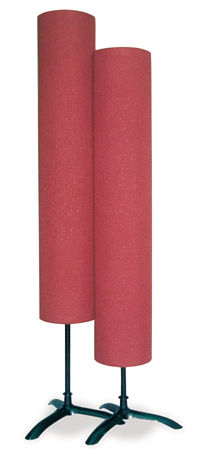
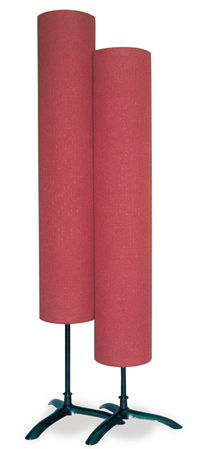
Acoustic Sciences Corporation Studio Traps Specifications
Over time I've successfully used a variety of tuning devices to refine the acoustics in Kathleen's and my listening room. But I've always suspected that <A HREF="http://www.stereophile.com/accessoryreviews/215">Acoustic Science's Tube Traps</A> might be a good way to finish it off. I've occasionally asked visitors to stand in one spot or another behind the speakers as I listened for tergiversation (<I>ie</I>, "to change one's tune"; Hoo-hah!). I found several locations where a nice, dense audiophile body made an improvement to the sound.
Over time I've successfully used a variety of tuning devices to refine the acoustics in Kathleen's and my listening room. But I've always suspected that <A HREF="http://www.stereophile.com/accessoryreviews/215">Acoustic Science's Tube Traps</A> might be a good way to finish it off. I've occasionally asked visitors to stand in one spot or another behind the speakers as I listened for tergiversation (<I>ie</I>, "to change one's tune"; Hoo-hah!). I found several locations where a nice, dense audiophile body made an improvement to the sound.
The search for signal transparency has led to much experiment and debate concerning losses in fidelity that can be traced to the preamplifier or—as it's more often and awkwardly called these days when the phono stage is omitted—the "line controller."
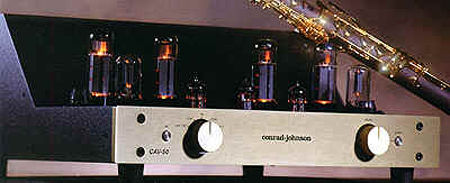
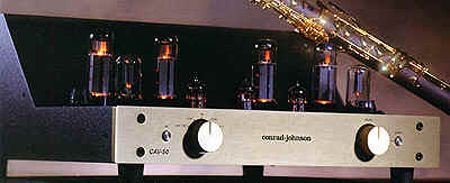
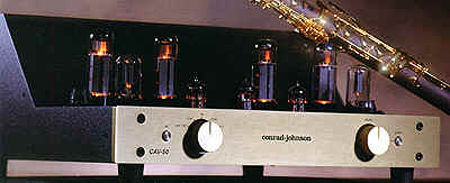
Conrad-Johnson CAV50 integrated amplifier Sam Tellig October 1998
The search for signal transparency has led to much experiment and debate concerning losses in fidelity that can be traced to the preamplifier or—as it's more often and awkwardly called these days when the phono stage is omitted—the "line controller."
The search for signal transparency has led to much experiment and debate concerning losses in fidelity that can be traced to the preamplifier or—as it's more often and awkwardly called these days when the phono stage is omitted—the "line controller."